October 26, 2026
Major Arcana Life Lessons: A Guide to the 22 Cards
From the Fool to the World: the lesson each Major Arcana card asks of you, how to spot one in a spread, and how to turn it into a small daily practice.
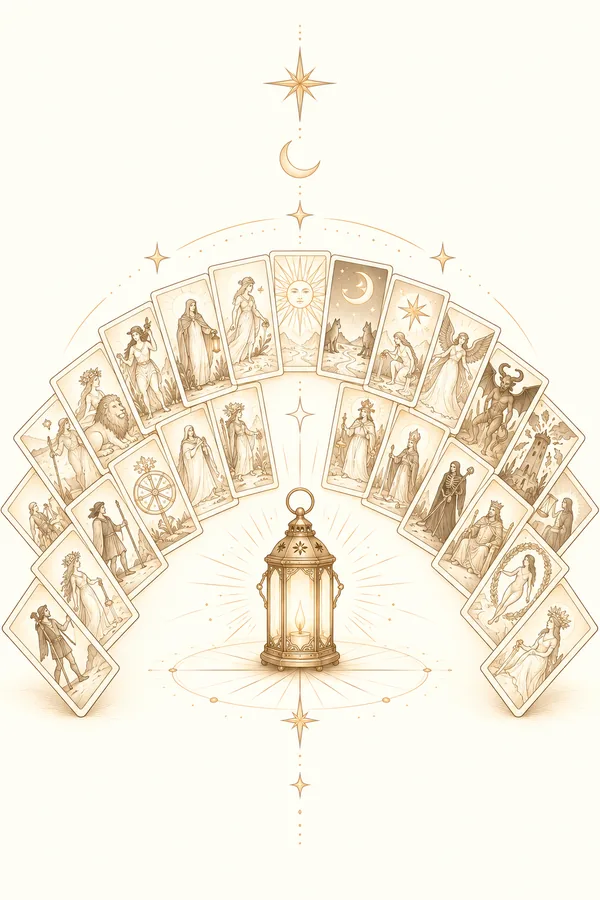
The 22 Major Arcana cards are more than memorable images—they are a practical map of the human journey. Each card marks a stage, a challenge, and a lesson, from the Fool’s first step to the World’s hard-won completion. This Major Arcana life lessons guide treats those lessons as something you can actually use: not abstract mysticism, but a structured way to recognize what a card is asking of you and how to respond.
Who this guide is for
- Beginners learning Rider-Waite symbolism who want a clear path through the Major Arcana instead of memorizing keywords in isolation.
- Enthusiasts who already read the cards and want deeper, actionable insights they can bring into daily decisions and long-term growth.
What to expect
This guide is organized around practical application:
- Card-by-card lessons—the core teaching of each Major Arcana card, its symbolism, and the question it asks you.
- How to spot lessons in spreads—recognizing when a Major Arcana card signals a life theme rather than a passing event, and how to read Majors in context.
- Turning readings into growth—simple practices to convert a reading into reflection, intention, and real change.
By the end, the Major Arcana become less like fortune-telling props and more like a trusted companion for self-understanding—one lesson at a time.
Why the Major Arcana Are the Life Lessons Deck
The Major Arcana earn their name. While the Minor Arcana track the day-to-day—a tense meeting (Five of Swords), a surprise check (Ace of Pentacles)—the 22 Majors address soul-level themes: identity, values, and the turning points that reshape a life. This is what makes them the life lessons deck.
Small Cards, Big Cards
In Rider-Waite imagery, the contrast is visual. A Minor card such as the Eight of Cups shows a single figure leaving eight stacked cups behind—one choice, one moment. The Major Arcana magnify that impulse into The Hermit, a lantern-bearing figure standing solitary on a mountain peak, withdrawn from the entire world to seek truth. The Minors narrate events; the Majors ask who you are becoming.
The Fool’s Journey
Numbered 0 to 21, the Majors unfold as a single narrative. The Fool steps off a cliff with a bindle; the journey ends with The World, the Fool dancing inside a completed wreath. Between them, every card marks an initiation—The Lovers (values and commitment), Death (necessary endings), The Tower (collapse of false structures). Each is a chapter, not an errand.
When They Appear
Majors tend to surface when life demands a shift: in identity, values, or direction. A Major-heavy reading rarely forecasts a busy Tuesday. It asks a larger question—and that is precisely why these cards work as a life lessons guide.
The Fool’s Journey as a Roadmap for Personal Growth
The Major Arcana is not a random collection of archetypes—it is a sequenced story of awakening, testing, loss, and integration. Read as a life lessons guide, the twenty-two trumps map the arc of any genuine growth process, and a querent’s spread often reveals exactly where on that arc they stand.
The Earthly Lessons: Fool to Chariot
The first arc concerns identity and agency. The Fool leaps; the Magician learns to direct will; the High Priestess discovers intuition; the Empress and Emperor build belonging and structure; the Hierophant tests inherited belief; the Lovers force a values choice; the Chariot demands disciplined direction. When these cards dominate, the lesson is usually about establishing selfhood in the world.
The Heart and Inner-World Lessons: Strength to Temperance
Here growth turns inward. Strength teaches gentle mastery; the Hermit, solitude; the Wheel, surrender to cycles; Justice, accountability; the Hanged Man, release of control; Death, necessary endings; Temperance, integration of opposites. This arc asks the querent to feel and reconcile rather than achieve.
The Spiritual Initiations: Devil to World
The final arc strips away illusion. The Devil exposes attachment; the Tower collapses false foundations; the Star restores hope; the Moon confronts fear and unconscious material; the Sun brings clarity; Judgement calls for reckoning; the World completes the cycle.
To locate a querent, note which arc their major cards cluster in, then read the next numbered card as the coming lesson. A Fool’s Journey reading becomes a life lessons guide in practice: the cards diagnose the stage, and the sequence supplies the curriculum.
The Fool: Trusting the Unknown and Beginning Again
In any major arcana life lessons guide, the Fool comes first for a reason. Card zero stands at the cliff edge, toes curled over thin air, while the white dog at his heels barks a warning he chooses not to hear. His bundle is deliberately small—a few necessities tied in a cloth—because the Fool understands that heavy baggage and new beginnings cannot travel together. The leap is not recklessness; it is trust practiced in public.
The Lessons of the Edge
The cliff edge marks the boundary between who you were and who you are becoming. The dog is not an enemy: it is instinct, asking you to look before you leap, and wisdom lies in listening without letting the bark become a veto. The Fool’s minimal bundle asks what you would carry if you truly trusted the road to provide the rest.
Prompts for Reflection
Where are you being asked to start before you feel ready? What fear keeps you at the edge—fear of looking foolish, of failing, or of succeeding and being seen? Name the bundle you are still carrying out of habit rather than need.
Journaling Questions and a One-Card Spread
- What would I attempt if I trusted I could begin again?
- Which fear has been barking the loudest, and what is it protecting?
- What am I willing to leave in the bundle behind?
For a new-beginnings spread, shuffle and ask: “What step is mine to take now?” Let the single card show you where the edge is—and whether the Fool in you is ready to jump.
The Magician: Turning Intention Into Action
In a major arcana life lessons guide, The Magician (card I) teaches that manifesting isn’t magic—it’s alignment. This is the first card of the Fool’s journey, and its lesson is foundational: power comes from aligning thought, word, and deed.
Reading the Symbols
Look at the Magician’s table: a cup, sword, coin, and wand. These are the four suits of the tarot, and he has them ready rather than hidden. Above his head, the infinity symbol suggests that focused will, wisely cycled, is inexhaustible. His raised hands channel energy between heaven and earth—intention above, action below.
The lesson? You already have what you need. Your tools are present; the work is bringing them into conscious use.
Practical Exercises
- Set a one-line intention for each day. Write it, then ask: what one action matches it?
- Align thought, word, and deed with a small “Word-Match” journal: note one place today where your words and actions agreed, and one where they didn’t.
- Inventory your table: list three skills, contacts, or resources you already own that support a current goal.
The Magician’s guide reminds us that intention without action is a wand unheld. Align all three—and the work begins.
The High Priestess: Listening to Inner Knowing
In a major arcana life lessons guide, the High Priestess is the card that teaches you to stop talking and start listening—to yourself. She sits between two pillars, Boaz and Jachin, representing the balance of opposites: light and dark, known and unknown, logic and intuition. Her lesson is not to choose one over the other, but to hold both in quiet tension until a deeper truth emerges.
Symbols of Hidden Wisdom
The crescent moon at her feet signals intuition that waxes and wanes—cyclical knowing rather than constant certainty. The veiled scroll in her lap holds wisdom that is not yet ready to be revealed. She reminds you that some answers cannot be forced; they arrive when the mind is still.
The Lesson: Trust What You Sense
The High Priestess asks you to honor inner knowing before you can prove it. If something feels off, pause. If a choice feels quietly right, notice that. Silence is her language, and intuition is her teaching.
Contemplative Practices
- Sit in five minutes of quiet meditation before decisions, letting thoughts settle like sediment.
- Pull a single card for inner guidance and journal what you sense before reaching for a meaning.
- Ask one honest question and wait a full day before answering it.
The High Priestess doesn’t demand certainty—only attention.
The Empress: Nurturing Abundance and Creative Growth
In the Major Arcana life lessons guide, The Empress (III) teaches the art of receiving. Her imagery—the garden, ripening wheat, the planet Venus—speaks of fertility that follows care rather than force. She asks us to trust that nourishment given freely returns in season.
The Lesson of Receiving
The Empress reminds us that abundance is not seized; it is cultivated. Venus, her ruling planet, governs attraction and worth, suggesting that we draw to us what we believe we deserve. Her wheat field models patience: growth happens in natural timing, not by tugging at seedlings.
Prompts for Reflection
- Body: How do you nourish yourself—food, rest, pleasure—without guilt?
- Relationships: Where do you give in order to receive, and where do you take without replenishing?
- Projects: Which creations need tending rather than pushing, and can you honor their natural pace?
The Empress’s lesson is self-worth anchored in patience. Those who know their value can wait for the harvest.
The Emperor: Structure, Boundaries, and Healthy Authority
In any major arcana life lessons guide, The Emperor stands as the card of order, responsibility, and the wise use of power. His throne is carved from stone—solid, unmovable, and enduring—signalling that real authority is built on foundations, not moods. The ram heads at the corners of the throne echo Aries: initiative and courage, but also the discipline to direct that energy rather than let it run wild. His stone setting places him in the world of consequence, where decisions have weight and structures must hold.
The Emperor’s lesson is not about domination but about stewardship. Healthy authority protects; control merely restricts. The difference is care: a boundary set with care says “this matters,” while control says “you don’t.” The Emperor asks you to build limits that hold others—and yourself—safe, and to lead with steadiness rather than force.
Reflection Questions
- Where in your life do you need to build firmer boundaries—and where have yours hardened into walls?
- Are you leading with care, or managing through control?
- What structure or routine would free you, rather than confine you?
- Whose authority do you trust, and what makes it healthy?
- Where could softening your limits actually strengthen your integrity?
The Hierophant: Learning from Tradition and Finding Your Own Beliefs
In a major arcana life lessons guide, the Hierophant (card V) represents the teacher, the institution, and the wisdom passed down through generations. He sits between two pillars, much like the High Priestess, but where she guards inner mystery, he transmits shared doctrine. His raised right hand signals blessing and instruction—the gesture of one who speaks with authority—while the crossed keys at his feet symbolize the tension between inherited knowledge and personal access to truth. He asks: what have you been taught to believe, and what do you actually believe?
The Lesson of Inherited Wisdom
The Hierophant’s life lesson is not blind obedience but thoughtful inheritance. Tradition offers structure, ethics, and belonging; it gives language to experiences we haven’t yet had. Yet the crossed keys remind us that every system holds both a lock and its opening. Honoring tradition means learning it deeply enough to question it honestly—keeping what aligns with your values, releasing what no longer rings true, and forming beliefs you can call your own.
A Spread for Comparing Taught and Chosen Beliefs
Try a four-card spread:
- What I was taught — the inherited rule or value.
- Why it mattered — the need it originally served.
- What I now believe — your authentic position.
- How to integrate both — a way to honor the past while living your truth.
The Hierophant does not demand conformity; he demands sincerity.
The Lovers: Choice, Values, and Alignment
In a major arcana life lessons guide, The Lovers is often misfiled under romance. Its deeper teaching is about choice—specifically, the choice to act in alignment with your values. The card asks not whom you love, but whether your commitments reflect what you actually hold sacred.
Reading the Symbols
The angel above the couple represents higher conscience—the part of you that sees both options clearly. The two figures stand as complementary forces: desire and duty, impulse and principle. The tree behind one figure and the flames behind the other remind us that every choice bears fruit and carries heat. Alignment is not the absence of tension; it is standing honestly between both.
A Two-Option Decision Spread
When a choice feels muddled, try this focused spread:
- Card 1 – Value: What do you truly value here?
- Card 2 – Option A: How does this path honor or betray that value?
- Card 3 – Option B: How does the other path honor or betray it?
- Card 4 – Alignment: Where do your actions and values already meet?
The Lovers’ life lesson is integrity: choose consciously, and let the choice match the person you intend to be.
The Chariot: Direction, Discipline, and Inner Drive
The Chariot, card VII of the Major Arcana, teaches one of the tarot’s most practical life lessons: momentum is not the same as motion. Look closely at the card and you will find a masterclass in controlled drive.
Symbols of Controlled Momentum
Two sphinxes—one black, one white—pull the chariot in different directions, yet the charioteer holds no reins. This is the heart of the lesson: opposing forces can be harnessed rather than fought. The starry canopy above reminds you that willpower answers to something larger than impulse, while the charioteer’s armor shows that discipline is protection, not restriction. Together, the symbols ask you to steer inner conflict with intention instead of suppressing it.
Goal-Setting Prompts
- What two competing desires or obligations are pulling you now, and how can both serve one destination?
- Where has motion replaced momentum in your week?
- What boundary (your “armor”) would protect your focus?
Three-Card Focus Spread
- Focus: what deserves your disciplined attention now.
- Challenge: which opposing force needs harnessing, not conquering.
- Outcome: where controlled momentum will carry you if you stay at the reins.
Strength: Gentle Courage and Emotional Mastery
In a major arcana life lessons guide, Strength (card VIII) offers one of the most practical teachings in the deck: real courage is quiet. The classic image of a woman calmly closing—or gently opening—the lion’s jaws is not a scene of conquest but of rapport. She does not overpower the beast; she soothes it. The lion represents our instinctual nature—anger, fear, appetite, raw emotion—and the woman represents the higher self meeting that energy with compassion rather than force.
The Lesson: Softness as Strategy
Strength teaches that suppression and domination both fail. What tames the lion is patience, steady presence, and self-compassion. Applied to daily life, this means treating your own fear and reactivity as you would a frightened animal: with attention, not punishment. Emotional mastery, in this card’s terms, is not control but relationship.
Prompts for Practice
- Name the lion: “The feeling I’m avoiding is ______.” Say it plainly, without judgment.
- Ask: “What does this fear need—space, reassurance, or action?” Then respond with the softest effective option first.
- Recall a moment you forced an outcome versus one where calm patience worked. What did each cost you?
Let Strength remind you: gentleness is not weakness. It is courage that has learned to stay.
The Hermit: Solitude as a Source of Clarity
In a major arcana life lessons guide, The Hermit (Trump IX) teaches that purposeful solitude is a skill, not an escape. The lantern he raises holds a six-pointed star—wisdom that must be sought inwardly before it can be shared—while his staff grounds each step and his mountain-peak vantage rewards the climb with perspective. Read together, these symbols describe intentional withdrawal: stepping back from noise long enough to hear your own counsel.
The Lesson: Solitude Versus Isolation
The Hermit’s light is carried outward-facing; he climbs alone but does not hide. The life lesson is to separate healthy solitude—chosen, time-bound, and reflective—from isolation, which is unchosen, open-ended, and numbing. Ask yourself: Does this quiet restore me and return me to others clearer, or does it keep me from them?
A Self-Reflection Spread
Try this four-card layout:
- The Lantern — What inner truth needs my attention?
- The Staff — What steadies me when I withdraw?
- The Mountain Peak — What perspective awaits me in solitude?
- The Path Down — How do I return to connection?
A Simple Practice
Set aside twenty minutes of regular quiet time—no screens, no agenda—and close with one written sentence: What did I hear? Keep the retreat short, deliberate, and repeatable; The Hermit values rhythm over retreat.
The Wheel of Fortune: Cycles, Timing, and What You Can Control
In a major arcana life lessons guide, the Wheel of Fortune (Key 10) teaches that change is the one constant. At its center, the wheel turns beneath a sky of shifting elements—symbols of fate and fortune in motion. The four creatures at its corners (angel, eagle, bull, and lion) represent the fixed points that endure while the wheel spins: the steady elements of your life that remain even as circumstances rise and fall.
The Core Lesson
The Wheel asks you to release what cannot be controlled and act on what can. You cannot stop the turning of fortune, but you can choose your response. Landing on top is not permanence; neither is the descent. This is the guide’s central lesson for Key 10: respond with intention rather than resist the cycle.
Reflection Prompts
- Where in my life am I currently experiencing a rise, a peak, a descent, or a low point?
- Which season—spring, summer, autumn, or winter—best describes this phase?
- What am I trying to control that I should release to the turning wheel?
- What small action is genuinely within my power right now?
Use these questions to identify your current cycle and to shift energy from resistance toward responsive, grounded action.
Justice: Truth, Accountability, and Cause and Effect
In a major arcana life lessons guide, Justice (XI) stands as the card of clear sight and honest reckoning. The seated figure holds scales and a sword: the scales weigh evidence without bias, while the sword cuts through rationalization to deliver a decision. Together they symbolize fair judgment—not punishment for its own sake, but the sober alignment of action and outcome. Justice teaches that cause and effect are not abstract laws; they are the everyday arithmetic of our choices.
What We Owe Ourselves
This card’s deepest lesson is personal responsibility. Justice asks you to see situations as they are, not as you wish them to be, and to account for your part in creating them. That includes what you owe yourself: honesty about your motives, boundaries held without apology, and the courage to accept consequences rather than deflect them. Fairness begins inwardly—you cannot weigh others accurately on a scale you refuse to stand on yourself.
Journaling Prompt
Recall a recent decision whose consequences are still unfolding. Without blame or excuse, write what you chose, what you told yourself at the time, and what actually followed. Then ask: what do I owe myself—and others—now, to set the scales right?
The Hanged Man: Sacred Pause and Reframed Perspective
In a major arcana life lessons guide, the Hanged Man (card XII) teaches one of the deck’s most counterintuitive lessons: that willing surrender can be a form of power. The figure hangs upside down by one tied foot, yet his face is calm and a halo glows around his head. The inverted posture is not a punishment but a chosen vantage point—suspension accepted on purpose. The tied foot shows restraint that is voluntary, not imposed, while the halo marks the insight that comes when we stop struggling and let a situation be as it is.
The Lesson: Not Defeat, but New Vision
The Hanged Man’s core teaching is that defeat and reframing are different things. When a situation will not move, the card invites you to change how you see it rather than force an outcome. This is the sacred pause: a deliberate interval in which you release urgency and let meaning shift.
Practices for the Pause
- Name one situation where you feel stuck. Ask: “What would this look like from the opposite point of view?”
- Take a 24-hour pause from deciding. Notice what changes when you stop pushing.
- Journal what you are being asked to surrender—control, timing, or a fixed story.
A Spread for Reframing
Lay three cards: What I see now — What I am holding too tightly — How this looks inverted. Read the third card as if it were drawn upside down, and let its reversed meaning become your new angle.
Death: Endings That Make Room for Growth
In a major arcana life lessons guide, Death (XIII) is rarely about literal loss. Look at the card’s symbols: the skeleton clears the field, but the sun rises on the horizon, and a white rose blooms in the foreground—purity and renewal emerging from what looks like an ending. Death teaches that completion is not failure; it is a necessary turn in the cycle. The lesson is to release what is finished and to grieve it well, so grief becomes a doorway rather than a wall.
Prompts: What Needs to End?
- What in my life already feels complete, even if I keep it alive out of habit or fear?
- Which ending am I resisting, and what do I imagine I would lose?
- What has the white rose taught me—what small sign of renewal have I already noticed?
A Ritual for Closure
Write the ending—a role, a relationship pattern, a self-image—on a slip of paper. Name what it gave you and thank it. Name what it cost. Then safely burn or bury the paper, and plant or place something living nearby. Each morning for a week, greet the sunrise and note one thing that is growing in the cleared space.
Death’s promise is simple: endings make room. Grieve fully, release honestly, and let the rising sun find you ready.
Temperance: Balance, Integration, and Patience
In a major arcana life lessons guide, Temperance (Trump XIV) stands as the card of deliberate moderation. The classic image shows an angel pouring water between two cups—an act that looks effortless but requires steady hands and patient attention. That single stream is the whole lesson: nothing is spilled, nothing is rushed, and two separate vessels become part of one continuous flow. Behind the figure, a path leads toward a distant sun, reminding us that balance is not a destination reached in a day but a direction we keep walking.
Blending Opposites Without Extremes
Temperance asks you to hold opposing forces—work and rest, ambition and contentment, solitude and connection—without letting either one dominate. The angel’s feet touch both land and water, showing that integration means honoring different parts of life at once rather than swinging between extremes. When you find yourself all-or-nothing, this card invites the slower, alchemical work of mixing: a little discipline with a little ease, honest effort with genuine recovery.
A Temperance Balance Spread
To apply the lesson, try a simple three-card spread. Shuffle and ask, “Where does my life need tempering?” Lay three cards:
- Card 1 — Work: Where am I overextending or holding back?
- Card 2 — Rest: What does genuine restoration require of me right now?
- Card 3 — Relationships: Where can I blend my needs with another’s more patiently?
Read the three together as one stream, not three separate answers. Temperance rewards the long view: small, consistent adjustments made with patience will carry you further along the path than any dramatic correction.
The Devil: Facing Attachment, Temptation, and Limiting Beliefs
In the Major Arcana life lessons guide, the Devil (card 15) is often misread as an omen of external evil. Its true teaching is subtler: it reveals the captivity we impose on ourselves. Look closely at classic depictions—the figures are chained, yet the chains hang loose around their necks. They could step free at any moment. The bonds are self-imposed, held in place by habit, fear, or attachment rather than force.
The Lesson of the Loose Bonds
The Devil asks you to notice what you insist keeps you trapped. A habit you “can’t” break. A fear you’ve never questioned. An attachment or temptation you keep choosing over your own freedom. The card does not judge desire; it asks whether the desire is serving you or steering you. Recognition is the first act of release.
Shadow-Work Prompt
Journal on this: “What chain around my neck is loose, and why do I keep holding it in place?” Name one habit, fear, or limiting belief. Then ask what it protects you from—and what it costs.
A Spread for Surfacing Limiting Patterns
- Card 1 — The Chain: What belief or attachment holds me?
- Card 2 — The Loose Link: How am I choosing to stay bound?
- Card 3 — The Key: What awareness frees me?
Use this Major Arcana life lessons guide as a mirror. The Devil’s wisdom is not condemnation but invitation: see the loose chain, and choose to lift it.
The Tower: Destruction as Necessary Clarity
In a major arcana life lessons guide, The Tower carries the heaviest reputation—and the deepest gift. Its lightning bolt is not divine punishment but a searchlight. What it strikes down was already cracked: the job built on pretense, the relationship held together by silence, the self-image propped up by others’ approval. The Tower simply ends the pretending.
The Lesson: Truth Arrives Before Rebuilding
The Tower teaches that clarity often arrives as upheaval. You are not being punished; you are being shown what could not hold. In the major arcana’s arc of lessons, this is the necessary clearing before the Star’s calm rebuild in later cards. False structures must fall so something genuine can stand.
Grounding Prompts for Upheaval
- Which structure just collapsed was already unstable before the lightning struck?
- What did this disruption make impossible to ignore?
- What remains standing—and what does its survival tell you?
Rebuilding with Intention
Pause before replacing what fell. Ask: Am I rebuilding the same false structure out of fear? Choose foundations with tested integrity—honest conversations, sustainable commitments, self-knowledge that doesn’t depend on external validation. The Tower’s gift is clarity; let it shape what you build next.
The Star: Hope, Healing, and What Comes After the Storm
In the Major Arcana’s life lessons guide, The Star (XVII) follows the Tower—and that sequence is the teaching. After upheaval, the kneeling figure pours water onto land and pool beneath a starlit sky: renewal that flows from a source you can’t see but can trust. The lesson isn’t instant repair. It’s quiet hope—the decision to tend your inner reservoir even when the night is still dark.
The Lesson of Quiet Hope
The Star asks you to restore, not rebuild. Where the Tower stripped away false structures, The Star invites gentle replenishment: rest, honesty, small acts of care. Hope here is not naive optimism but a practice—returning, one calm choice at a time, to what sustains you.
A Healing-Focused Spread
- The Storm – What has recently shaken you.
- The Water Poured – What restores your energy.
- The Pool – What needs time to settle.
- The Guiding Star – The hope quietly leading you forward.
Prompts for Naming Your Hope
- What am I hoping for, in one honest sentence?
- Where is my inner reservoir running low—and what refills it?
- What small act of renewal can I offer myself today?
The Moon: Navigating Fear, Illusion, and Intuition
The Moon card in a major arcana life lessons guide asks you to walk the winding path between two towers—one of certainty, one of doubt. Below, a dog and a wolf howl at the moon above the water, instinct and instinct that has been tamed. This is the major arcana’s lesson in ambiguity: not everything can be resolved, and not every shadow is a threat.
Reading the Landscape
The moon above the water reflects rather than reveals. Its light distorts—what looks like a monster may be a rock; what feels like danger may be old fear. The dog and wolf remind you that both the domesticated and wild parts of your mind are speaking at once. The path between the towers is narrow because this is not a card of clear choices; it is a card of learning to sit with uncertainty. The lesson is not to banish fear but to listen past it—trusting quiet intuition over the loud alarm of anxiety.
A Spread for Separating Fear from Insight
Try this three-card Moon spread when you feel caught between dread and guidance:
- The Dog (What I fear): name the story your anxiety is telling.
- The Wolf (What I instinctively know): ask what your body sensed before your mind argued.
- The Path (What to do next): a single grounded step through the uncertainty.
In this major arcana life lessons guide, the Moon teaches that intuition is often mistaken for fear—and the work is to tell them apart.
The Sun: Joy, Clarity, and Unapologetic Visibility
In a major arcana life lessons guide, The Sun arrives as the deck’s great exhale—the card that asks you to stop shrinking. Its imagery is deliberately open: a child rides bareback and unarmored, sunflowers turn their faces upward without hesitation, and the sun itself radiates without checking who’s watching. These are symbols of vitality that doesn’t perform, it simply shines.
The Lesson: Let Yourself Be Seen
The Sun teaches that visibility is not vanity. The child on the horse has nothing to hide and nowhere to be but here—a reminder that joy thrives when you stop editing yourself for an imagined audience. Clarity, too, is a Sun lesson: what’s genuinely good in your life often isn’t hidden, just unnoticed. This card asks you to look directly at it.
Playful Prompts for Practice
- Sunflower scan: Name three things that went right today, however small—the coffee that hit the spot, the text that made you smile.
- Bareback moment: Do one thing this week purely because it delights you, and let someone witness it.
- Unapologetic yes: Say an enthusiastic yes to something you’d normally downplay, and notice how it feels to not minimize it.
The Sun’s promise in the major arcana life lessons guide is simple: joy, practiced openly, becomes its own clarity—and what you celebrate, you strengthen.
Judgement: Awakening, Self-Honesty, and Life Reviews
Judgement (XX) closes the major arcana with a summons. The angel’s trumpet is a call you cannot unhear; the rising figures are people answering it; the angel itself represents the clear-eyed view from above, seeing your life without flattery or distortion. Together they teach the lesson of this card: honest self-assessment is the doorway to renewal.
The Symbols as a Call to Honesty
The trumpet signals an invitation to rise above old patterns — not punishment, but awakening. The figures emerging from their graves are outdated versions of yourself, ready to be released once you have truly looked at them. The angel asks one question: what do you see when you stop defending yourself?
The Lesson: Answer the Deeper Calling
Judgement asks you to respond to what genuinely calls you and to retire the self you have outgrown — habits, roles, stories that no longer fit. This is not self-criticism; it is self-honesty in service of growth.
A Year-in-Review Spread
Lay three cards: What I answered (the past year’s true callings), What I avoided (honest blind spots), What now calls me (the next rising).
Prompts for Honest Self-Evaluation
- Where did I perform a version of myself rather than live as myself?
- What truth did I hear and postpone?
- What am I ready to let rise — and what am I ready to leave in the ground?
The World: Completion, Wholeness, and the Next Beginning
In a major arcana life lessons guide, The World (XXI) marks the culmination of the Fool’s journey—and its most misunderstood moment. Study the card’s symbols and you’ll see why.
Symbols of Integration
The laurel wreath encircles the dancing figure: a boundary that is also a victory crown, showing that true completion holds everything within it, not just the highlights. The dancing figure—often androgynous, one leg crossed—embodies balance between opposites: action and rest, self and other, striving and surrender. The four corners (lion, bull, eagle, angel) represent the four fixed signs and the four directions: the whole of experience, integrated rather than escaped. Wholeness, this card teaches, is not perfection—it’s inclusion.
Closure as a Doorway
The World’s deepest lesson: ending is a threshold. The Fool steps off the cliff again, but now with the wreath’s wisdom. Ask yourself: what have I truly finished—and what am I pretending is finished? Closure creates the empty space the next beginning needs.
A Completion Spread
- What has reached its natural end?
- What gift does this cycle leave with you?
- What remains unintegrated?
- What is waiting at the next threshold?
Prompts for Acknowledging Growth
- Name three ways you are different than when this cycle began.
- What did you survive that you once feared?
- What will you carry forward—and what stays behind in the wreath?
How to Spot Major Arcana Lessons in Any Spread
Major Arcana cards act as headline themes in a reading. When they dominate — appearing in clusters, at key positions, or as the only Major in an otherwise Minor-heavy spread — they signal that a long-term life lesson is in play rather than a passing daily concern.
Recognizing the pattern in common spreads
- Past, Present, Future: A Major in the Future position points to a lesson still being learned; a Major in the Present marks a turning point you’re in the middle of.
- Celtic Cross: Majors in the central cross suggest core identity work; Majors in the staff columns indicate external events carrying karmic weight.
- One-card pulls: A lone Major is a strong nudge toward big-picture reflection — treat it as a theme for the week, not an answer to a small question.
Phrasing lesson-based questions
Invite big-picture answers by asking, “What life lesson is asking for my attention?” or “What long-term theme is shaping this situation?” Avoid yes/no framing, which shrinks the Major’s scope.
Turning cards into lessons
Read the Major with its Minor neighbors: the Minor shows how the lesson appears day to day, while the Major names what you’re meant to learn.
Reading Reversed Major Arcana as Unlearned Lessons
In a major arcana life lessons guide, reversals are rarely signs of doom—they’re notes on where a lesson is blocked, internalized, or still in progress. The upright card shows the lesson mastered; the reversed card shows the work remaining.
Three States of an Unlearned Lesson
- Blocked: The lesson is resisted or avoided. The Tower reversed often signals an upheaval delayed—a needed change postponed until circumstances force it.
- Internalized: The lesson is happening inwardly. The Hermit reversed may mean solitude has tipped into isolation, or reflection is underway but not yet shared.
- In progress: The energy is present but incomplete. The Star reversed points to healing that has begun but needs patience and continued effort.
A Caution Against Fear
Treat reversals as invitations to reflection, not warnings of punishment. Fear-based readings—“this card reversed means disaster”—shut down the very learning the major arcana is here to prompt.
A Three-Card Spread for Unlearned Lessons
- The Lesson: What the card, upright, is teaching.
- The Block: What the reversal reveals about where you’re stuck.
- The Step Forward: One concrete action to integrate the lesson.
Read the reversal as a question, not a verdict: what would this lesson look like fully learned?
Working With Repeating Major Arcana Cards
When a Major Arcana card keeps returning across separate readings, treat it as more than coincidence. The majors speak to life lessons rather than passing circumstances, so a repeat appearance is an invitation to notice a persistent theme. The card may surface in daily draws, in readings for different questions, or in one position across several spreads—each instance is worth recording.
Track the Pattern
Keep a tarot journal dedicated to major arcana life lessons. For every reading, note the date, the question, the card, and—most importantly—your personal response. Log symbols that catch your attention (the Hermit’s lantern, the Tower’s lightning) and how they connect to events in your life. Over weeks, patterns emerge that a single reading cannot show.
Name the Lesson
Use these prompts to clarify what the card is teaching:
- What area of life does this card keep pointing to?
- What have I resisted or avoided when this card appears?
- If this card were a mentor, what would it ask of me?
Set a Small Action
Choose one concrete step for the coming week that honors the lesson—a conversation to have, a habit to begin, a boundary to set. Small actions make the major arcana’s guidance tangible, and your journal will reveal whether the card’s message begins to shift.
Turning Major Arcana Lessons Into Everyday Practice
A Major Arcana life lessons guide is most useful when it moves off the table and into your routine. Rather than treating the cards as fixed predictions, treat them as mirrors for self-directed reflection. The aim is insight you act on, not dependency on readings.
A Simple Rhythm
- Morning card pull (one minute): Draw a single Major Arcana card and name its lesson in one sentence—e.g., The Hermit: make space before deciding. Write it where you’ll see it.
- Weekly reflection (ten minutes): Review the week’s pulls. Which lessons recurred? Where did you resist them?
- Monthly theme review (twenty minutes): Identify the dominant card or theme and ask what habit would embody it for the next month.
The Notice–Reflect–Act Framework
For each card, run three steps:
- Notice — Where is this energy already showing up today?
- Reflect — What is one honest question this lesson asks of me?
- Act — What is one small, concrete action I can take within 24 hours?
For example, The Emperor invites you to notice where structure is missing, reflect on what you’re avoiding, and act by setting one clear boundary.
Keep It Self-Directed
Use the cards to ask better questions, not to outsource decisions. If a pull starts feeling like a verdict you can’t question, pause and return to your own judgment. The guide’s purpose is agency, not fortune-telling.
Major Arcana FAQ: Common Beginner Questions
What does it mean when most cards are Major Arcana?
A spread dominated by Majors points to a turning point rather than daily logistics. The Major Arcana life lessons guide is about soul-level themes—identity, vocation, belief, loss, and growth—so a Major-heavy reading suggests the situation carries lasting weight. In Rider-Waite terms, think of The Fool stepping off the cliff or The World completing the circuit: these are chapters, not errands. Expect the lesson to unfold slowly, and revisit the full card sections to trace which life theme is active.
Are reversed Major Arcana negative?
Not inherently. Reversal more often signals an inward turn, a delay, or a lesson not yet integrated. A reversed Emperor may mean authority is being avoided rather than abused; a reversed Star can indicate hope that needs rebuilding from within. Rider-Waite symbolism still holds—water pours, pillars stand—but the energy moves internally. Treat reversals as questions, not verdicts.
Which Major Arcana card signals life change?
The Wheel of Fortune (card 10) is the classic marker, with Death (13) close behind. The Wheel turns circumstances; Death ends a chapter cleanly. For sudden awakening, The Tower (16) clears what cannot stand—painful but clarifying. Pair each with its full card page for nuance.
Where should a beginner start?
Begin with The Fool (0), then walk the Fool’s Journey in order. Learn one Major per week using its symbolism, journal prompt, and life-lesson questions—the complete Major Arcana life lessons guide is built for exactly this pace.
Recommended tool
New to tarot?
Start with the beginners' cheat sheet and core keywords.
Keep reading
More on Methodology & Guides
October 18, 2026
Tarot Cards for Beginners Cheat Sheet
Start reading without memorizing 78 cards: a tarot cheat sheet with keywords, suit and number formulas, court cards, and the four spreads to learn first.
Read the article
September 29, 2026
Major Arcana vs. Minor Arcana: Key Differences and How to Read Them
22 Majors, 56 Minors: learn what separates archetypes from everyday cards, how suits and numbers work, and how to read the mix.
Read the article
October 23, 2026
Tarot Suit Meanings: Wands, Cups, Swords and Pentacles
What each tarot suit means, how elements and numbers combine, and a fast method for reading any card, from Wands to Pentacles.
Read the article