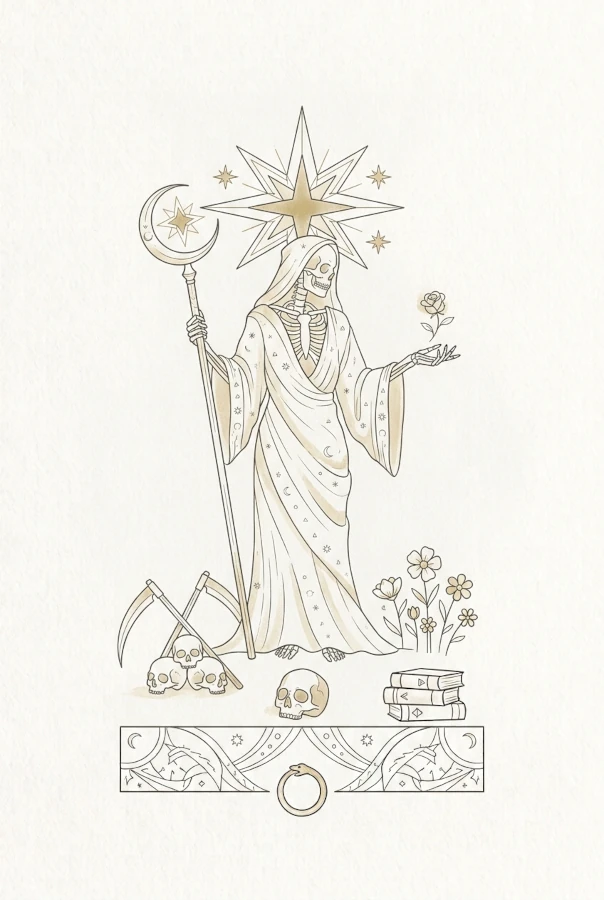
DEATH
Death (Arcana 13): Complete Meaning and Interpretation
In the fascinating universe of the Tarot, few cards provoke as much immediate unease, superstitious murmurs, or instinctive rejection as the thirteenth card, often called Death. Its number, associated with misfortune in the collective imagination, and its traditional iconography — a skeleton reaping existences — have made it the symbol par excellence of endings, destruction, and ineluctable fatality. Yet this terrifying reputation is a thick veil that obscures its deepest and most precious meaning. Far from being an omen of despair, Arcana 13 is above all the master card of radical transformation. It does not represent physical death, but the necessary end of a cycle, a situation, an attachment, or a part of oneself that has served its time, to allow an authentic rebirth. Dare to move beyond the initial apprehension: behind what seems to be an end lies the powerful invitation to an essential renewal.
Symbolic Reading of Death: The Skeleton's Harvest of Renewal
The Death card in the Tarot reveals an iconography rich and nuanced, far from a simple allegory of the end. At the center, an androgynous figure, often represented as a skeleton, exercises its action without apparent violence. This is not an executioner in motion, but a natural principle, motionless or walking slowly, embodying an ineluctable function. Its tool, the scythe, is an essential key to reading. Its vivid red color evokes vital energy and decisive action, while its crescent shape links it to lunar cycles and the rhythms of nature. It is a harvester, cutting what is ripe to allow a new cycle, far more than a simple destroyer.
Beneath the figure's feet, the black ground represents the fertile soil, the deep unconscious, and the field of all possibilities where the seed of transformation can germinate. Scattered on this ground, human fragments — heads, hands, feet — symbolize the attachments, outmoded egos, and old identities that are 'reaped,' freeing the essence of being. Finally, in the foreground, tenacious vegetation — small shoots or delicate flowers — points irresistibly upward. It is the visual testimony of the rebirth inherent in the process, reminding us that life persists and regenerates itself always from what has been transmuted.
Death: The Gateway to Radical Transformation
Death does not speak of physical ending but embodies the universal principle of radical transformation. It represents the point of no return, the moment when a cycle, a situation, or a state of mind reaches its absolute end to make way for the new. Its action is that of a spiritual razor, cutting with cold necessity what has become obsolete, stagnant, or illusory. This end is ineluctable; it is not a punishment but a natural law of existence, as certain as the twilight that precedes the night. The process it initiates is a true initiatory mourning: for a new seed to germinate, the old envelope must decompose. This period of dissolution, though often painful, is the essential soil for rebirth. Concretely, it manifests in our lives as the end of a relationship that has run its course, the loss of a job that frees us toward a new path, the stripping away of an old identity, or the deep healing of a wound that required letting a part of ourselves die.
Interpreting Death in Your Readings: A Practical Guide by Life Domain
When Death appears in your reading, it is not an omen of fatality but a powerful call to transformation. Its central message is the imperative necessity of metamorphosis and liberation. The key is to identify what in your life needs to be transfigured.
In Love & Relationships, Death can signify the painful but salutary end of a relationship, or a deep inner work to liberate oneself from old patterns before welcoming new love. It is the closing of a chapter that makes space for a new story to begin.
In Career & Finances, this card often evokes the end of a cycle: a project that concludes, an inevitable restructuring, or even a dismissal that, though brutal, forces you onto a more aligned path. It clears the ground for something more authentic to your true nature.
In Spirituality & Personal Development, Death invites you to cooperate with change rather than resist it. It is the card of the phoenix — the radical letting go that precedes regeneration. This card teaches that every ending carries the seed of a new beginning, and that true growth requires the courage to let die what must die.
Death Reversed: Resistance and Stagnation
When Death appears reversed, its message is unequivocal: the energy of transformation is blocked. Where the upright card announced a necessary and liberating metamorphosis, its reversed version reveals a resistance to change, a paralyzing fear of letting go. The keywords associated with it — stagnation, delayed transition, slow psychological death, inability to turn the page — depict a situation where one desperately clings to what is already over.
This is no longer a natural end but a refusal to let die what must disappear, creating a period of heavy stagnation. This position signals that transformation is poorly lived or repressed, often from fear of the unknown or the void that might follow. Concretely, this card evokes clinging to a relationship that no longer exists, a job that stifles, or outdated beliefs. It is fear that freezes, preventing mourning and the beginning of a new stage. As advice, Death reversed is an urgent alarm signal. It presses us to accept the change that presents itself, however difficult. It warns that refusing this inevitable molt, fighting against the current of life, will only prolong and intensify the suffering.
Death: A Symbol with Celestial and Heroic Roots
To enrich our understanding of Death, it is essential to contemplate its powerful symbolic correspondences. In astrology, this arcana is associated with the sign of Scorpio, archetype of death and rebirth, of deep transformation, and of the mysteries of the invisible. It is governed by Pluto, planet of the underworld, of radical change, and of regeneration through destruction.
In numerology, 13 reduces to 4 (1+3=4), symbolizing stability rediscovered after transformation, reconstruction on new foundations. This positive vision contrasts with popular unease but resonates in the Tarot where this card marks a necessary completion to allow a new beginning. These themes echo from the myth of the phoenix rising from its ashes, to the Hindu goddess Kali who destroys to liberate, to the Aztec god Quetzalcoatl who descends into the underworld to be reborn. In the Kabbalistic tree, Death corresponds to the path of the Hebrew letter Nun, meaning 'fish,' symbolizing life in the midst of dissolution, the spark of consciousness that persists through all transformation. In alchemy, it represents the nigredo phase — the blackening, the putrefaction necessary before the whitening and the final gold of spiritual realization.
Final Advice of Death: The Courage to Let Go and Be Reborn
Death, the nameless arcana, in its ultimate synthesis, reveals itself as a card of liberation and necessary renewal. Far from being an omen of fatality, it acts as the ultimate catalyst on the hero's journey, forcing the dissolution of obsolete structures, attachments that hinder, and illusions that veil the truth of being. Its passing, though often intense, clears the ground for a more aligned existence to germinate. The central advice of this card is clear: accept the endings that life places before you. See in them not collapses, but doors wide open to infinitely more authentic beginnings. Cooperate with the changes that knock at your door, even if they arrive with brutality. Trust that the dismantling of the old is the necessary condition for the emergence of the new. Let Death guide you, not as a specter, but as a wise and powerful ally, toward regeneration and the emergence of a truer, freer, and more luminous version of yourself.
Frequently Asked Questions
Does Death always signify physical death?
Almost never. In the vast majority of readings, it symbolizes an ending, a radical transformation, or a deep letting go necessary for rebirth. It marks the end of a cycle to allow a new one to begin.
Why is it sometimes called the 'Nameless Arcana'?
The tradition of not naming the most powerful forces directly stems from the recognition of its sacred and elusive character — an energy of mutation too vast to be contained in a simple word. This silence invites us to move beyond fear and contemplate the universal process it embodies.
Is Death a negative card?
No. It is a neutral and powerful card, often beneficial in the long term. It acts as a catalyst. Though its passage can be difficult, it clears the ground to rebuild something new, stronger, and more authentic.
What is the difference between Death and The Tower?
The Tower (XVI) represents sudden, violent destruction often from external forces. Death (XIII) represents a slower, more internal, and necessary transformation — like a snake shedding its skin. One is a collapse, the other a metamorphosis.