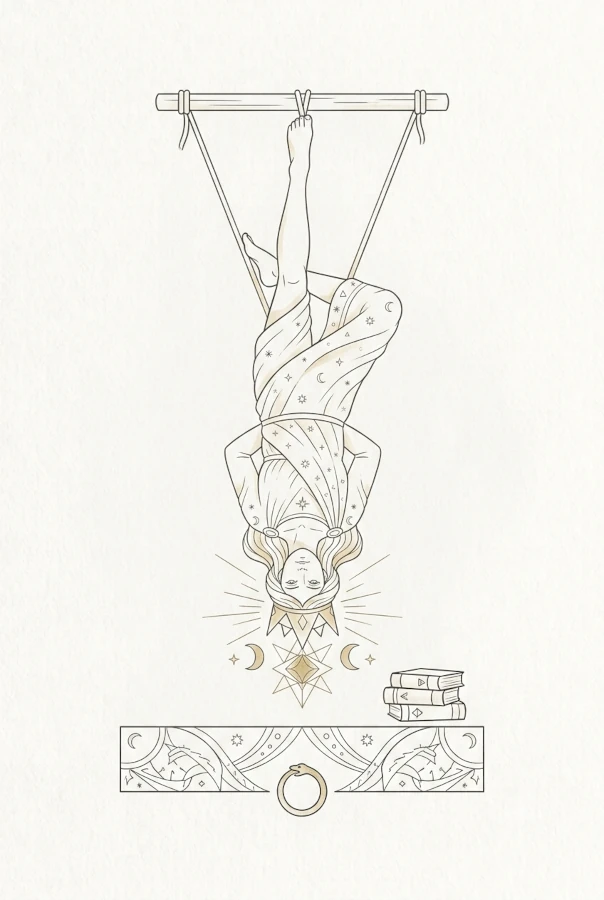
THE HANGED MAN
The Hanged Man (Arcana 12): Complete Meaning and Interpretation
At first glance, he unsettles and confuses: suspended by one foot, motionless, with a serene gaze. The Hanged Man, the twelfth major arcana of the Tarot, embodies one of the most profound and misunderstood paradoxes of the oracle. His image often evokes forced stagnation, painful sacrifice, or powerlessness, confronting the seeker with an energy that seems contrary to movement and progress. Yet beneath this appearance of passivity hides an inner transformation of rare power. This article aims to demystify this fascinating arcana, exploring its multiple symbolic facets — from voluntary sacrifice to liberating surrender, through a radical reversal of perspective. We will decipher its messages to provide concrete and nuanced interpretative keys for your readings.
Symbolic Reading of The Hanged Man: The Voluntarily Inverted Perspective
The Hanged Man presents a figure immediately striking in its inverted posture. The character, always male, is suspended by his right foot from a living wooden gallows, often leafy, evoking the Tree of Life more than an instrument of torture. His other leg is folded behind the knee of the suspended leg, forming a geometric '4' — symbol of materiality and earthly structure transcended. His hands are placed behind his back, in an attitude that suggests less constraint than the voluntary withdrawal from action.
His face, far from reflecting anguish, displays a deep, almost contemplative serenity, often accentuated by a luminous halo crowning his head — sign of a spiritual illumination in progress. His clothing, sometimes mottled with red and blue, indicates the duality of forces at play (action and passivity, heaven and earth) that he unifies through his conscious sacrifice. The rope itself seems loose, a crucial detail that underlines the voluntary nature of this suspension. Every element converges toward a single meaning: this imposed pause is not a punishment, but an active renunciation. By accepting to see the world upside down, the Hanged Man performs a liberating sacrifice of his old perspective, making this apparent immobilization the crucible of a radically renewed inner vision.
The Hanged Man: The Alchemy of Surrender
The Hanged Man embodies the moment when true strength is born from voluntary abandonment. Far from being a suffered defeat, the sacrifice evoked here is a deliberate act of faith — a self-offering for a gain of a higher nature. It is about letting go of what we cherish — a project, a certainty, a relationship, a part of our ego — not by constraint, but by the profound intuition that this renunciation opens the way to something more essential. This gesture is inseparable from surrender, that subtle art of accepting not to control everything, of making a forced pause in our agitation to let the universe or life act through us. By hanging ourselves thus, head down, we experience a radical reversal of values: what seemed vital loses its importance, and previously invisible perspectives are revealed. This inverted posture offers a new perspective, filtering the world through the prism of humility and receptivity. It symbolizes a necessary period of waiting, silent maturation, or initiatory trial, where, by ceasing to force destiny, we allow deep wisdom to mature within us and guide us toward our next chapter.
Interpreting The Hanged Man in Your Readings: A Practical Guide by Life Domain
When The Hanged Man appears in your reading, it does not foretell failure or powerlessness, but invites you to embrace a voluntary suspension. Its central message is clear: it is time to pause, release control, and see things from a radically different angle. Here is how to decipher its energy according to the context of your question.
In Love & Relationships, The Hanged Man evokes a period of constructive doubt or suspension. For a couple, it may indicate a long-distance relationship requiring patience, or the need for a pause to reassess feelings. It often invites a temporary sacrifice — of ego, of certainties — for the good of the relationship. If you are single, this card suggests that a period of intentional waiting may be necessary before a new love can enter your life.
In Career & Finances, The Hanged Man may indicate a project pending validation, a training period, or a necessary phase of reflection before taking action. It sometimes advises accepting a less immediately rewarding position that will be rich in lessons for the future. In finances, it advocates patience and long-term vision — investments whose fruits will only be visible later, or a period of voluntary restrictions for a greater goal.
In Spirituality & Personal Development, The Hanged Man is a powerful call to inner stillness. It is time to stop forcing outcomes and instead embrace the transformative power of waiting. This card symbolizes an initiation through suspension — a period where the ego is put aside so that deeper wisdom can emerge. It teaches that true clairvoyance and unshakeable inner peace are born in these moments of imposed stillness, when we accept to see the world from a new angle.
The Hanged Man Reversed: When Surrender Becomes Stagnation
When The Hanged Man appears reversed, its message of wisdom through voluntary suspension becomes blocked or distorted. The card then signals a resistance to surrender and a profound fear of change. Instead of accepting a fruitful pause, the person flails in sterile immobility, desperately clinging to their point of view or to a situation that no longer evolves.
The feeling of sacrifice, central to this card, becomes here a useless or endured sacrifice, lived in bitterness. The posture can tip into victimization: one feels martyred by events or by others, without managing to transform this ordeal into an inner lesson. Concretely, this can manifest as frustrating delays, endless waiting that seems to lead nowhere, or the obstinate refusal to see a situation from a new angle. The energy of The Hanged Man is thus thwarted: instead of a chosen suspension to be reborn better, it is endured stagnation that prevents all growth and all genuine renewal.
The Hanged Man: A Symbol with Celestial and Heroic Roots
To enrich our understanding of The Hanged Man, it is essential to contemplate its powerful symbolic correspondences across various traditions. In astrology, this arcana is associated with the sign of Pisces, evoking sacrifice, the dissolution of limits, and connection to the collective unconscious. Its element is Water, fluid and intuitive, and its ruling planet is often Neptune (sometimes the Moon), reinforcing themes of dream, mystery, and transcendence.
In numerology, The Hanged Man occupies the 12th position, a number rich in meaning. Reduced (1+2=3), it refers to the number of the Trinity, of creative synthesis and expression, suggesting that this apparent sacrifice leads to a form of higher accomplishment. Like the twelve months of the annual cycle, it symbolizes a time of necessary completion before renewal. In the Kabbalistic tree, The Hanged Man is associated with the Hebrew letter Lamed, meaning 'goad' or 'teaching,' governing the path that connects Geburah (Severity) to Hod (Glory, Splendor). This is the path of absolute humility, where the rigidity of law is transmuted into radiant intelligence through accepted trial and voluntary renunciation. In alchemy, the Hanged Man corresponds to the operation of solve — dissolution — where the old self, the rigid structures of personality, must be dissolved and sacrificed so that the matter of the soul can be purified and regenerated.
Final Advice of The Hanged Man: The Wisdom of Voluntary Suspension
The Hanged Man, in its ultimate synthesis, transmits a paradoxical and profoundly liberating teaching. Far from being a symbol of fatality or failure, it represents a sacred initiation through suspension. Its essential message is a call to cease struggle, to abandon immediate control in order to embrace the transformative power of voluntary waiting. It teaches us that true clairvoyance and unshakeable inner peace are often born in these moments of imposed stillness, when we accept to see the world from a new angle. Like a fruit that needs time on the tree, certain realizations and certain parts of ourselves can only mature if we stop pulling on the branch. This period of 'turning over,' though disorienting, always prepares a renewal. It is the necessary crucible for a deeper understanding of oneself, of others, and of the subtle laws of existence. When you encounter this energy in your life, see it as an invitation to let go with trust. Take a moment to meditate: in what areas of your existence might the patient and visionary energy of The Hanged Man be at work, silently preparing you to be reborn with increased wisdom?
Frequently Asked Questions
What does the number 12 signify in The Hanged Man?
The number 12, reduced to 3 (1+2=3), refers to creative synthesis and expression. Like the twelve months of the year, it symbolizes a time of necessary completion and gestation before renewal.
Why is the Hanged Man suspended upside down?
The inverted posture represents a voluntary reversal of perspective. By seeing the world upside down, the Hanged Man releases old viewpoints and gains access to a radically new understanding. It is a conscious sacrifice of the ego's habitual stance.
What does The Hanged Man mean in a love reading?
The Hanged Man evokes a period of constructive doubt or necessary pause. It may indicate a long-distance relationship requiring patience, or the need to temporarily sacrifice ego for the relationship's good.
What is the main warning of The Hanged Man reversed?
The Hanged Man reversed warns against resistance to surrender, sterile immobility, and victimization. It signals that what could be a fruitful pause has become endured stagnation, preventing growth and renewal.