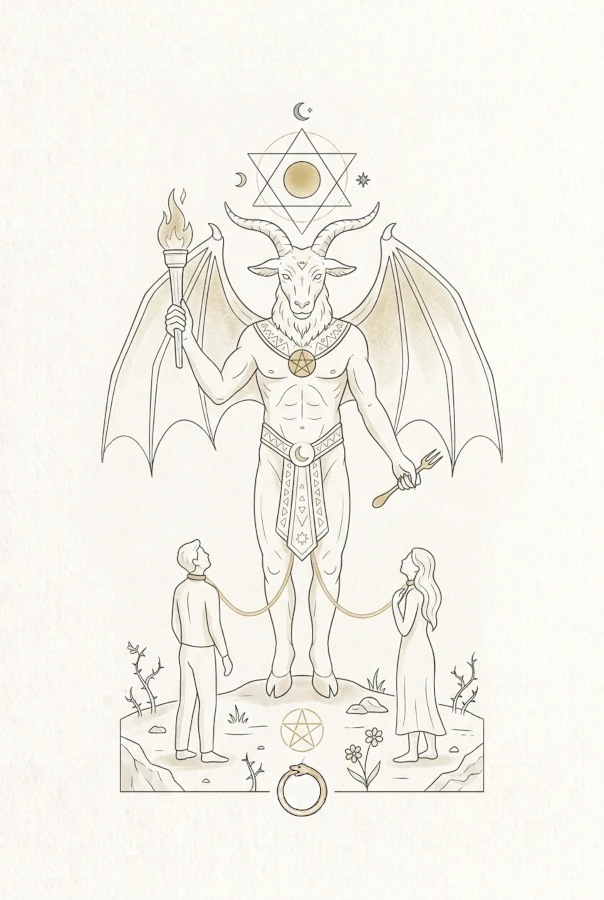
THE DEVIL
The Devil (Arcana 15): Complete Meaning and Interpretation
Among the 78 cards of the Tarot, the Devil stands as one of the most complex and deeply misunderstood. Far from frightening simplifications or purely religious connotations, this major arcana embodies the powerful and often repressed forces of the inner shadow. It does not speak of absolute evil, but of the temptations that bind us, of compulsive attachments, dependencies, and chains we forge ourselves — or accept to carry. This article demystifies this ambivalent figure by exploring its rich symbolic facets, from psychoanalytic archetypes to alchemical transformations, without forgetting its numerological resonance. We will then decipher its practical messages in readings, whether to illuminate dynamics in love, professional blockages, financial patterns, or health imbalances. At the heart of this exploration lies an essential question: is the Devil ultimately a jailer who imprisons us, or a liberator in disguise who confronts us with our own prisons in order to offer us the keys?
Symbolic Reading of the Devil: The Shadow's Throne
In the Tarot of Marseille, the Devil presents itself as an enigmatic and powerful scene, rich in complex symbolism. At the center sits an androgynous composite figure, often associated with Baphomet. Its human torso is topped by bat wings, evoking darkness and the underworld, while its bestial feet (often bird talons or hooves) anchor it in instinctual and earthly nature. The gesture of its hands is fundamental: one hand raised, in a double sign (blessing or curse, revelation or concealment), and one hand lowered, pointing toward the world below. On its forehead, the inverted pentagram signals the inversion of values and the primacy of matter over spirit. The flaming torch it sometimes holds symbolizes both the light of forbidden knowledge and the fire of destructive passions.
At its feet, two figures, a man and a woman, are chained to its pedestal. The crucial observation reveals that these chains are loose and could be removed — the imprisonment is largely consented, the fruit of illusion or addiction. These captives wear budding horns and a tail, faint mirrors of the Devil's own attributes, signifying their progressive degradation toward a bestial state and their identification with their jailer. The dark, cavernous atmosphere of the background underscores the realm of the unconscious, repressed impulses, and primal fears. Every detail contributes to painting not an external monster, but the inner shadow, the enslavement to instincts, addictions, and rigid thought structures we accept, often without seeing the key to liberation within reach.
The Devil: The Prison of Illusion and the Key of Awareness
The Devil embodies the moment when we become enslaved to our own desires and attachments. This card, the fifteenth of the Fool's journey, symbolizes the power of the shadow — the parts of ourselves we deny, repress, or refuse to acknowledge. The figure on the throne is not an external demon but a projection of our own inner chains: addictions, toxic relationships, compulsive patterns, material greed, and the illusion of separation. Yet within this dark vision lies a profound teaching. The chains around the captives' necks are deliberately loose — they could slip free if they chose to. The Devil does not truly imprison; it seduces us into imprisoning ourselves through our attachment to pleasure, power, and false security. The card invites a brutal examination of conscience: to what or whom have we voluntarily surrendered our freedom? Where have we given away our personal power in exchange for comfort, instant gratification, or the illusion of control? The first step toward liberation is seeing these chains for what they are.
Interpreting the Devil in Your Readings: A Practical Guide by Life Domain
When the Devil appears in your reading, it acts as a powerful mirror of your own attachments and shadow patterns. Its central message is clear: identify the chains you have accepted, and recognize that you hold the key to your own liberation.
In Love & Relationships, the Devil symbolizes intense, magnetic attraction. It can indicate a karmic bond or a relationship where passions are heightened. The positive potential is a deep physical connection and liberated desires. The warning is the risk of possessiveness, toxicity, jealousy, manipulation, or codependency. The chains of this card become very real in such dynamics.
In Career & Finances, the Devil speaks of ambition, power, and material success. Its positive aspect is a sharp competitive spirit, iron will to achieve goals, and the ability to play by the rules to succeed. Its warning is against unhealthy work environments, unethical practices, or workaholism that becomes a gilded cage.
In Spirituality & Personal Development, the Devil is a call to shadow work. It invites you to confront the parts of yourself you have denied: unacknowledged desires, anger, sensuality, ambition. Integration does not mean acting on these impulses, but owning them consciously. The path to wholeness runs through the shadow, not around it.
The Devil Reversed: The Beginning of Liberation
When the Devil appears reversed, a powerful energy of liberation is at work. This card often announces a pivotal moment where the chains that bound you — whether material, relational, or born of addiction — begin to loosen. It signals the awakening of a new consciousness, a salutary rejection of a toxic hold or an alienating situation. You are reclaiming your power and feeling a renewed will to take control of your life.
However, this liberation is not without nuance. Sometimes, the Devil reversed can reveal a refusal to face your own shadows, a tendency to project all responsibility onto external factors, which can create inner chaos. If the rupture is too brutal and disordered, it can also lead to an unstable void. The invitation of this card is clear: it offers you the key to your prison, but it is up to you to use it with wisdom and self-mastery to build an authentic and lasting freedom. The shadow integrated becomes a source of strength; the shadow denied or projected becomes a recurring trap.
The Devil: A Symbol with Celestial and Heroic Roots
To enrich our understanding of the Devil, it is essential to contemplate its powerful symbolic correspondences. In astrology, this arcana resonates with the planet Saturn, master of limits, karma, discipline, and rigid structures, combined with the energy of Capricorn, symbolizing ambition, authority, materialism, and perseverance. Together they depict the force that chains us to earthly desires and social obligations.
In numerology, the Devil is associated with 15, reduced to 6 (1+5=6), the number of harmony, conscious choices, and responsibility. This numerical path moves from individual will and ego (1), through the trials of freedom and change (5), to arrive at balance and commitment (6). The Devil is thus the crucial numerological trial — the confrontation with our attachments and passions necessary to access the conscious harmony of The Lovers (Arcana 6). In alchemy, the Devil perfectly embodies the nigredo phase, the 'Black Work,' where the raw material of the soul — our brute instincts, fears, dark impulses — is confronted and must be worked in the darkness. This figure is the guardian of the threshold of true transformation. In Jungian psychology, the Devil represents the Shadow archetype — everything consciousness refuses to recognize in itself. Carl Jung insisted on the necessity of integrating this shadow. Denying or fighting it only strengthens its hold; accepting and dialoguing with it allows the individual to reclaim vital energy and accomplish the process of individuation.
Final Advice of the Devil: The Courage to See and the Power to Choose
The Devil, in its ultimate synthesis, reveals itself not as a figure of absolute evil or fatality, but as a mirror held toward our depths. What we call 'Devil' is in fact merely a spectral projection, born of the accumulation of our most entrenched fears, repressed desires, and compulsive attachments. Its chains, though they seem solid, hold only through our silent consent to carry them. The true message of this card is profoundly initiatory: it invites us not to flee, but to face and integrate our shadow. By daring to look these raw energies, these impulses and dependencies, straight in the eye, we accomplish the most crucial alchemy. Captive energy transmutes into lucid willpower and conscious creative power. Thus, the Devil reveals itself as the Guardian of the Threshold. It does not block the passage; it is its demanding protector. Once its energy is understood and domesticated from within, it dissolves to reveal the path to a freedom no longer naive, but conquered, authentic, and sovereign. The question it leaves you with is this: will you continue to wear your chains, or will you take hold of the key you have always possessed?
Frequently Asked Questions
Does the Devil card represent evil?
No. The Devil represents the shadow self — the repressed parts of our psyche, our attachments, addictions, and compulsive patterns. It is not an external evil but a mirror of our own inner chains, which we have the power to remove.
Why are the chains loose in the Devil card?
The loose chains are a crucial detail: they show the imprisonment is largely consented. The captives could easily free themselves if they chose to. This symbolizes that our real chains are psychological — born of illusion, addiction, or fear of change.
What does the Devil mean in a love reading?
The Devil can indicate intense magnetic attraction, a karmic bond, or a passionate relationship. Its warning is against possessiveness, jealousy, codependency, and toxicity. It calls for honest examination of the power dynamics in the relationship.
What is the main message of the Devil reversed?
The Devil reversed announces liberation from bondage. Chains begin to loosen, awareness awakens, and you reclaim your personal power. However, it also warns against the chaos of a too-brutal rupture or the refusal to face one's own shadow.