THE EMPEROR
The Emperor (Arcane IV): The Architect of Order and Authority
At the heart of the initiatory journey of the Tarot stands a sovereign figure, the embodiment of order, structure, and conscious authority. The Emperor, Arcana IV, is far more than a simple monarch; he is the indispensable pillar that builds the fertile, intuitive inner world of the Empress into tangible realities in the outer world. He represents law, reason, stability, and the power to construct. In this article, we will decipher together the powerful symbols that compose this card, from the immutable mountains to his scepter of command. We will explore its spiritual meanings and deep psychological resonances, before diving into the nuanced interpretation of its readings, upright and reversed. Finally, we will see how to integrate its structuring and willful energy into our daily lives to build wisely. Prepare for a journey toward self-mastery and the affirmation of your own inner authority.
Iconography and Symbolism: Deciphering the Throne of Power
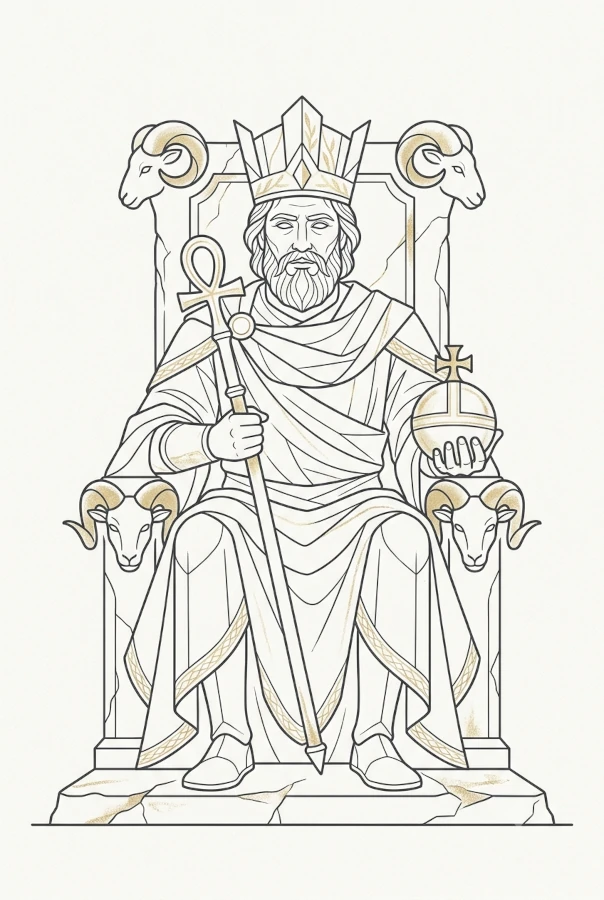
In the Rider-Waite-Smith, the Emperor is a figure of absolute authority, seated on a throne of raw stone anchored in a desert landscape. Every detail of this iconography composes an elaborate visual language about structure, control, and the foundation of a lasting order. The throne itself, massive and cubic, symbolizes stability, law, and the unshakeable foundations upon which the empire is built. In his right hand, he holds a scepter in the shape of an ankh, the famous Egyptian symbol of life. This crucial detail transforms the simple staff of command into an emblem of power over life itself and the union of opposites (the circle of spirit over the cross of matter). At his side, a shield adorned with an eagle — the bird of Jupiter and imperial symbol — evokes protection, a high and strategic vision, and the extent of a unified empire. The long white beard of the figure is not only a sign of age but of experienced wisdom and patriarchal authority. Behind him, the arid mountains represent challenges overcome, ambition realized, and an environment mastered by will. The color palette reinforces this message: the bright red of the robe and mantle embodies action, vitality, and executive power, while the touches of yellow (on the sleeves and the mountain) underscore intellect, clarity, and the light of reason that guides his reign. In contrast, the Emperor of the Tarot of Marseille presents a more static and heraldic iconography, often front-facing, with a fleur-de-lis scepter (symbol of the French monarchy) and an imperial eagle at his feet, emphasizing dynastic heritage and earthly sovereignty rather than the detailed philosophical symbolism of the Rider-Waite. Here, every element converges to form a coherent archetype: that of the ruler who imposes order upon chaos through law, structure, and a will enlightened by intelligence.
Spiritual and Psychological Meanings: The Archetype of the Father and the Builder
On a spiritual level, the Emperor embodies cosmic law and the intelligent structure that underpins the universe. He represents the active principle of manifestation, the ability to give tangible form to ideas and inspirations. He is the divine architect who transforms chaos into cosmos, imposing a necessary order for creation. Psychologically, he corresponds to the construction of a solid and integrated Self — a healthy ego. This archetype teaches us self-mastery, discipline, the ability to set clear boundaries, and to take responsibility. He is the force that structures our psyche, establishes protective boundaries, and allows us to act with authority and integrity in the material world.
In direct contrast to the receptive, nurturing, and instinctive energy of the Empress (the Mother), who symbolizes fertile nature and the flow of life, the Emperor (the Father) represents culture, civilization, deliberate action, and stability. Where the Empress is the garden, he is the stone wall; where she is the intuitive idea, he is the execution plan. Together, they form the fundamental creative dyad: receptivity and action, potential and its realization.
The Emperor Upright: The Exercise of Rightful Authority
When the Emperor appears upright in a reading, he delivers a powerful message about structure, control, and authority in your life. The upright Emperor embodies the archetype of enlightened leadership and beneficial structure. He symbolizes success achieved through discipline, rational planning, and a healthy mastery of oneself and one's environment. This is the card of conquered stability, protection assured by solid foundations, and a project taking concrete and lasting form.
At work, it may indicate a promotion to a position of responsibility, the success of a structured project, or the need to establish clear rules to move forward. In financial matters, it speaks of stability, sound investments, and rigorous management. On a personal level, it encourages you to become the architect of your own life, to set healthy boundaries, and to develop inner authority (self-confidence and discipline). In love, it can evoke a stable and committed relationship, founded on mutual respect and shared responsibilities, or the need to bring more structure and reliability into it.
The Emperor Reversed: The Pitfalls of Power
When reversed, the Emperor reveals the dysfunctions related to control and authority. It may signal rigidity, suffocating authoritarianism, or abuse of power, whether you are the source or the victim. This manifests as excessive control in a relationship, tyrannical management at work, or rules so rigid that they stifle all creativity and flexibility. Failure may occur due to planning that is too rigid and ill-suited to changing realities.
This meaning can also indicate a conflict with an authority figure (a parent, a superior, an institution) or with the law. Constructively, the reversed Emperor is an urgent call to flexibility. It invites you to reassess your structures, to let go of what you cannot control, and to find a balance between order and fluidity. Perhaps it is time to delegate, listen to advice, or replace rigidity with a more flexible and adaptive approach.
Integrating the Emperor's Energy: From the Card to Action
The Emperor is not a distant figure to be feared, but a structuring energy to be embodied. To work concretely with his teaching, begin with a simple meditation: visualize yourself 'sitting on your inner throne.' Close your eyes, anchor your posture, and feel the stability, clarity, and rightful authority emanating from your center. This practice cultivates confidence in your own judgment. When this card appears in a reading, ask yourself targeted questions such as: 'In what area of my life do I need to establish more order and structure?', 'Is my authority (toward myself or others) benevolent and fair, or rigid and tyrannical?' or 'What are the solid foundations upon which I can build?'.
For beginners, do not fear it: it does not announce a dictator, but invites you to take responsibility with maturity. It can symbolize an influential person in your life (a father, a mentor, a leader) whose leadership qualities or, conversely, excessive control you should observe. More deeply, it represents above all a mindset to adopt: that of the architect of your own life, who establishes healthy boundaries, makes thoughtful decisions, and acts with integrity to manifest your projects in the concrete world.
Key Combinations with Other Arcana
The Emperor, archetype of structure, authority, and concrete manifestation, sees his reading enriched and powerfully nuanced when combined with other major arcana. His energy combines, strengthens, or clashes, drawing precise scenarios. For example, associated with the Empress, he forms a perfect union between the structuring masculine principle and the fertile feminine principle: this is the alliance of vision and its realization, promising a fruitful and lasting project. With the World, the Emperor celebrates major success and accomplishment, crowning long and disciplined efforts with tangible recognition.
Facing the Magician, his energy gives a framework to the innovative idea: the beginner's potential becomes structured, takes a viable form, and begins a concrete existence. In contrast, the proximity of the Tower announces a brutal shock: the Emperor's rigid structure may collapse under a stroke of fate or a revolution against established authority. Context is paramount: this same Emperor/Tower combination can, in a question about personal transformation, signify the necessary deconstruction of an overly rigid ego to be reborn on healthier foundations.
Conclusion: Order from Chaos
The Emperor teaches us that chaos is not the natural state of things, but raw material. His essence resides in this fundamental truth: life, to truly flourish, needs structure. Without a framework, creativity scatters, energy is wasted, and growth remains disorderly. But remember that the ultimate power of this archetypal figure is not domination for its own sake; it is a service. He erects boundaries to protect, he establishes laws to create a secure framework where our boldest projects can take root and rise.
Do not see in him a distant tyrant, but recognize the architect of your own existence. He invites you to lay solid foundations, define your rules, and assume authority over your destiny. The final lesson is a subtle balance: a structure too rigid suffocates, while fluidity without anchors dissolves. The art is to be both the rock and the river.
Frequently Asked Questions
What does the Emperor's ankh scepter symbolize?
The ankh scepter is the ancient Egyptian symbol of life. In the Emperor's hand, it transforms his authority into power over life itself, representing the union of opposites: the circle of spirit over the cross of matter, and the life-giving force of wise governance.
How does the Emperor differ from the Empress?
The Empress embodies receptive, nurturing, instinctive feminine energy — the fertile garden and intuitive idea. The Emperor represents the structuring masculine principle — the stone wall, the execution plan, deliberate action, and stability. Together they form the fundamental creative dyad: potential and its realization.
What does the Emperor reversed mean in a love reading?
In love, the Emperor reversed warns of excessive control, rigidity, or an abuse of power within the relationship. It may indicate a partner who is domineering or stifling, or a dynamic where rules and expectations have become suffocating. It calls for more flexibility, mutual respect, and a rebalancing of authority.
Is the Emperor a favorable card for career and finances?
Yes, upright, the Emperor is very favorable for career and finances. It indicates success through discipline, a possible promotion, the fruition of a well-structured project, financial stability, and sound investments. Reversed, however, it warns against tyrannical management, overly rigid planning, or financial losses due to imprudence.
How can I work with the Emperor's energy in daily life?
You can embody the Emperor's structuring energy by establishing clear routines, setting healthy boundaries, taking disciplined action toward your goals, and making decisions from a place of inner authority. A simple practice is to visualize yourself 'sitting on your inner throne' — anchoring yourself in stability and clarity before making important choices.