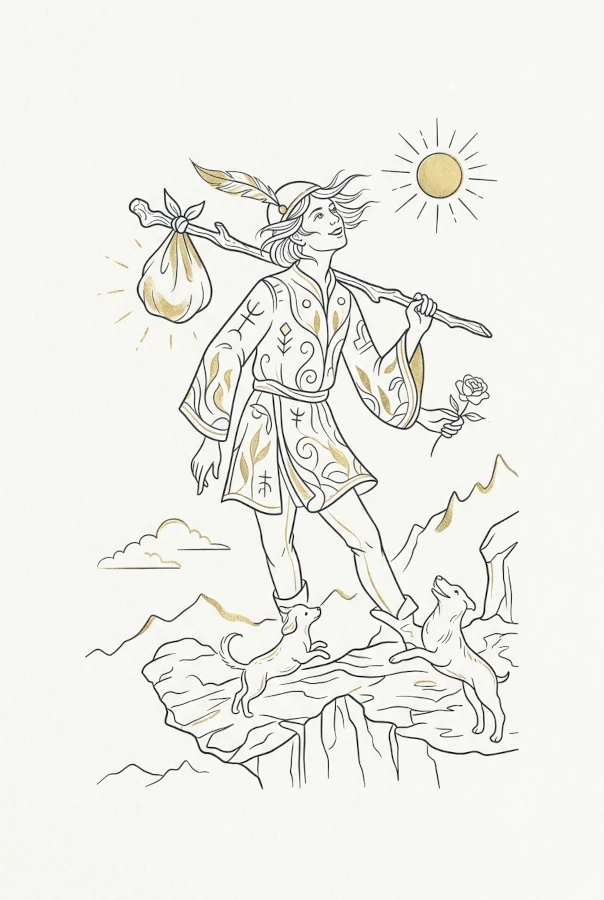
THE FOOL
The Fool (Arcana 0): The Enigmatic Traveler of the Tarot
At the threshold of the great mystery of the Major Arcana stands a figure apart, as fascinating as it is elusive: The Fool. No other card captures the imagination or raises as many questions. By its unique status — bearing no number or the digit 0, both beginning and end of the cycle — it is the enigmatic keystone of the entire edifice of tarot. Under its many names, whether called The Fool or The Madman, it embodies the very essence of the journey. But who is it really? A senseless person walking with lost eyes toward the precipice of unconsciousness, or a liberated sage, embodying pure potential and the irresistible call of the unknown? It is this fundamental duality that we will explore. Through a detailed symbolic analysis of its attributes, we will decipher its silent language. We will then examine its practical interpretations in readings (love, work, life path) before diving into its deep psychological and spiritual resonances. Prepare to follow the Fool's step on a journey to the heart of freedom, risk, and primal innocence.
The Fool: An Iconography of Departure and the Unconscious
In the Tarot of Marseille, the Fool stands as a visual enigma, a complex allegory of the inner journey. Its iconography, rich and meticulous, tells a story of rupture and pure potentiality. At the center, the character himself, often youthful, advances with a decided step, his gaze turned toward the sky or the horizon, symbolizing an intuition that transcends immediate reason. His motley and torn clothing speaks of a past from which he detaches himself: the rags represent social conditioning and worn-out identities, while the bright colors (red, yellow, green) evoke the multiple facets of his being and an intact vitality.
In his hand, the staff is not a weapon but a support and a symbolic backbone. It represents will and inner direction, the link between heaven (spirit) and earth (matter), while serving as physical support for the unknown. On his back, the bundle suspended from the staff contains the light baggage of past experiences and unrealized potential. It is not a burden, but a reserve of resources, carefully chosen not to hinder his march.
At his feet, a small animal, often a dog or cat, nibbles or pulls at his clothing. This figure embodies instincts, attachments, and that part of oneself that resists change. It reminds us that departure is never a total escape; a part of us remains anchored, questioning or holding us back, adding a dynamic tension to the scene. Finally, the landscape completes this symbolic narrative. The precipice before which the Fool seems to walk is not a threat of falling, but the representation of the unconscious, the abyss of possibilities where certainties crumble. The winding path under his feet and the open horizon behind him sketch the map of a journey without a fixed itinerary, where the only destination is experience itself. Together, these elements form a coherent narrative of liberating departure: an act of faith that engages the whole being, conscious and unconscious, in an adventure where freedom is born precisely from the acceptance of uncertainty and the dialogue with one's own shadow parts.
The Fool in the Great Esoteric and Symbolic Traditions
Far beyond the image of the vagabond, the Fool embodies a universal principle present in the great esoteric traditions. In Kabbalah, it is associated with the letter Shin (ש), symbol of divine Fire and the Spirit that animates all creation. This connection makes it the archetype of the spark of pure consciousness, not yet fixed in matter. In numerology, its number is Zero, representing infinite potential, the fertile void from which everything can emerge. It is also intimately linked to the Master Number 22, the number of total realization and the completion of the Major Arcana cycle. In alchemy, it corresponds to the Prima Materia, the original undifferentiated substance, or the Rough Stone that the adept must work. Astrologically, it is associated with the planet Uranus (genius, rupture, sudden illumination) and the element Air (mind, freedom, movement). Finally, depending on tarot traditions, its interpretation varies: the Tarot of Marseille emphasizes its ambivalence between folly and wisdom; the Rider-Waite offers a more optimistic vision of a journey guided by faith; while Oswald Wirth offers a hermetic reading, making the Fool the seeker on the path of Knowledge. Thus, through these multiple facets, the Fool reveals itself as the very principle of the quest, of pure potentiality and the breath of the Spirit in perpetual motion.
The Archetype of the Fool: The Eternal Child at the Dawn of the Heroic Journey
In the rich language of Jungian archetypes, the Fool embodies the fascinating figure of the Sacred Fool, the Innocent, or the Eternal Child. It represents a psychic state of pure potentiality, prior to the crystallization of the ego and its rigid identifications. Psychologically, it symbolizes that suspended instant where everything is still possible, where personality has not yet chosen its path and remains open to the infinity of the unconscious. Its departure, the bundle at the end of its staff, is a perfect allegory of the call to adventure that inaugurates the mythical "Hero's Journey" described by Joseph Campbell. It leaves the known world, not through reckless bravado, but through a profound intuitive audacity, an absolute trust in the process of life. This first step into the void is an act of faith toward the soul; it is the sine qua non condition for individual consciousness (the future Hero) to emerge, confront its shadows and lights, and ultimately realize itself. The Fool thus reminds us that true wisdom often begins with a courageous letting go, a renewed connection with spontaneity and the messages of the unconscious, guided not by Cartesian reason but by the inner compass of instinct and the sense of possibility.
The Fool Upright: The Call of Adventure and New Beginnings
When the Fool appears upright in your reading, it blows a great wind of freedom and limitless possibilities. This card is a luminous signal, an invitation to embrace novelty with faith and spontaneity. It symbolizes the beginning of an unknown path, where enthusiasm and trust in life are your best assets. The keywords that resonate here are: freedom, beginning, audacity, letting go, journey (inner or physical), and pure potential. It is about seizing the opportunity that presents itself, even if it requires leaving your comfort zone.
On a professional level, the Fool strongly encourages new beginnings: launch that innovative project you've been thinking about, accept that different position, or dare a career change. This is the time to walk toward the unknown with the conviction that your curiosity and adaptability will be your guides. On a romantic level, it can announce an unexpected and exciting encounter, full of freshness, or signify a liberating phase of singleness where you rediscover yourself in complete independence.
On a financial level, this card often suggests a period of change requiring faith. An investment in yourself, a departure toward new economic horizons can be considered, accepting not to control everything from the start. For health, the Fool emphasizes the importance of mental balance and listening to your body. A "journey" toward new lifestyle habits (physical activity, diet, stress management) can be beneficial. In any case, the Fool upright reminds you that the greatest potential lies in your ability to open yourself to the unexpected and take the first step with a light heart.
The Shadow Challenges: Interpreting the Fool Reversed
When the Fool appears reversed, its energy of freedom and audacity becomes perverted or blocked, confronting us with the shadow of our own potential. It is no longer a liberating journey, but a wandering. The keywords associated with it betray this difficulty: irresponsibility, escape, confusion, fear of change, real folly, procrastination. The card depicts an energy that refuses to commit, to take life in hand, or that does so in a completely disordered manner. Its manifestations can be split into two poles: paralysis facing the unknown, a fear of taking the leap that leads to stagnation and refusal to grow; or conversely, sterile agitation, impulsive and disastrous decisions taken without reflection, motivated by a tendency toward escape rather than a true forward movement. Concretely, this can translate into professional failure due to lack of preparation (launching a project without a business plan, quitting a job without prospects), unstable relationships where one flees intimacy or commits too quickly without discernment, or financial losses through imprudence (risky investments, compulsive spending). The Fool reversed warns us: true folly is not about daring, but about going in circles in one's fears or rushing into the void without having prepared one's leap.
The Fool in Context: Key Combinations with Other Arcana
In the game of Tarot, the deep meaning of a card is fully revealed in its dialogue with others. The Fool, figure of innocence and departure toward the unknown, sees its message nuanced and considerably enriched depending on the arcana that accompany it. It is no longer just pure potential, but an energy that becomes precise and finds its direction. Here are some illuminating combinations: with the Lovers, the Fool becomes the call of the heart. This association speaks of a crucial choice guided by emotion and authenticity, often outside conventions. It is an invitation to follow a relationship or passion that promises freedom and fulfillment, even if the path is not mapped out. Meeting the Wheel of Fortune, the Fool's wandering transforms into an adventure guided by destiny. This combination evokes unexpected luck, a turn of fate that propels the seeker into a period of great change. Finally, the union of the Fool with the Tower is among the most powerful. It symbolizes a brutal but liberating rupture. The crumbling tower destroys old structures, and the Fool, carefree, emerges free. Each of these encounters shows how the Fool's primary energy is sculpted and takes meaning, moving from simple potentiality to a clear and powerful life direction.
The Spiritual Message of the Fool: Letting Go and Trusting Life
Beyond the image of the carefree vagabond, the arcana of the Fool delivers a spiritual lesson of radical depth: the art of letting go and absolute trust in the very process of life. It embodies the state of being where one stops resisting the flow of events, where one abandons the compulsive need to control, plan, or anticipate everything. The Fool carries no burden, for it has released its expectations and fears of the unknown. Its teaching resonates powerfully with contemporary practices like mindfulness, which invites us to simply be present, without judgment, to the experience unfolding. It is the figure of spontaneous creativity, which springs forth when we stop forcing inspiration, and of the finest emotional intelligence, which consists of listening to and following our inner intuition rather than external conventions. In short, the Fool offers us a key to authentic freedom: it invites us to embrace the unknown not as a threat, but as the very source of our growth, our discoveries, and our true path.
Embracing the Spirit of the Fool in Daily Life
The Fool, with its light bundle and gaze turned toward the horizon, imparts a fundamental teaching: life is a journey whose greatest wealth lies in the experience itself, not in the illusory security of a fixed destination. It reminds us that faith in our own path, even when it seems unpredictable, is the most powerful of compasses. Integrating its energy means cultivating the courage to take the first step toward the unknown — whether changing careers, expressing a personal truth, or allowing yourself to dream bigger. It also means introducing a salutary dose of lightness in the face of our own overly rigid plans, accepting that true wisdom is not about controlling everything, but about knowing how to dance with the unexpected. In this, the Fool perfectly embodies the synthesis of the fool and the sage, teaching us that authentic freedom sometimes requires the courage to appear "foolish" in the eyes of a world attached to conventions. So, when facing a transition, a decision to make, or a simple feeling of suffocation, invite the Fool as an ally. Let it whisper to you to trust your inner impulse, lighten your burden of unnecessary fears, and embrace with curiosity the next turn of your unique path.
Frequently Asked Questions
Why does the Fool have no number (or have 0 and 22)?
The Fool is the card of infinite possibilities. It is unnumbered, or sometimes associated with 0 (nothingness, pure potential) or placed between 20 and 21. It transcends the ordered sequence of the life path (Arcana 1 to 21), symbolizing absolute free will and the departure into the unknown.
What does the Fool's bundle really contain?
His bundle contains the experiences and talents acquired in past lives or previous cycles. It is his only baggage, light but essential, giving him confidence to leap into the void. It represents the inner capital he can rely on.
Does the animal (dog/cat) bite the Fool or guide him?
The animal, often a dog, symbolizes primal instincts and unconscious fears. It does not bite ferociously, but seems rather to hold him back or harass him, representing the last attachments to the known that try to hold him back. It is a paradoxical guide: by nipping at him, it paradoxically pushes him forward to free himself.
Does the Fool really walk toward a precipice? Isn't he afraid?
Yes, he walks toward the unknown, symbolized by the precipice. His "madness" is not the absence of fear, but the courage to go on despite it. He trusts life. The precipice is not a certain fall, but the leap into a new dimension of his existence.
Is the Fool a good or bad card in love?
It is neither good nor bad, but radically free. In love, it speaks of an unexpected encounter, a coup de foudre, a desire for adventure as a couple, or the need for absolute freedom within the relationship. It can announce an exciting departure or a relationship that refuses conventions, but also some instability or fear of commitment.
How to tell the difference between a message of 'creative folly' and 'irresponsibility' with the Fool reversed?
It is all about context and intention. Creative folly (reversed or not) is a vital impulse, a calculated risk in the service of an ideal or a project. Irresponsibility (often accentuated by the reversal) is selfish impulsivity, a flight forward without regard for consequences for oneself or others. Ask yourself this question: does this impulse come from a deep desire for growth or from a fear of facing one's responsibilities?