October 28, 2026
The Hermit Tarot Card Meaning: Solitude, Not Loneliness
The Hermit as chosen retreat: how to tell solitude from isolation, what he says about love and distance, and the signs isolation has gone too far.
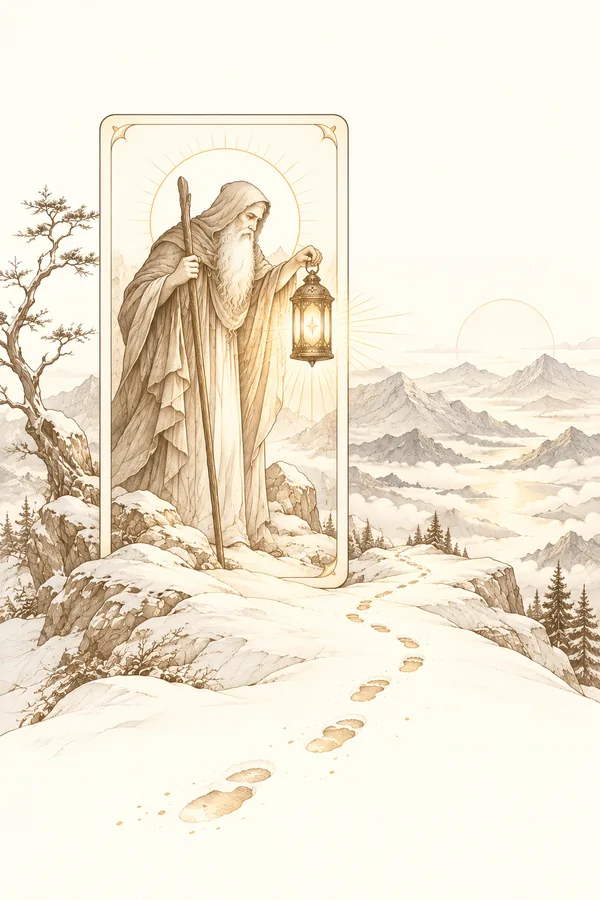
The Hermit, Key 9 of the Major Arcana, is the tarot’s great card of solitude. But the solitude it describes is not the same as loneliness. In the Rider-Waite-Smith deck, an old figure stands alone on a mountain peak, holding a lantern and a staff—not lost, not abandoned, but deliberately withdrawn. The Hermit chooses his solitude. It is purposeful retreat: a season for reflection, inner listening, and spiritual stocktaking before returning to the world.
If you have ever typed “what does The Hermit mean about being alone?” into a search bar, you are in exactly the right place. This guide answers that question directly, starting from the card’s core meaning and working outward. We will cover the upright and reversed meanings of The Hermit, unpack the symbolism of the Rider-Waite imagery, and explore what the card says about love and career. Practical spreads and journaling prompts will follow so you can work with the card in your own readings.
Throughout, keep one idea in view: The Hermit’s solitude is a teacher, not a punishment. By the end, you will be able to tell healthy withdrawal from isolation—and know when the lantern is guiding you inward, and when it is time to walk back down the mountain.
The Lantern in the Dark: Why The Hermit Is the Card of Chosen Solitude
Few cards are as misunderstood as The Hermit. When he appears in a reading, querents often flinch, assuming it forecasts isolation or abandonment. But the Hermit is not the card of loneliness — he is the card of solitude, and the distinction matters.
Solitude Is Not Loneliness
Loneliness is imposed and painful: the ache of being unseen. Solitude is chosen and nourishing: the deliberate quiet that lets you hear yourself think. The Hermit embodies the second kind. He withdraws not because he has been rejected by the world, but because he has important inner work to do — and he knows that work requires stillness.
Reading the Image
In the Rider-Waite image, the old man stands alone on a snowy peak. The height and the snow signal withdrawal from the crowd — he has climbed above familiar noise and conversation. His gray cloak is unassuming; he is not performing wisdom, simply carrying it. In one hand he holds a staff for support and endurance; in the other, a lantern. Inside the lantern burns a six-pointed star, a symbol of light and guidance. That detail is the key to the whole card: he carries the light with him, and the light is meant to illuminate the path — for himself first, and ultimately for others.
What the Card Is Really Saying
The Hermit rarely means “you will be alone forever.” It means “go inward to find your light.” The card asks you to honor a period of intentional retreat — reflection, study, meditation, or simple quiet — so you can return to the world with something real to offer.
The Gray Cloak and the Six-Pointed Star: Reading the Symbols of The Hermit
Every symbol in The Hermit’s landscape answers a reader’s practical question about solitude. For beginners, start with the figure.
The Cloak, Staff, and Lantern
The gray cloak signals humility and anonymity—wisdom earned with age, not displayed. It answers, “Why doesn’t The Hermit look like a hero?” Because inner work is unglamorous.
The staff offers support and groundedness during that inner work, steadying the solitary climb.
The raised lantern is illumination and guidance. It answers the common question, “Why does The Hermit carry a lantern?” Not to light his own path only, but to light the way for others who follow later—solitude in service of insight.
The Star and the Summit
Inside the lantern burns the six-pointed star (Star of David): the union of above and below, spiritual insight made visible. The snow-covered summit shows detachment from worldly noise—clarity found in quiet.
Finally, the number 9 marks completion before a new cycle begins, so solitude here is a purposeful pause, not isolation.
When The Hermit appears, ask: Where do I need quiet to see clearly?
Upright Hermit Meaning: When Solitude Is the Answer
When The Hermit appears upright, it is an invitation to step back from the noise and seek your own answers instead of outside validation. This is the card of deliberate solitude — not loneliness, but chosen quiet that produces clarity.
In readings, it commonly points to a few situations. You may simply need time alone to think, away from other people’s opinions. It can signal a period of study or spiritual seeking, where reflection matters more than activity. As a mentorship card, it works both ways: you may be the guide others seek, or you may need to find one. Above all, The Hermit asks you to trust inner wisdom over crowd opinion.
A Practical Note for Beginners
When The Hermit appears upright, ask yourself: what decision do you keep outsourcing to others? The card’s quiet prompt is to sit with that question until your own answer surfaces.
Reframing the Fear
The Hermit is often feared as a card of isolation or withdrawal. Reverse that: this is not a bad card. It is a pause that produces clarity — a lantern held up in the dark, not a door closing. Solitude, here, is the answer rather than the problem.
Reversed Hermit Meaning: When Solitude Goes Sideways
Upright, the Hermit shows solitude as a lantern: a chosen, purposeful withdrawal that helps you hear your own voice. Reversed, that lantern tips and the light falls on the shadow side of being alone.
Two Ways Solitude Curdles
The first direction is isolation as avoidance — retreat that has quietly hardened into hiding. You stop answering messages, refuse help from people who care, and let loneliness ferment into bitterness. The healing retreat has become a bunker.
The second direction is the opposite: an inability to be alone at all. Fear of your own company, constant noise and company as anesthesia, or forced solitude you never chose — lockdowns, illness, exile — that leaves you stranded rather than reflective.
Telling Them Apart in a Reading
Read the surrounding cards as context. Hermit reversed beside Four of Cups or Eight of Cups suggests withdrawal that has soured. Next to Three of Swords or Five of Pentacles, look for grief or hardship that has become enforced isolation. Beside Two of Cups reversed or Page of Cups reversed, expect fear of intimacy or restlessness with solitude. Court cards of connection (Two of Cups, Three of Cups) often show the longing for company you’re denying yourself.
A Practical Question
Reversed Hermit asks one honest question: are you retreating to heal, or hiding to escape? If solitude restores you and you can name when it will end, it’s medicine. If you dread re-emerging, or dread being alone, it’s time to reach toward someone.
The Hermit in Love and Relationships
When The Hermit appears in a love reading, it rarely signals a verdict on the relationship itself. It points to solitude as a theme—what the querent needs, what a partner is seeking, or what the connection is asking for. Understanding this card can turn a moment of distance into an opportunity for growth.
For Singles: A Season, Not a Sentence
The Hermit does not mean you are destined to be alone. For single querents, it signals a deliberate season of self-discovery—a time to clarify values and heal before partnership. This card honors introspection; it suggests that solitude chosen consciously is preparation, not punishment.
For Couples: Space Versus Distance
In a relationship reading, The Hermit often reflects one partner’s need for breathing room, or a sense that someone has grown emotionally distant. Distance is the message; whether it becomes a problem depends on how it is handled.
Common Reader Questions
“Does The Hermit mean my partner wants to leave?” Usually not. More often it means they need space to process something—work stress, personal growth, or simply quiet. Ask rather than assume.
“Is The Hermit a breakup card?” Rarely. It warns against ignoring distance, not against the relationship itself. Unaddressed withdrawal is what causes damage.
Practical Advice
Communicate solitude as a need, not a rejection: “I need some quiet evenings this week—it’s about recharging, not about us.” Reassure with specifics and a timeframe. This small act of clarity prevents a partner’s abandonment fears from filling the silence.
The Hermit in Career, Money, and Life Path Readings
When the Hermit appears in a career reading, the solitude he represents becomes a professional asset rather than a limitation. You may be entering a phase that calls for independent, focused work—deep research, skill-building, or mastering a craft away from office noise. This card often signals a mentor or mentee relationship, where wisdom passes quietly between two people. It can also point toward a solo career path or remote work that honors your need for autonomy.
Money and Finances
Financially, the Hermit counsels caution and self-reliance. Manage money deliberately: build savings, question hype, and avoid herd-driven investment decisions. His lantern lights only the next step—not the whole market.
Life Path Guidance
On your life path, the Hermit typically appears when you are re-evaluating your purpose or feeling out of step with peers. That discomfort is not failure; it is an invitation to withdraw, reflect, and return with clarity.
Reversed in Career
Reversed, the Hermit warns of burnout from overwork in isolation or avoidance of necessary collaboration. Solitude has tipped into stagnation—reach out before the lantern goes dark.
The Hermit as Feelings and as Action in a Reading
The Hermit tarot card meaning centers on solitude, and in a reading that solitude can show up as either an inner emotional state or an outer behavior. Knowing which one you’re looking at changes the entire message.
The Hermit as Feelings
As a feelings card, the Hermit describes someone introspective and guarded. They need space, not because they don’t care, but because they process emotionally in private. Affection may be quietly consistent yet rarely demonstrative. The key beginner distinction: holding back here usually comes from self-protection, not disinterest. Ask whether the withdrawal serves reflection or fear.
The Hermit as Action
As an action card, the Hermit shows up as literal behavior: withdrawing from social contact, researching, journaling, meditating, seeking counsel from a trusted elder or mentor, or pausing a decision to think it through. The energy is deliberate and slow rather than stuck.
Telling Them Apart in a Spread
Position matters. In a feelings position, read the Hermit as inner withdrawal or guarded care. In an outcome or action position (for example, position five in the Celtic Cross), read it as a concrete step: retreat, study, or a deliberate pause before deciding. In short, the Hermit as feelings withdraws inward; as action, it withdraws on purpose.
Practical Spreads for Working With The Hermit
The Hermit’s solitude is purposeful, not punitive—and spreads help you tell the difference. Try these concrete applications.
One-Card Pull
Ask, “What do I need to be alone with right now?” Draw a single card. Its suit and number name the specific inner matter—a grief, a decision, a truth you’ve been outsourcing to other voices. Sit with it in journaling or quiet reflection rather than acting immediately.
Three-Card Past–Present–Future
Lay three cards. When The Hermit lands in the present position, read it as an inward season already underway: something is being consolidated before it can be shared. The past card shows what sent you inward; the future card hints at what ripens when the withdrawal ends.
Relationship Spread
In a two-person spread (you, them, the dynamic), The Hermit signals a space or distance issue—one party needing room, or loneliness inside the connection. Ask whether the distance is chosen or imposed, and name it aloud.
Career Spread
In work readings, The Hermit flags mentorship (seeking a guide or becoming one) or independent study—a course, certification, or deep-focus project pursued solo. It favors depth over visibility right now.
The Solitude Check
Draw two cards: one for what solitude is giving you, one for what it is costing you. The first clarifies the gift—clarity, rest, discernment. The second keeps you honest about isolation’s price—missed connection, avoidance, stalled momentum. Together they turn The Hermit’s withdrawal into a conscious choice rather than a habit.
The Hermit Versus the Fool, the Hierophant, and the Hanged Man
The Hermit’s solitude is easily confused with cards that share its imagery of aloneness or stillness. Distinguishing them sharpens the Hermit tarot card meaning: solitude here is deliberate, earned, and inward-facing.
The Hermit and the Hierophant: Inner Teacher vs. Outer Teacher
Both cards deal in wisdom, but from opposite directions. The Hierophant transmits knowledge through institutions—churches, schools, lineages, tradition. The Hermit withdraws from those structures to consult the inner teacher. When you draw the Hermit, the answer isn’t in the congregation; it’s on the mountain, lantern in hand.
The Hermit and the Fool: Beginning vs. Integration
The Fool’s solitude is a threshold—an innocent step into the unknown. The Hermit’s solitude is a pause to integrate what has already been lived. The Fool leaps; the Hermit reflects before the next leap.
The Hermit and the Hanged Man: Willing Stillness vs. Suspension
The Hanged Man is suspended, often involuntarily, seeing the world upside down. The Hermit chooses his withdrawal and brings light to it. One waits for insight; the other walks toward it, slowly and on purpose.
The Numerological Link to the Wheel of Fortune
The Hermit is card 9; the Wheel of Fortune is 10—and 1 + 9 = 10. The Hermit’s solitude is the quiet reckoning that prepares the turning point of the next cycle. Withdraw, understand, and the Wheel turns.
Common Questions About The Hermit and Solitude, Answered
Is The Hermit a yes or no card?
Not exactly—it leans toward “not yet.” The Hermit’s solitude is a pause for reflection, not a green light. Before you act, the card asks you to step back and look inward. If you need a yes/no read, treat upright as “wait and reflect” and reversed as “you’ve isolated long enough—reconnect before deciding.”
Is The Hermit a bad card?
No. Solitude here is purposeful, not punitive. Upright, The Hermit signals healthy withdrawal for clarity and self-knowledge. Reversed, it flags isolation that’s gone too far—loneliness, avoidance, or refusing help. Either way, the card is a prompt for balance, not a warning of misfortune.
What does The Hermit mean in a daily pull?
Take quiet time. Carve out a pocket of solitude—a walk, journaling, a screen-free hour—and let answers surface on their own. Upright, this is restorative introspection. Reversed, check whether you’re hiding from people who matter and nudge yourself back toward connection.
Does The Hermit mean someone is thinking of me?
Often yes—quietly and from a distance. The Hermit suggests someone reflecting on you privately rather than reaching out. Upright, their feelings are sincere but contained; reversed, they may be overthinking or withdrawn. Don’t expect grand gestures—this is inner work, not outward action.
What zodiac sign is The Hermit associated with?
Virgo. Its themes of analysis, discernment, and purposeful solitude fit Virgo’s reflective, detail-oriented nature—the sign that sorts, studies, and seeks understanding before stepping forward.
A Final Word: Making Solitude a Practice, Not a Punishment
When The Hermit appears in a reading about solitude, it is not delivering a verdict of loneliness. It is teaching a skill. The card shows solitude as something you do — deliberately, temporarily, and with purpose — rather than something that happens to you. The lamp is held, not dropped; the mountain is climbed, not fled to. That distinction is everything.
A Small Ritual for Lonely Days
On a day when you feel isolated, draw The Hermit intentionally. Sit with the image and ask one question in your journal: What is the lantern revealing that I couldn’t see in the noise? Write without editing for five or ten minutes. You are not solving loneliness; you are listening to it, the way the Hermit listens on the peak.
The Descent Is Part of the Story
Notice what the card leaves out: the Hermit does not stay on the mountain forever. Solitude in tarot always bends toward reconnection — clarified insight, a return with something worth sharing. The withdrawal is in service of the return.
So let the card reframe your lonely hours as practice rather than punishment. The Hermit’s solitude is an invitation, not a sentence — and invitations, unlike sentences, can be accepted on your own terms.
Recommended tool
Explore the Arcana
Browse the 22 Major Arcana and their meanings.
Keep reading
More on Individual Cards
October 28, 2026
The Emperor Tarot Card Meaning in Career
The Emperor at work: leadership, contracts and structure, what the reversal exposes about micromanagement, and how to read him in a job or business spread.
Read the article
October 28, 2026
Wheel of Fortune Tarot Card Meaning: Change
Cycles, timing and luck: what the Wheel moves, what stays yours to steer, and how to read her upright, reversed and in a yes or no question.
Read the article
October 27, 2026
The Empress Tarot Card Meaning in Love
The Empress as love, feelings and outcome: her upright warmth, what the reversal exposes, and how she reads beside the Emperor and the Lovers.
Read the article