October 28, 2026
The Emperor Tarot Card Meaning in Career
The Emperor at work: leadership, contracts and structure, what the reversal exposes about micromanagement, and how to read him in a job or business spread.
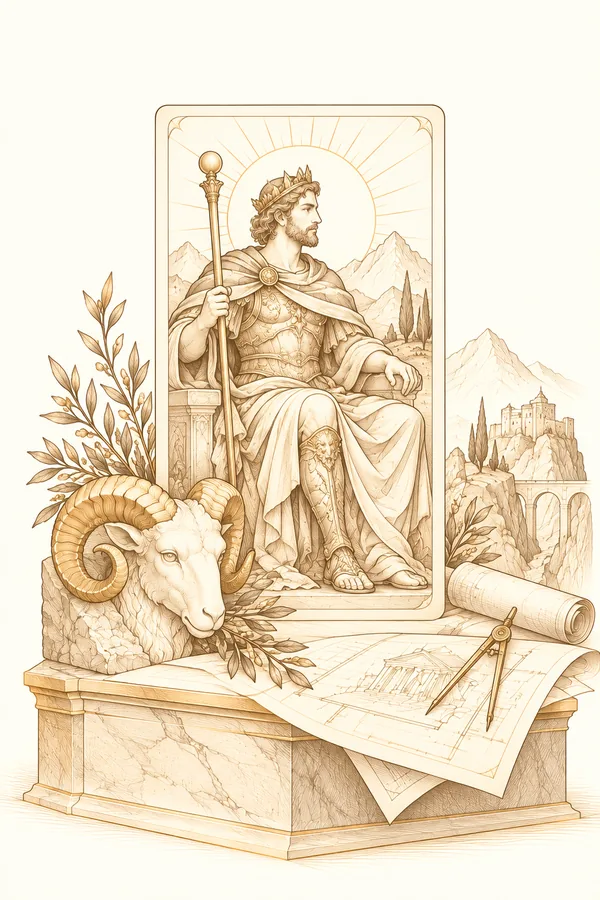
The Emperor is Major Arcana IV, the fourth card of the tarot’s major sequence and the first to embody fully mature, worldly power. Ruled by Aries and depicted in the Rider-Waite-Smith deck as a stern ruler seated on a stone throne adorned with ram heads, he represents authority, structure, leadership, and long-term stability. Where the Empress nurtures growth, the Emperor builds systems that protect it.
In career readings, this card carries distinct weight. When the Emperor appears in a work, business, or money question, he speaks to how you claim authority, impose order, and build something durable. He may signal a boss, a corporate structure, a promotion into management, or your own need to set boundaries and lead. He can also warn against rigidity, bureaucracy, and domineering behavior, which is why context and position matter so much.
This guide delivers exactly what the Emperor means in career readings. Whether you are new to tarot or reading professionally, you will find clear interpretations for the upright and reversed card, guidance on how he reads across common spread positions, and practical next steps you can actually apply to your work life. Every interpretation stays grounded in Rider-Waite symbolism, so you can see where each meaning comes from and adapt it to the question at hand.
What the Emperor Means for Career at a Glance
The Emperor is the tarot’s archetype of authority, structure, and long-term strategy—and in a career reading, he signals a moment for discipline over inspiration. His presence points to leadership, clear systems, contracts, and institutional power: the energy of building something that lasts, whether inside a company or through entrepreneurship. The core career keywords are authority, structure, systems, ambition, and control. Expect themes of promotion, management responsibility, formal agreements, and the rewards—and demands—of taking charge.
At a glance:
- Leadership — stepping into authority or being asked to act like the person in charge
- Discipline — consistent effort, clear boundaries, and follow-through over shortcuts
- Entrepreneurship — building your own structure, brand, or business from the ground up
- Promotions — recognition through rank, title, or expanded responsibility
- Contracts — negotiations, offers, and agreements that formalize your position
- Institutional power — government, corporate, or established organizations where rules and hierarchy matter
One-line takeaway: The Emperor in a career reading asks whether you are building something durable or merely holding on to control.
If the Emperor has appeared in your spread, read on—the sections below break down his meaning in specific career contexts, from job interviews and promotions to office politics, self-employment, and what his reversed position reveals about rigidity, micromanagement, and power struggles.
The Rider-Waite Imagery and Why It Matters for Work Questions
Before you reach for a meaning list, let the Emperor card itself answer your career question. Every detail in the Rider-Waite image is a work lesson waiting to be read.
Read the Image First
Start with the stone throne carved with rams’ heads. Rams are Aries energy—initiative, drive, the impulse to charge ahead. In career terms, this card asks whether you’re leading with boldness or waiting for permission. The ram appears four times: ambition that repeats and compounds.
Then find the ankh scepter in his right hand and the orb in his left. The ankh is the Egyptian symbol of life—here, legacy. The orb is dominion over what he’s built. Together they say: think in terms of long-term career capital, not quick wins. What are you building that outlasts this quarter?
Notice the armor beneath the red robe. Armor protects, but the robe is what the world sees. This is professional boundaries: warmth and authority worn together. The Emperor sets terms, keeps commitments, and doesn’t confuse kindness with having no limits.
Finally, the barren mountains behind him. There’s no lush growth—just structure and rock. The career message is stark: systems, discipline, and order come before abundance. You build the framework first; results follow.
Why Beginners Should Start Here
Each symbol gives you a direct answer—initiative (rams), legacy (ankh), boundaries (armor), structure (mountains)—without memorizing a single keyword. Consult meaning lists to confirm, not to begin.
The Emperor Upright in Career: Structure, Authority, and Ambition
The Emperor upright in a career reading signals success earned through planning, hierarchy, and self-discipline—not luck. This is the card of the strategist who builds a foundation before seeking recognition. When it appears, your professional path favors order: clear goals, respected chains of command, and consistent effort over time.
Typical Career Scenarios
- Promotion or leadership role: The Emperor often marks a step into authority—managing a team, heading a project, or formalizing a leadership position you have quietly earned.
- Government or corporate roles: Stable institutions, civil service, and structured corporate environments resonate strongly with this card.
- Business ownership: Entrepreneurship under the Emperor means systems, contracts, and long-term infrastructure rather than risk-taking.
- A demanding boss or mentor: Expect a figure who rewards competence and rule-following—and who may test your patience with high standards.
A Word of Caution
The Emperor rewards those who master the rules, yet warns against rigidity. Structure serves ambition, but inflexibility stifles it. Stay decisive without becoming dogmatic.
Reflection Prompts
- Where in my career have I confused control with competence—and what would flexibility look like?
- Which structures (systems, mentors, hierarchies) actually support my ambition, and which merely constrain it?
- If I were the authority in my current situation, what rule would I change first—and why?
The Emperor Reversed in Career: Tyranny, Rigidity, and Power Struggles
When The Emperor appears reversed in a career reading, authority has gone awry. This card rarely signals simple failure; more often it exposes how control—yours or someone else’s—has become corrosive.
External Tyranny
A toxic boss, an inflexible company, or a rule-bound culture that crushes initiative. You may feel micromanaged, punished for speaking up, or trapped in power struggles where decisions are about dominance rather than strategy.
Internal Tyranny
The reversal can also point inward: perfectionism, refusal to delegate, and burnout from overcontrol. If you cannot release the reins, The Emperor reversed asks whether your standards have become a cage.
Finding Balance
Reversed does not always mean failure. It can signal the need to loosen your grip or, conversely, to set firm boundaries with a controlling workplace. Ask: where is rigidity costing more than it protects?
If This Is Your Management Style
- Audit your delegation—identify tasks you hoard out of distrust.
- Replace “because I said so” with clear, shared reasoning.
- Invite dissent and reward initiative, not just compliance.
The Emperor’s mature power lies in structure that serves people, not control for its own sake.
The Emperor as Advice and as an Action Card
In a career reading, the Emperor rarely asks you to wait and see. He hands you the reins. As advice, this card says: stop hoping someone else will set the structure — build it yourself. Create a plan with milestones, install systems that don’t depend on your memory, and negotiate your terms firmly rather than accepting whatever is offered.
Speaking the Advice Aloud
A reader might phrase it like this: “The Emperor is telling you to step into authority here — set the terms of this negotiation instead of reacting to theirs.” Or: “This is your cue to take ownership of the project and lead by example; your consistency is the argument.” The grammar matters — the Emperor is a verb.
Counsel vs. Outcome
As counsel, the Emperor is an instruction: act with structure, discipline, and visible leadership now. As an outcome card, he describes arriving at stability — a promotion to leadership, a formalized role, or a system that finally holds. Read as advice, he’s the plan; read as outcome, he’s the institution you built.
The Emperor in Spread Positions: Past, Present, Future, and Outcome
The Emperor changes meaning significantly depending on where he lands in a career reading. In the past position, he usually points to an authority figure or structure that shaped your professional path—a demanding boss, a mentor, a corporate hierarchy, or a strict set of expectations you internalized. In the present, he is a demand to take charge now: set boundaries, build systems, negotiate firmly, and act like the decision-maker you already are. As an outcome, he favors stability and status—a permanent contract, a management or leadership role, or a position with clear rules and real authority.
When He Appears as an Obstacle or Challenge
The Emperor in a challenge position deserves attention. He can flag a controlling person—a micromanaging superior, a rigid client, or a gatekeeper—or, just as often, your own rigidity. Ask whether you are clinging to a structure that no longer serves you or mistaking stubbornness for leadership.
Best Spreads for This Card
For career questions, the Past-Present-Future spread is ideal for tracing how authority and structure have shaped your trajectory, while a career-path spread clarifies where legitimate leadership belongs in your next move. Read the Emperor by position, not in isolation: the same card that once described your constraints may now describe your seat at the table.
The Emperor Among the Major Arcana: Career Comparisons
In a career reading, the Emperor signifies structure, authority, and leadership earned through discipline. You build the systems, set the standards, and take responsibility for outcomes. But he is easily confused with neighbouring Major Arcana, so context matters.
The Hierophant: Authority vs. Bureaucracy
The Emperor is the leader; the Hierophant navigates the institution. If you are setting direction, the Emperor speaks. If you are working within rules, approvals, or tradition (HR policy, compliance, professional bodies), that is the Hierophant’s territory.
The Empress: Nurture vs. Command
The Empress grows abundance through care and creativity; the Emperor secures it through command and boundaries. Career-wise, the Empress favours development and people-centred growth, the Emperor favours accountability and decisive management.
Justice: Fair Process and Contracts
Both value fairness, but Justice concerns process, contracts, and equitable decisions, while the Emperor concerns the hierarchy and standards that enforce them. Signing an agreement or resolving a dispute points to Justice; running the team points to the Emperor.
The Chariot: Momentum vs. Maintenance
The Chariot pushes fast toward a goal through willpower; the Emperor maintains and stabilises what exists. Choose the Emperor when the task is building lasting structure, not chasing the next win.
How to Tell Them Apart in a Work Reading
Ask one question: What is the querent actually doing? Setting rules and owning authority: Emperor. Following institutional process: Hierophant. Nurturing growth: Empress. Fair process or contracts: Justice. Driving momentum: Chariot.
The Emperor With Other Cards: Key Career Combinations
The Emperor is about structure, authority, and long-term security at work—but paired with another card, that energy sharpens in revealing ways. Read these combinations the way you’d read a workplace memo: specific, practical, and worth acting on.
Emperor + The Tower
Expect sudden restructuring, a leadership shake-up, or an authority figure being “dethroned.” Review your contingency plan and avoid making impulsive financial commitments until the dust settles.
Emperor + Page of Pentacles
A classic mentorship pairing—someone senior takes you under their wing, or you step into a newly defined role with room to learn. Say yes to training and formalize the offer in writing.
Emperor + Seven of Wands
You may need to defend your position, protect your budget, or hold firm on boundaries with a demanding boss. Document your wins and stand your ground without escalating.
Emperor + Four of Pentacles
The Emperor’s control can tip into hoarding—micromanagement, refusing to delegate, or clinging to an outdated budget. Loosen your grip before rigidity costs you influence.
Emperor + Death
A career transformation arrives through release: an old title, department, or power structure ends so a sturdier foundation can be built. Let it go; the Emperor rebuilds.
Pull any two cards together and practice reading them as a work-and-money question.
Is the Emperor a Yes or No Card for Job and Business Questions?
The Emperor is a qualified yes—strong for some career questions, a caution for others. As a yes/no card, it answers “yes” when your question involves leadership, authority, and long-term stability. Think promotions to management, civil service, corporate roles, or building a business on a solid structure. It says yes to offers with clear hierarchies, contracts, and a defined ladder. For questions needing flexibility, creative risk, or a quick pivot, it leans no or “not yet”—this card moves slowly and dislikes improvisation.
Timing and How to Ask
Timing is slow and steady: Aries season, early spring, or a matter of months rather than weeks. Nothing arrives overnight here. Sharpen your question to get a cleaner answer—instead of “Will I get a job?” ask “Is this structured role with a defined path a good move for me?” or “Will this offer give me long-term stability?”
The Condition Behind the Yes
A yes from the Emperor rarely comes free. It arrives with conditions: effort, accountability, discipline, and a willingness to work within a system. Treat a positive answer as a mandate to build, not a promise of ease.
Practical Steps After Drawing the Emperor in a Career Reading
The Emperor in a career reading is a card of structure, authority, and long-term building. When it appears, it rarely suggests waiting for someone to hand you a promotion or a clear path forward. Instead, it asks you to take charge of the framework around your work. Here are concrete steps to turn the card’s energy into action.
Your Action List
- Write a 90-day plan. Define one or two measurable goals, the milestones between them, and who is responsible for each. The Emperor rewards plans that are specific and reviewable.
- Audit who holds authority in your situation. Map the decision-makers, gatekeepers, and informal influencers around your role. Know exactly where power sits before you act.
- Prepare for a negotiation. Whether it concerns salary, scope, or resources, gather evidence of your value and enter with a clear ask and a firm bottom line.
- Set clear professional boundaries. Decide what you will and will not absorb — extra hours, unclear ownership, scope creep — and communicate those limits plainly.
A Journaling Prompt
“Where am I leading, and where am I controlling?”
This question keeps the Emperor’s energy constructive rather than rigid.
Remember
The Emperor is a call to build structure, not to wait for permission. Pull the card again in your own question about work, and note what changes in how you read it.
Recommended tool
Explore the Arcana
Browse the 22 Major Arcana and their meanings.
Keep reading
More on Individual Cards

October 28, 2026
The Hermit Tarot Card Meaning: Solitude, Not Loneliness
The Hermit as chosen retreat: how to tell solitude from isolation, what he says about love and distance, and the signs isolation has gone too far.
Read the article
October 28, 2026
Wheel of Fortune Tarot Card Meaning: Change
Cycles, timing and luck: what the Wheel moves, what stays yours to steer, and how to read her upright, reversed and in a yes or no question.
Read the article
October 27, 2026
The Empress Tarot Card Meaning in Love
The Empress as love, feelings and outcome: her upright warmth, what the reversal exposes, and how she reads beside the Emperor and the Lovers.
Read the article