October 28, 2026
Wheel of Fortune Tarot Card Meaning: Change
Cycles, timing and luck: what the Wheel moves, what stays yours to steer, and how to read her upright, reversed and in a yes or no question.
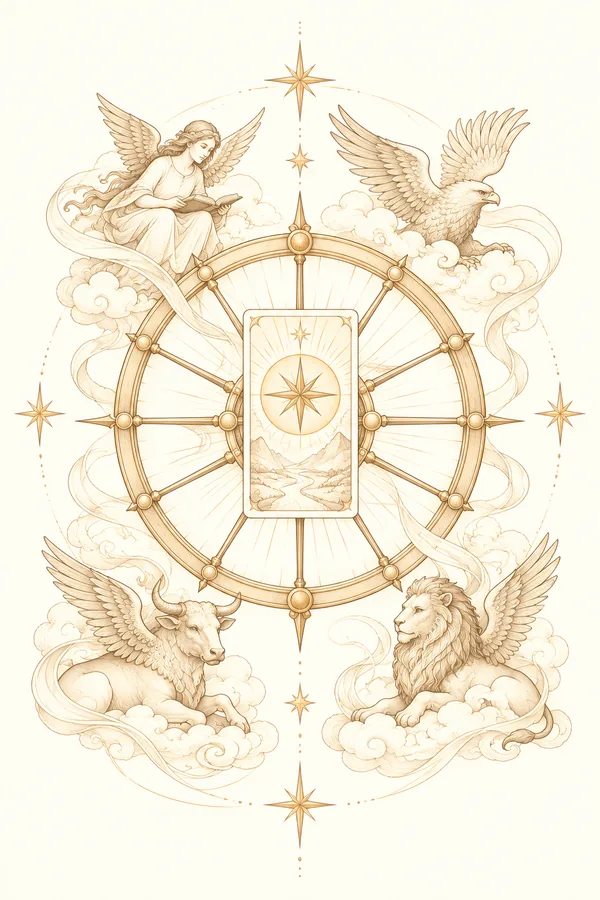
The Wheel of Fortune is card X in the Major Arcana, the halfway point of the tarot’s twenty-two-card journey and its most direct meditation on change. Where other cards describe events or people, the Wheel describes the conditions under which everything else happens: cycles turning, seasons shifting, circumstances rearranging themselves whether or not we agreed to it.
That is precisely why “change” is the meaning seekers most often ask about with this card. When the Wheel appears in a reading, people want to know what is about to move, how fast, and whether they have any say in it. The card’s answer is nuanced. It is a lesson in timing and control—distinguishing what turns without our permission, like luck, timing, and the broader cycles of life, from what remains within our steer: our responses, our preparation, and our willingness to move with the turn rather than against it.
This guide offers a practical walkthrough of the Wheel of Fortune’s meaning, framed specifically around change. We will cover the card’s symbolism, its upright and reversed expressions, applications in love and career, yes/no and timing guidance, and how it interacts with other cards in a spread—so that when the Wheel shows up, you can read its motion with clarity rather than resignation.
The Wheel at a Glance: Keywords, Number, and Ruling Planet
Keywords: cycles · fate · luck · turning points · karma · timing · destiny · ups and downs
Number: 10
Ruling planet: Jupiter
The Essentials for Beginners
The Wheel of Fortune is card 10 of the Major Arcana, and it sits at the heart of the deck’s message about change. Its keywords—cycles, fate, luck, turning points, karma, and timing—all point to the same idea: life moves in rhythms you don’t fully control, and what goes down will come back up again.
Why the Number 10 Matters
Ten marks the completion of one cycle and the start of the next—think of a clock reaching the top of the hour and beginning again. Because 10 reduces to 1 (1 + 0 = 1), the Wheel carries the energy of fresh starts hidden inside every ending. When this card appears, a chapter is closing and a new one is already turning into view.
Jupiter’s Role
The Wheel is ruled by Jupiter, the planet of expansion, fortune, and bigger-picture perspective. Jupiter reminds you that the Wheel’s changes aren’t random chaos—they’re opportunities to grow. The card asks you to trust the turn, stay flexible, and ride the cycle rather than resist it.
Fortuna to Fate: A Brief History of the Turning Wheel
The Wheel of Fortune is one of the oldest images in the tarot, and its roots run deeper than the deck itself. In Roman religion, Fortuna was a goddess of chance, plenty, and the turning year. Over time her symbol became a great wheel: turn it one way and a figure rises; turn it again and that same figure is crushed beneath the rim.
The Medieval Wheel
Medieval Europe kept the image alive. Manuscripts and church carvings show kings and beggars strapped to a rotating wheel, inscribed with words like regnabo (I shall reign), regno (I reign), regnavi (I have reigned), and sum sine regno (I am without a kingdom). The message was moral, not mystical: fortune is temporary, and no position — high or low — is permanent.
Enter the Tarot
When the wheel entered tarot in 15th-century Italy, it carried this medieval baggage. The Visconti-Sforza and Marseille decks show a wheel with figures rising and falling, plus a crowned sphinx or creature at the top. In 1909, Pamela Colman Smith’s Rider-Waite-Smith design standardized the scene: a sphinx above, a snake descending on the left, and Anubis rising on the right — symbols of wisdom, fall, and ascent around one turning circle.
Why Luck Is Only Part of the Meaning
The wheel of fortune tarot card meaning is often reduced to luck, but the history says otherwise. As a card of change, it teaches what Fortuna’s wheel always taught: cycles turn, circumstances shift, and the only constant is the turning itself. That is why the card feels ancient — and why it asks us not just to be lucky, but to read the wheel honestly.
Reading the Rider-Waite Image: Symbolism of Change
What You See
At the center, a great wheel turns, inscribed with the letters TARO (or ROTA), the alchemical symbols for mercury, sulfur, water, and salt, and the Hebrew letters of the divine name. At the top sits a sphinx holding the sword of balance and discernment; on one side, a snake (Typhon) descends; on the other, Anubis rises. In the four corners, winged creatures—an angel, an eagle, a bull, and a lion—read open books.
What It Means
The wheel is the card’s lesson in change. As it rises and falls, each figure teaches a stage of awareness: the descending snake shows the fall and loss that precedes renewal; the rising Anubis shows recovery and ascent; the sphinx above holds the steady, balanced center from which to observe both. The alchemical symbols mark these shifts as natural transformations rather than catastrophes. The four winged creatures—stable, reading, watchful—show the elements held constant amid the turning.
For beginners: this card asks you to notice which part of the wheel you are on and to meet change with discernment rather than resistance. Rise and fall are cyclical; awareness is your only fixed point.
Upright Wheel of Fortune: When the Wheel Turns in Your Favor
When the Wheel of Fortune appears upright, the keyword is change—but not the chaotic, random kind. This card signals movement, momentum, and events already set in motion beyond your conscious control. Something is shifting, and the shift carries its own logic. Change here is typically positive or necessary: an opening door, a stroke of luck, a turning point that redirects your path even if you didn’t choose it.
Reading the Turning Point
The Wheel reminds you that fortune moves in cycles. What was stuck begins to turn; what was closed begins to open. This isn’t passivity—it’s timing. Notice where momentum is already building in your life: a conversation that suddenly advances, an opportunity that appears without effort, a circumstance that resolves on its own. These are the Wheel’s turning spokes.
Acting With the Cycle
Your task is not to force the outcome but to cooperate with it. Say yes to the door that opens. Position yourself where opportunity can find you. Resisting the turn wastes the moment; moving with it multiplies your luck. Ask yourself: what is changing right now, and how can I align with it rather than brace against it? The upright Wheel of Fortune asks for trust in the process and readiness to act when your moment arrives.
Reversed Wheel of Fortune: Resistance, Setbacks, and Bad Timing
When the Wheel of Fortune appears reversed in a reading about change, the card points to friction rather than flow. Instead of riding the turning cycle, you may be digging in your heels—resisting a shift you sense is inevitable, or feeling stuck in a downturn that seems to have no exit. This is the card of “why now?” and “why me?,” where luck feels unfair and progress stalls.
Resistance and the Blame Game
A key reversed Wheel of Fortune meaning around change is misplaced responsibility. It’s easy to blame fate, bad luck, or other people when outcomes falter—but the card often asks you to look at where your own choices are holding the cycle in place. Are you avoiding a decision? Clinging to a situation that has already turned? Resistance itself can become the setback.
Bad Timing vs. Bad Luck
Not everything is in your control, and the reversed Wheel acknowledges genuine bad timing: external circumstances, delays, and recurring patterns that keep repeating until the underlying lesson is addressed. The nuance matters—sometimes the wheel is simply slow, not broken.
Patience or Passivity?
Practical guidance starts with naming what you’re resisting. Ask: What change am I refusing to accept, and what would happen if I stopped fighting it? Then distinguish patience from passivity. Patience actively prepares for the next turn; passivity waits for luck to fix things. Shift what you can influence—your response, your timing, your next step—and let the wheel turn.
Love and Relationships: Upright and Reversed
When the Wheel of Fortune turns up in a love reading, the keyword is change—but the card describes the movement of the relationship landscape, not a fixed outcome. How that change unfolds depends on orientation.
Upright
Upright, the Wheel points to fateful meetings and turning points. A chance encounter can become something significant, or an existing relationship may enter a new phase—an engagement, moving in together, or a reconciliation that finally moves forward. Long-term cycles that once stalled begin to turn. The message is momentum: what has been in flux is finding its direction.
Reversed
Reversed, the Wheel often shows on-again-off-again dynamics, timing mismatches, and patterns that repeat until they are addressed. Love may feel like a loop—the same argument, the same distance, the same almost. The card asks you to notice the cycle and choose whether to break it or keep spinning.
A Note on Reading This Card
The Wheel of Fortune is not a guarantee of a specific person. It signals change in the relationship landscape, not a promise that a particular someone is “meant to be.” Read it as an invitation to move with the turning—and to stay clear-eyed about what you actually want.
Career and Money: Upright and Reversed
The Wheel of Fortune tarot card meaning centers on change—cycles turning, luck shifting, and momentum arriving from beyond your planning. In career and money readings, that change is rarely subtle.
Upright: Opportunity on the Move
Upright, the Wheel signals sudden opportunities: a promotion, a market turn in your favor, or a career pivot that gathers momentum quickly. The change may not come from your effort alone—being in the right place at the right time is part of the card’s message. Readiness matters more than control. Grounded action: refresh your resume, skills, or network now so you can move decisively when the opening appears.
Reversed: When the Cycle Turns Against You
Reversed, the Wheel points to layoffs, delayed offers, financial swings, or the sense of being at the mercy of forces outside your control. The card doesn’t promise disaster, but it does counsel against forcing outcomes mid-downturn. Grounded action: review your finances—budget, savings, and obligations—and wait out the cycle with a clear head rather than making panic moves.
In both positions, the Wheel of Fortune tarot card meaning asks you to respond to change with preparation and steadiness, not resistance.
Yes or No? Pulling the Wheel for a Direct Answer
When the Wheel of Fortune appears in a yes-or-no reading, it rarely delivers the flat, unambiguous verdict queriers hope for. This is one of the most context-dependent cards in the deck, because its core message is change—and change itself is neither a yes nor a no until you know what is turning.
Upright: Leaning Yes
Upright, the Wheel generally leans yes, especially when your question involves timing, cycles, or an opportunity that depends on external factors lining up. The card signals momentum: the wheel is moving, and conditions are shifting in your favor. Trust the yes most when you asked something like “Will this opportunity come around?” or “Is now a good time to act?”—questions where the turning of events is the point.
Reversed: Not Now, or Unclear
Reversed, the Wheel leans not now rather than a hard no. Something is stalled, out of sync, or working against your timing. The answer you want may still arrive—just not on your schedule. Treat reversed as uncertain or delayed, not as a permanent refusal.
When to Trust It—and When Not To
Trust the upright yes when the outcome genuinely depends on forces beyond your control. Treat the answer as effectively no when you are asking the Wheel to guarantee something you must build yourself; this card describes change, not effort.
For important questions, pair the Wheel with a clarifier—the Ace of Pentacles for a concrete yes, or the Four of Swords for a wait. That combination turns a slippery card into a usable answer.
Timing and One-Card Readings with the Wheel
When the Wheel of Fortune appears in a timing question, it rarely points to a distant date. This is a card of motion—quick turns, cyclical returns, and events anchored to seasons or repeat anniversaries. “Soon” with the Wheel often means when the cycle completes, so look for turning points already in motion: a fiscal quarter closing, a birthday, the same week something happened last year. If the Wheel shows up in a one-card pull, its frequent appearance during periods of transition is itself the message—you are mid-turn, not stalled.
A Three-Step One-Card Reading
- Identify the cycle. Ask: what is repeating, ending, or coming back around? Name the pattern the Wheel is spinning.
- Name the shift. Is the turn upward, downward, or neutral? The Wheel changes conditions, not character—describe what is moving.
- Decide one response. Choose a single action that works with the turn: prepare, release, or ride it.
Change with the Wheel of Fortune tarot card meaning is rarely random; it is rhythmic. Read it as a timing signal and a prompt to act at the hinge of the cycle.
Card Combinations: How Partners Reshape the Message
The Wheel of Fortune rarely speaks alone. Its core message—change, cycles, turning points—gains precision from the cards beside it. With The Tower, the Wheel’s change turns abrupt: what looked like gradual rotation becomes upheaval, a sudden reset you didn’t schedule. With Justice, the emphasis shifts to karmic rebalancing—change arrives as a fair outcome, cause meeting effect. Beside The Lovers, the Wheel signals fated relationship choices; the turn is relational, asking you to choose consciously. With The World, the cycle completes successfully—change lands as arrival, not disruption.
A Worked Example
Consider a three-card spread: Wheel of Fortune, Justice, The Tower. Read as keyword stacking, this is chaos plus fairness plus collapse. Read as synthesis, it tells a story: a turning point (Wheel) brings a reckoning (Justice) that arrives as sudden upheaval (Tower). The change isn’t random—it’s corrective. Something owed is being settled, and the settlement will feel disruptive even though it’s fair. The Tower here isn’t disaster; it’s the mechanism of rebalancing.
Note how each partner reshaped the message. Justice tempered the Wheel from “fate” to “accountability,” while the Tower converted that accountability into immediate, unavoidable action. The reading’s advice: don’t resist the turn—the structure coming down was already unbalanced. That’s how the Wheel of Fortune’s meaning of change stays specific: partners don’t decorate the card, they redefine it.
Deal Comparison and Practical Uses: RWS, Marseille, Thoth, and Modern Decks
How the Decks Differ on Change
In Rider-Waite-Smith, the wheel of fortune tarot card meaning change centers on turning cycles: the sphinx, snake, and Anubis figure mark rise, fall, and renewal, so change arrives as a season you can name. Marseille treats the wheel more structurally—a bare diagram of fate’s mechanics—emphasizing that fortune turns by rule, not mood. Thoth reframes it as cosmic intelligence: change is not luck but an ordered process you can align with.
Practical Uses
Journal the cycles you notice—when the card appears, note what’s ending, peaking, or beginning. Track recurrences across readings as recurring themes, not predictions. Use the card as a prompt for acceptance and adaptation: ask, “What am I clinging to that the wheel is already moving?”
FAQ
Is a recurring Wheel a sign? It usually highlights an ongoing transition—worth journaling, not fearing. Warning or positive? Neither; it’s neutral motion. The surrounding cards and your response set the tone.
Learning to move with the wheel turns change from something that happens to you into something you navigate.
Recommended tool
Explore the Arcana
Browse the 22 Major Arcana and their meanings.
Keep reading
More on Individual Cards
October 14, 2026
Wheel of Fortune Tarot Timing: Cycles & Change
When will it happen? Learn Wheel of Fortune tarot timing: upright and reversed timeframes, spreads, astrology, and honest windows.
Read the article
October 28, 2026
The Emperor Tarot Card Meaning in Career
The Emperor at work: leadership, contracts and structure, what the reversal exposes about micromanagement, and how to read him in a job or business spread.
Read the article
October 28, 2026
The Hermit Tarot Card Meaning: Solitude, Not Loneliness
The Hermit as chosen retreat: how to tell solitude from isolation, what he says about love and distance, and the signs isolation has gone too far.
Read the article