October 26, 2026
Tarot Reversals and Yes or No Answers
Do reversed cards mean no? How three schools of thought answer that, which cards still lean yes, and a four-step method that keeps verdicts consistent.
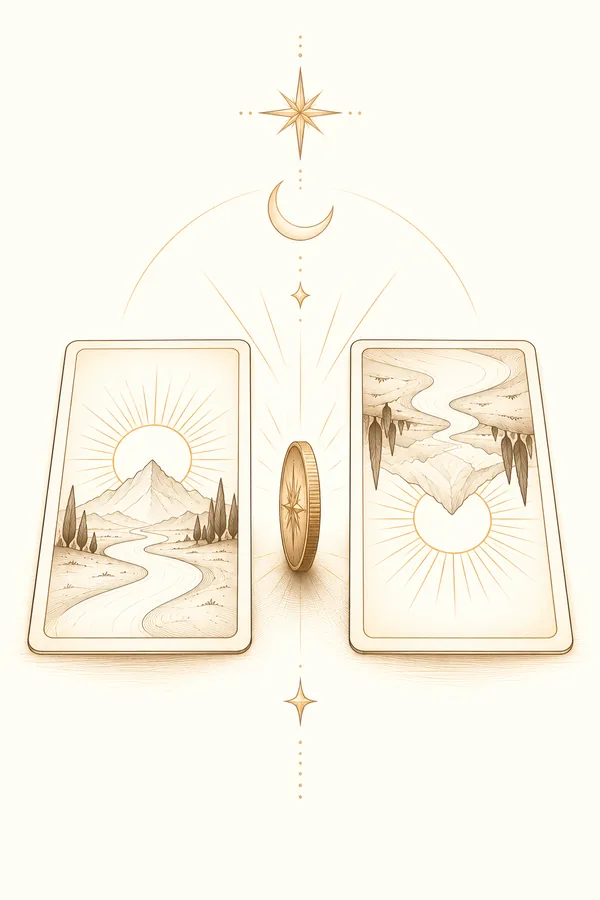
Does a reversed tarot card mean yes, no, or something else entirely? This is one of the first questions beginners ask once they start working with reversals, and it is also one of the hardest to answer simply. In a standard yes/no reading, an upright card usually leans toward yes and a reversal toward no—but that shortcut breaks down quickly, because the meaning of a reversed card depends on the context of the question, the phrasing you or your querent used, and the reading style you follow.
Some readers treat reversals as a firm “no” or a delay, others read them as blocked energy, internal work, or a softened version of the upright card, and still others avoid reversals in yes/no spreads altogether. None of these approaches is wrong; what matters is applying one consistently so your answers stay clear and trustworthy.
This outline covers the ongoing debate over reversals in yes/no readings, card-by-card guidance for the most common reversed cards, and a set of practical rules beginners can apply immediately—so you can stop guessing and start reading reversals with confidence.
Why Reversals Break the Simple Yes/No Formula
The tidy rule sounds satisfying: upright cards mean yes, reversed cards mean no. Ask the cards a question, flip a card, get an answer. But in real readings, this shortcut collapses almost immediately.
Consider a reversed Sun. If reversals automatically meant no, this card would read as flat refusal—yet a reversed Sun often signals delayed joy, dimmed enthusiasm, or a yes that arrives late. It still leans yes. The same holds for a reversed Ace: the potential isn’t blocked, just not yet in motion, which is a softer yes or a not-yet rather than a no. Meanwhile, a reversed Tower can actually ease a no—the upheaval is muted, the collapse averted, and the answer may shift toward “less bad than feared” rather than a hard negative.
The Question Changes the Weight
Phrasing matters just as much. “Will it happen?” is a predictive question, so reversals often signal delay, internal blocks, or conditions unmet—answers that blur the yes/no line. “Should I?” is a question of counsel, so a reversal tends to flag caution, misalignment, or a reason to pause rather than a flat prohibition.
In practice, a reversed card is best read as a modifier—an adverb, not a verdict. It adjusts timing, intensity, and internal readiness rather than flipping a binary switch.
The Three Schools of Thought on Reversed Yes/No Answers
When a reversed card lands in a yes/no spread, readers disagree about what that reversal actually does to the vote. Most approaches fall into three schools.
Strict Polarity
Here, an upright card votes yes or no by its nature, and the reversal simply flips it. If the Two of Cups upright is a clear yes, reversed it becomes a firm no. It is the simplest system and easy to apply consistently, though critics say it flattens the nuance reversals are meant to provide.
Softened Polarity
This school keeps the card’s basic vote but weakens or qualifies it. A reversed Two of Cups might mean “yes, but not yet,” “a hesitant yes,” or “yes, provided the connection is repaired.” Readers who use this approach treat reversals as modifiers of timing, confidence, or conditions rather than an outright negation.
Independent Meaning
The third school ignores the yes/no frame for reversals entirely. Instead, the reversal changes the card’s energy and story, and the querent reads the answer from that altered meaning. A reversed Two of Cups here points to imbalance or miscommunication in a partnership—neither a yes nor a no in itself, but a picture of what stands in the way.
Whichever school you follow, consistency matters more than the system itself.
The Four Core Ways to Read a Reversed Card
When it comes to tarot card reversals and yes/no meaning, the real problem isn’t that reversed cards are mysterious—it’s that readers mix methods mid-spread. The solution is to pick one of four core interpretations and apply it consistently to every reversal in the reading.
Blocked or Diminished Energy
The card’s upright yes-energy is obstructed or weakened. In a yes/no verdict, this usually reads as no for now—the outcome isn’t denied, just not currently flowing.
Internalized Energy
The card’s meaning turns inward: private work, unspoken feelings, an answer you already hold. For yes/no questions, this often reads as no external yes yet—read it as “the answer lives with you, not the situation.”
Excess or Shadow Expression
The card’s energy is overdone or distorted. In yes/no terms, this typically reads as no as framed—the thing you’re asking about may be present in an unhealthy or exaggerated form.
Delay or “Not Yet”
The card’s message is genuine but timing is off. The verdict: yes, but later—a conditional green light rather than a refusal.
Choose your lane. If you read reversals as blocked energy, read every reversal that way across the spread; don’t switch to “delay” because it suits one card. Consistency is what makes reversed-card yes/no readings reliable rather than arbitrary.
Reversed Cards That Usually Still Mean Yes
Not every reversal flips a yes into a no. Some cards carry so much inherent momentum that, reversed, they read as a softened yes — “yes, with conditions” or “yes, with a delay.” Blanket-flipping these to no is one of the most common reversal misreads.
The Cards and Why They Bend Rather Than Break
The Sun (reversed): In Rider-Waite, the child rides beneath a blazing sun. Reversed, the clarity dims but does not vanish — the answer is yes, perhaps with less fanfare or a postponed timeline.
The Star (reversed): The figure pours water under a starry sky. Reversed, hope is internalized rather than lost; the yes is quiet and requires self-trust.
Ace of Wands (reversed): The hand offers a sprouting wand. Reversed, the spark is delayed or blocked, not extinguished — yes, once momentum returns.
The Lovers (reversed): The angel blesses the pair. Reversed, misalignment, not refusal — yes, contingent on honest communication.
The World (reversed): The dancer nears completion. Reversed, the final loop is unfinished — yes, almost there.
How to Read Them
Treat these reversals as conditional or delayed affirmatives: yes, if you address the friction. Reserve outright no for cards whose energy genuinely inverts.
Reversed Cards That Usually Lean No
When you ask a yes or no question and a card appears reversed, the answer often depends on whether the reversal shows blocked energy or simply delayed timing. Some reversals, however, consistently lean toward no—or at least “not right now.” These cards share a common thread: resistance, misalignment, or energy that is not yet moving in your favor.
The Reversals That Point to No
- The Emperor reversed signals instability and weak structure. Without a firm foundation, a yes is not supportable.
- The Chariot reversed shows loss of control and scattered will. When you cannot steer the outcome, the answer leans no.
- The Eight of Cups reversed reflects fear of leaving a situation you have already outgrown. Staying out of fear is not a true yes.
- The Four of Pentacles reversed warns of releasing your grip on something you should still hold. Letting go prematurely invites loss.
- The Hierophant reversed suggests breaking from guidance you still need. Rebellion without readiness rarely ends well.
The Common Thread
Each of these reversals reveals energy that is stuck, misdirected, or prematurely forced. They are not permanent no’s, but they indicate the conditions for a yes are not yet in place. When one of these appears in a yes or no reading, treat it as a signal to pause, reassess, and address the resistance before moving forward.
Major Arcana Reversals in a Yes/No Reading
Major Arcana reversals carry extra weight in a yes/no reading because the Majors speak to life lessons rather than passing circumstances. When one appears reversed, a flat “no” is rarely the whole answer. More often, the cards say: the outcome is available, but the timing or the inner work is the real answer. Treat a reversed Major as a conditional yes/no — the condition being what the card shows you.
Two Anchors from the Rider-Waite Deck
Wheel of Fortune reversed — yes, but outside your control. The great wheel with its sphinx and turning figures reminds you that cycles move whether or not you are ready. Reversed, this is a qualified yes: the change you ask about can happen, but you cannot force its timing. The honest answer is “yes, when the wheel turns” — so release your grip on how and when.
Justice reversed — no until fairness is restored. Justice sits with scales and an upright sword; reversed, the scales tip and the sword wavers. This is a firm no at present, not because the wish is wrong, but because a balance — a contract, a truth, an unequal exchange — must be corrected first. Correct it, and the question can be asked again.
Reversed Majors rarely deny; they redirect.
Suit-by-Suit Rules: Wands and Cups Reversals
When a reversal appears in a yes or no reading, the suit tells you where to look before you interpret the card itself. Wands and Cups carry two different verdicts.
Wands Reversed: “Not Yet” or “No Without Change”
Wands govern action, drive, and momentum. Reversed, they usually signal stalled energy or waning passion. The default answer leans toward not yet, or a no that becomes a yes only if motivation shifts. Ask: is the querent actually willing to act, or just wishing?
Example: Page of Wands reversed — the idea is there, but the follow-through isn’t. Treat it as “not yet, enthusiasm needs reviving,” not a permanent no.
Cups Reversed: “Yes, Once the Emotional Undertow Is Addressed”
Cups govern feeling and connection. Reversed, they point to emotional blocks, avoidance, or disconnection. A yes about love often becomes yes, once you address the emotional undertow — the block, not the desire, is the obstacle.
Example: Two of Cups reversed — the bond exists but is strained or unbalanced. Read it as conditional: repair the disconnect and the yes returns.
The Quick Rule
Wands reversed: check the action. Cups reversed: check the feeling. In both, the reversal rarely means a flat no — it means the yes has a condition.
Suit-by-Suit Rules: Swords and Pentacles Reversals
When a reversed card appears in a yes or no reading, the suit tells you how to weigh the answer. Swords and Pentacles are the two most grounded suits — and the two most likely to turn a yes or no verdict into a “yes, but” or a “no, unless.”
Swords Reversals: The Mind Under Pressure
Swords govern thought, communication, and conflict, so reversals here often point to mental confusion, self-deception, or anxiety that is finally being released. That duality shapes the verdict:
- Relief and clarity returning — a reversed Swords card can signal that worry is lifting, which leans yes.
- Poor judgment or muddled thinking — when the card reflects confusion or avoidance, the honest answer is no, or at least “not until you see the situation clearly.”
Ask yourself: is the querent thinking straight, or talking themselves into something?
Pentacles Reversals: The Material Check
Pentacles govern money, work, and physical security. Reversals tend to flag financial or material instability, so practical questions — “Will I get the job?” “Should I buy this?” — lean conditional. The answer is usually “yes, if the foundations hold” or “no, not in this form.”
How the Elements Shape the Tone
Swords verdicts come with a mental edge: fast, sharp, and clarity-dependent. Pentacles verdicts are slower and cautious, tied to tangible outcomes. Same reversal, different question — let the element set the tone.
Court Card Reversals: When the No Is a Person
In yes or no readings, a reversed court card rarely delivers a flat no. More often, it names a person whose behavior is working against the situation — or a distorted role you are playing yourself.
Reading the Card as a Person
A reversed King of Pentacles can point to a hoarding boss who blocks your raise; a reversed Queen of Cups, to emotional manipulation dressed as care. The no is not the situation’s verdict but someone’s interference.
Person, Trait, or Verdict?
Check the surrounding cards. Court cards clustered together suggest other people; cards describing your own state (Nine of Swords, Hermit) suggest your distorted role; a clear yes/no card beside the reversal clarifies the verdict. Ask: does this card mirror someone in the situation, or a pattern I am enacting?
The Final Answer
When a reversed court card appears, treat the no as conditional — it means “not while this person or behavior is in play.” Name the dynamic, adjust the role or boundary, and the answer can change.
Question Phrasing That Makes Reversals Easier to Judge
Reversals complicate yes/no readings most when the question itself is vague. A well-phrased question turns a reversal into a clear signal rather than a muddle.
Ask About Your Best Interest, Not Someone Else’s Actions
“Is it in my best interest to reach out?” reads far more cleanly through a reversal than “Will he text me?” The first gives the reversal a job: it means no, and often specifically that pursuing the matter isn’t the right use of your energy right now. The second leaves you guessing whether a reversed card means “no,” “not yet,” or “he’s blocked.”
Avoid Compound Questions
“Will I get the job and will I like it?” has two possible outcomes and one card can’t hold both. Split it into separate readings so a reversal points to one thing.
Good phrasings:
- “Is it in my best interest to accept this offer?”
- “Should I bring this up with them now?”
- “Is now the right time to launch this?”
Why “Should” Beats “Will”
“Will” questions invite a fate-based yes/no, and a reversal just flips to “no.” “Should” questions carry agency, so a reversal reads gracefully as guidance to pause, reconsider, or wait rather than a flat refusal.
Add a Timeframe
“Will this resolve by spring?” sharpens a “not yet” reversal into something you can act on: hold off, prepare, revisit in a set number of weeks.
Using Spreads to Weigh Reversed Yes/No Cards
A reversed card in a yes/no reading isn’t an automatic no—its verdict depends on where it lands. Position is the deciding factor.
One-Card Pull
If your single card is reversed, treat the answer as a qualified no: not a hard refusal but a “not yet” or “not as asked.” Follow up with a second pull asking what would shift it toward yes.
Three-Card Spreads
In a past/present/future spread, a reversal in the past suggests an old block has been cleared, softening the verdict; in the future, it warns that the answer may turn negative unless something changes. With a yes/no/clarifier spread, judge the yes/no position first, then let a reversed clarifier explain why the answer leans as it does.
Turn a Reversal Into Information
Assign one position specifically to “what’s blocking this.” A reversal there reframes the no as diagnostic rather than final—name the obstacle, and the reading tells you what to work with.
Weigh the Whole Spread
Multiple reversals tilt the overall answer toward caution even when one card stands upright—the upright card is a single opening, the reversals the surrounding weather. Read the balance of the spread, not the loudest card.
When Most or All of Your Cards Come Out Reversed
You ask a clean yes-or-no question, lay out three cards, and every single one lands upside down. Before you conclude the universe has voted “no” on your entire life, take a breath. A heavily reversed spread is rarely blanket doom. In yes-or-no readings, mass reversals usually point to one of three things: the answer lives in internal work rather than external events, the situation is genuinely blocked or stalled, or you aren’t fully ready to hear a straight answer yet.
Practical Steps Before You Panic
- Check your deck. If you don’t intentionally shuffle reversals in, a wall of upside-down cards may just mean your deck got flipped in the bag. Sort it upright and reshuffle.
- Re-shuffle once. One honest re-shuffle is fine. Repeated re-shuffling until you get the answer you want is not reading—it’s negotiating.
- Read the dominant reversal as the theme. When most cards reverse, treat reversal itself as the message: the yes-or-no energy is turned inward, delayed, or unresolved.
The Five-Reversal Rule
If five or more cards come out reversed, pause. Don’t force a yes or no. Reframe the question from “Will this happen?” to “What am I not seeing?” or “What needs to shift first?” A mass reversal is an invitation to slow down—not a verdict.
Common Beginner Mistakes with Reversed Yes/No Readings
Reversed cards in yes/no readings trip up almost every beginner. The good news: these mistakes are easy to spot—and easy to fix.
Treating every reversal as “no”
This is the most common trap. A reversal isn’t an automatic negative; it often signals delay, internal blocks, or a “not yet.” In yes/no terms, that might mean “yes, but conditions apply” rather than a flat no. Check the card and the question before deciding.
Ignoring the question’s context
“Is he right for me?” and “Will I get the job?” call for different reversed readings. A reversed Three of Cups may mean “no” to a casual fling but “not now” to a friendship question. Context shapes the answer.
Mixing reading methods mid-spread
If you started with upright-means-yes, don’t switch to counting reversals as no halfway through. Pick one method and stay consistent—changing rules mid-reading produces answers you can’t trust.
Fearing a reversed Death or Tower
These cards look scary upright, but reversed they often ease their severity—resisted change rather than upheaval. Don’t read panic into a card that’s asking for gentleness.
Pulling endless clarifiers
When the answer isn’t what you wanted, drawing “just one more card” to force a yes/no backfires. It muddies the reading and feeds anxiety. Trust your first interpretation; if you’re truly stuck, pause and return later.
A Simple Four-Step Method for Reversed Yes/No Answers
Reversed cards make yes/no readings feel murky, but a repeatable process removes the guesswork. Use these four steps for every reversed yes/no pull.
Step 1: Establish the upright lean
Before interpreting the reversal, note the card’s baseline. The Sun upright is a clear yes; the Five of Pentacles is a no. This anchors the reading.
Step 2: Apply your reversal method
Decide in advance what reversals mean for you—delayed yes, softened no, blocked energy, or internalized answer. Consistency is what makes reversals readable.
Step 3: Factor in position and context
Check the card’s position and neighbouring cards. A reversed “yes” card beside the Ten of Swords tilts negative; the same card beside the Ace of Cups tilts hopeful.
Step 4: State the answer with its condition
Deliver a verdict plus a caveat: “Yes, but only if…” or “No, not yet—wait until…”
Worked example: Two of Wands reversed for “Should I take the job offer?”
Upright, the Two of Wands leans yes—planning, vision, bold choices. Reversed (using the “delayed/blocked” method), the energy stalls. Suppose it sits in the “obstacle” position beside the Four of Pentacles: the blockage is caution, not the offer itself. Verdict: Yes, conditionally—clarify the role’s growth path and salary before committing. Write this down with the date. Over months, your log will reveal whether your reversed yes/no calls run optimistic or cautious, and your readings will sharpen accordingly.
Quick Reference: Reversed Yes/No Cheat Sheet
A quick snapshot of how reversed cards typically lean in yes/no readings. Treat it as a starting point — context and intuition always outrank a list.
Major Arcana
- Fool: Not yet — pause before leaping.
- Magician: Yes, with conditions — prepare first.
- High Priestess: Not yet — the answer is hidden.
- Empress: Yes, with conditions — nurture it.
- Emperor: Soft no — structure is missing.
- Hierophant: Soft no — rethink the rules.
- Lovers: Soft no — misalignment.
- Chariot: Not yet — stalled momentum.
- Strength: Yes, with conditions — patience required.
- Hermit: Not yet — go inward first.
- Wheel of Fortune: Not yet — timing is off.
- Justice: Soft no — imbalance unresolved.
- Hanged Man: Not yet — surrender and wait.
- Death: Soft no — let it end.
- Temperance: Yes, with conditions — adjust the mix.
- Devil: Soft no — attachment clouds it.
- Tower: Soft no — not on this foundation.
- Star: Yes, with conditions — hope, but slowly.
- Moon: Not yet — too much confusion.
- Sun: Yes, with conditions — delayed shine.
- Judgment: Not yet — answer the inner call first.
- World: Yes, with conditions — one loose end remains.
Wands
- Ace: Not yet — spark needs fuel.
- Two: Not yet — plans unsettled.
- Three: Not yet — expansion delayed.
- Four: Yes, with conditions — home base unstable.
- Five: Soft no — conflict unresolved.
- Six: Yes, with conditions — recognition withheld.
- Seven: Soft no — defenses failing.
- Eight: Not yet — delays.
- Nine: Soft no — exhaustion speaks.
- Ten: Soft no — drop the burden.
- Page: Not yet — enthusiasm untested.
- Knight: Not yet — haste misdirects.
- Queen: Yes, with conditions — confidence wavering.
- King: Soft no — leadership unclear.
Cups
- Ace: Not yet — feelings unopened.
- Two: Soft no — mismatch.
- Three: Yes, with conditions — circle shifting.
- Four: Not yet — apathy blocks it.
- Five: Soft no — grief distorts.
- Six: Yes, with conditions — nostalgia, not reality.
- Seven: Not yet — too many options.
- Eight: Soft no — ready to walk away.
- Nine: Yes, with conditions — wish not fully earned.
- Ten: Soft no — harmony incomplete.
- Page: Not yet — message delayed.
- Knight: Not yet — fantasy over substance.
- Queen: Yes, with conditions — boundaries needed.
- King: Soft no — emotions unmanaged.
Swords
- Ace: Not yet — clarity missing.
- Two: Not yet — stalemate.
- Three: Soft no — pain skews judgment.
- Four: Not yet — rest first.
- Five: Soft no — win isn’t worth it.
- Six: Yes, with conditions — transition incomplete.
- Seven: Soft no — deception present.
- Eight: Soft no — you’re not trapped, but it feels so.
- Nine: Soft no — anxiety answers, not truth.
- Ten: Soft no — worst is passing; don’t decide now.
- Page: Not yet — facts unverified.
- Knight: Not yet — recklessness.
- Queen: Yes, with conditions — clarity returning.
- King: Soft no — rigidity blocks.
Pentacles
- Ace: Not yet — seed unplanted.
- Two: Not yet — juggling.
- Three: Yes, with conditions — teamwork shaky.
- Four: Soft no — hoarding blocks flow.
- Five: Soft no — scarcity mindset.
- Six: Yes, with conditions — strings attached.
- Seven: Not yet — harvest unclear.
- Eight: Yes, with conditions — keep working.
- Nine: Yes, with conditions — independence at risk.
- Ten: Soft no — foundation unstable.
- Page: Not yet — study more.
- Knight: Not yet — routine stalled.
- Queen: Yes, with conditions — self-care first.
- King: Soft no — resources mismanaged.
Reminder: Use this as a starting point, not a substitute for context and intuition.
Frequently Asked Questions About Reversed Yes/No Tarot
Does a reversed card always mean no?
No. A reversal usually signals delay, blockage, or an inward-facing version of the card’s energy, not a flat negative — so a reversed positive card can read as “yes, but not yet.” Treat reversals as modifiers of the answer rather than an automatic “no” verdict.
What if I don’t read reversals — can I still do yes/no?
Yes. Many readers shuffle so cards land upright, or simply note reversed cards and interpret them by their upright meaning with a caveat about timing. Your yes/no method should match the system you actually read with, so consistency matters more than whether reversals appear.
Can a reversed Tower be a good sign?
Yes, in a specific sense. A reversed Tower often means a crisis is averted, delayed, or happening internally rather than through external upheaval, which can be a gentler “no” to disaster. It’s rarely a cheerful yes, but it can be a relief card.
What does it mean if my yes/no card is reversed in a love reading?
It typically softens or complicates the answer: “yes, with conditions,” “not right now,” or “the situation needs addressing first.” Read it as a qualified response and let the surrounding cards clarify whether the obstacle is timing, communication, or readiness.
Recommended tool
New to tarot?
Start with the beginners' cheat sheet and core keywords.
Keep reading
More on Methodology & Guides
October 13, 2026
How to Read Reversed Tarot Cards: Meaning Without Fear
Upside-down cards? Learn how to read reversed tarot cards with five lenses, a 4-step process, and honest limits — no fear required.
Read the article
October 18, 2026
Yes or No Tarot Cards List
All 78 cards sorted into yes, no and maybe: the yes or no tarot cards list, how orientation and suit shift the answer, plus love and career contexts.
Read the article
September 28, 2026
3-Card Spreads
Three cards, one clear question: master the classic Past-Present-Future spread plus five more layouts, and read them as one story.
Read the article