October 26, 2026
How to Interpret Court Cards in a Reading
Court cards can be a person, a mood or a role. Learn the ranks, the suits and the questions that settle which reading applies, without second-guessing.
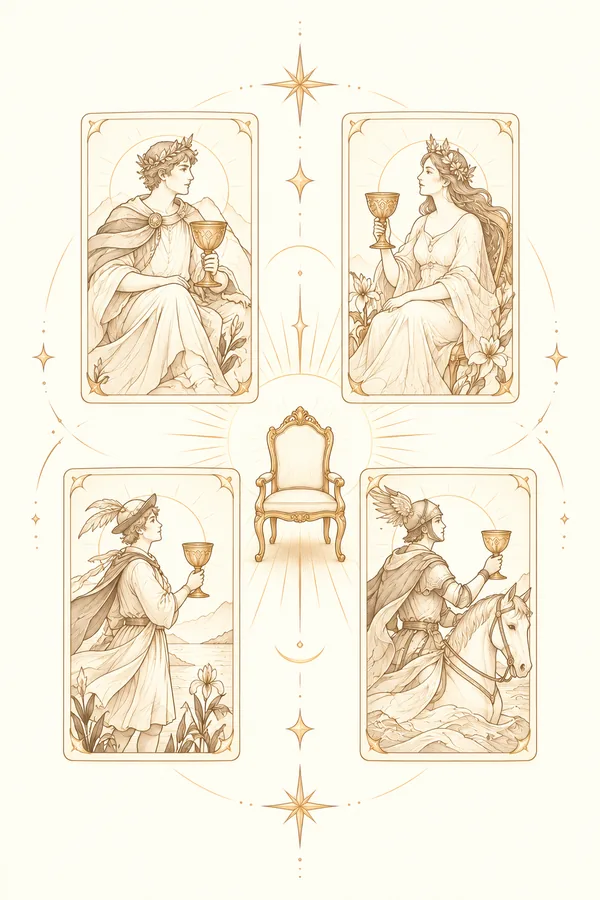
The court cards are the sixteen figures that populate the tarot: the Page, Knight, Queen, and King of each suit—Wands, Cups, Swords, and Pentacles. They are among the most vivid cards in the deck, and among the most confusing to read.
The problem is not a lack of meanings. It is that a court card can plausibly show up as a person in the querent’s life, as a mood or attitude the querent is embodying, or as a course of action being asked of them. Faced with that ambiguity, many readers freeze—or default to “it’s probably a person”—and the reading stalls.
This section offers a repeatable decision process for interpreting court cards, rather than another list of keywords to memorize. You will learn how to use the surrounding cards, the question, and the court card’s own imagery to decide which of the three readings fits, and how to commit to one without second-guessing yourself.
Examples throughout use Rider-Waite-Smith imagery, so beginners can anchor abstractions in pictures: the Page of Pentacles standing in a green field, holding his coin up to the light, or the Queen of Cups on her throne by the sea, gazing at the covered cup in her hands. Once you can read the figure, the role becomes easier to see.
What Are Court Cards and Why They Confuse Readers
Court cards—Page, Knight, Queen, and King in each suit—are the part of the tarot that trips up even experienced readers. The confusion isn’t a gap in your skill; it’s built into the cards themselves.
The Structural Quirk
Courts are the only cards in the deck that depict human figures rather than scenes or symbols. The Minor Arcana show situations you can narrate: a figure carrying cups, a hand releasing coins. The Majors give you archetypal landscapes. A court card gives you a person, a rank, and a suit element compressed into a single image—Page of Cups is simultaneously a rank (beginner), an element (water), and a personality (dreamy, sensitive). Three layers of meaning in one small figure.
The Missing Framework
Most guidebooks list keywords for love, career, and advice—but they skip the question that actually matters: which mode is this card operating in? Is the Queen of Swords you, someone else in the situation, or the situation’s energy itself? Is the Knight of Wands a person arriving, or your own restless momentum? The deck offers fewer narrative clues here, so you have to supply the framework yourself.
That’s the design problem—and the reassurance. Once you learn the modes, courts stop being slippery and start being precise.
The Four Ranks: Pages, Knights, Queens, and Kings
When a court card appears in a reading, read the rank before the suit. Rank tells you how the suit’s element is being expressed—its stage of maturity and mode of power.
Pages: The Student
Pages are students and messengers, meeting their element young and curious but tentatively. The Page of Swords scanning the horizon with his blade raised shows this: alert, eager, not yet seasoned. In a reading, a Page suggests learning, a message, or a beginner’s stance toward the suit’s theme.
Knights: The Pursuer
Knights are the element in motion—all pursuit and momentum. They act, quest, and push forward, sometimes to the point of recklessness. A Knight in a spread points to action, drive, or a situation gathering speed.
Queens and Kings: Inward and Outward Mastery
Queens embody the element inwardly, mastered and expressed through receptivity and nurture. Kings express it outwardly as authority and stewardship. Same mastery, different direction: held within versus wielded in the world.
Not Gendered, but Developmental
These ranks are not gendered. They are developmental stages and modes of power available to anyone. Ask yourself: is the querent learning, pursuing, nurturing—or governing?
The Four Suits: Which Element Each Court Serves
A reliable shortcut for interpreting court cards in readings is to assign each suit its elemental personality type, then let rank refine it. Wands are fire—ambition, charisma, drive. Cups are water—emotion, intuition, relationships. Swords are air—intellect, communication, truth-telling. Pentacles are earth—work, money, the body.
Sixteen One-Line Portraits
- Page of Wands: the eager spark testing its own flame.
- Knight of Wands: the charging risk-taker who acts before checking the map.
- Queen of Wands: the magnetic host who warms a whole room.
- King of Wands: the visionary leader who sets the blaze in motion.
- Page of Cups: the tender dreamer with an open heart.
- Knight of Cups: the romantic messenger led by feeling.
- Queen of Cups: the deeply empathic confidante who reads the emotional weather.
- King of Cups: the calm emotional anchor in choppy waters.
- Page of Swords: the curious questioner who notices everything.
- Knight of Swords: the blunt communicator rushing toward the truth.
- Queen of Swords: the perceptive truth-teller with clear boundaries.
- King of Swords: the cool arbiter of principle.
- Page of Pentacles: the diligent student of practical things.
- Knight of Pentacles: the steady worker who finishes what they start.
- Queen of Pentacles: the nurturing provider of comfort and resources.
- King of Pentacles: the settled steward of resources.
Test these combinations against the art in your own deck—modern decks vary the costumes and props that carry these elemental clues.
Combining Rank and Suit: The Five-Second Court Card Method
Court cards stall readings because they can mean a person, a mood, or a role. The fastest fix is to read each court as a short sentence: [the rank’s mode of operating] + [the suit’s domain]. Say it aloud until it lands.
Rank supplies the how: Page = beginner’s curiosity, Knight = driven pursuit, Queen = inward mastery, King = outward command. Suit supplies the where. Queen of Wands, for example, becomes “inward mastery of fire expressed as confident, magnetic warmth.”
Flexing the Sentence to Context
The same formula bends to the question. Queen of Pentacles in a career spread reads as a manager who develops people; in a budgeting question, it’s a resourceful, self-sustaining mindset; in a family spread, a literal nurturing figure. Keep rank and suit fixed — let the setting choose the noun.
Using Inversions as Diagnostic Data
Reversed or blocked court energy often inverts the rank: a King acting like a Page (authority that fumbles or deflects), a Queen reduced to a Knight’s raw push. Treat this as a flag about how the energy is currently deployed, not a separate keyword system. The sentence stays; only the verb tenses shift.
The Three Ways a Court Card Shows Up: Person, Aspect, or Energy
Court cards cause more confusion than any other part of the deck because they don’t announce which of three jobs they’re doing. When you’re learning how to interpret court cards in readings, the single most useful skill is recognizing the interpretive fork: a court card can be (1) an actual person, (2) an aspect of the querent, or (3) an energy or role the situation is asking for. Test all three before committing.
Quick Tells for Each Reading
A person tends to appear alongside relationship or dynamic cards (Two of Cups, Lovers, court cards facing each other) or in positions explicitly about others—“what does he think,” “who influences this.”
A self-aspect often lands in the querent’s significator position, repeats across a spread, or shows up when the question is deeply personal. It’s a facet of the querent stepping forward—the Page of Swords as their curiosity, the Queen of Cups as their intuition.
An energy or role frequently sits in “advice” or “outcome” positions: the Knight of Wands as be bold, the King of Pentacles as take the steady, responsible path.
Don’t Default to a Description
Resist the lazy “some man with brown hair” reading. Court cards are not a lineup of physical descriptions. Instead, offer the querent all three interpretations and notice which one makes them lean in—recognition is your best diagnostic. “Could this be a person you know, a part of yourself, or a way of acting you’re being invited into?” Their reaction tells you which court card you’re actually reading.
How to Tell Which Meaning Applies in a Spread
Court cards are the great shapeshifters of a reading—a single Page or Queen might be a person, a personality trait, a situation, or an energy you’re being asked to embody. Rather than guessing, use the spread itself to narrow the field.
Read the Position First
Context often answers the question before you do. A court card in “how others see you” is rarely a literal stranger; it’s more likely describing how you come across. In “advice” or “outcome,” lean toward energy or approach. In “relationships” or “external influences,” a person becomes far more plausible.
Check for People Signals
Surrounding cards tell you whether the spread is populated by people. Lovers, Two of Cups, Three of Cups, and clusters of court cards all signal a human-centered reading. A lone court card among Aces and Tens of a suit usually points to an attitude or role rather than an individual.
Look for Repetition
Recurring court cards—within one spread or across recent readings—strengthen a person-or-energy verdict. Repetition is emphasis; note which one keeps appearing.
Ask One Clarifying Question
When still torn, ask aloud: “Is this card a person or an energy?” Draw a single card, or split two—one for person, one for energy—and read which answers more cleanly.
Let the Querent’s Resonance Confirm
Beginners should state their guess plainly: “I think this Queen is your own assertiveness, not someone else.” Then watch for the querent’s recognition. Their resonance, not your certainty, settles the meaning.
Reading the Courts as Specific People
Court cards often represent actual people in a reading—but the card tells you how that person shows up in this situation, not who they are in full. Treat it as behavioral information, not a biography.
Describe behavior, not identity
A King of Cups appearing in a conflict spread describes someone who stays emotionally steady under pressure—calm, diplomatic, maybe a little withholding. That is directly useful: it tells you what to expect from them in this exchange. It does not tell you their hair color, zodiac sign, age, gender, or life story. Keep descriptions to what the card shows about conduct, mood, and stance.
Watch the relational dynamics
Courts also reveal power structures. A Page facing a Queen can flag a mentoring imbalance or a power gap—one party learning, the other holding authority. Note who sits where in the spread and what that implies about the relationship.
Stay behavioral
Use courts to answer “How is this person acting, and what does that mean for me?” Avoid using them to guess physical traits or identities. The value is in the behavior you can work with, not the profile you can invent.
Reading the Courts as Parts of Yourself
Court cards often frustrate readers because they blur the line between people and qualities. When you read for personal growth, treat the Courts as internal subpersonalities: familiar voices, moods, and roles that live inside you. This makes them invaluable for shadow work and self-inquiry.
Courts as Inner Voices
A Knight of Swords in a low or challenging position might be your own rushing inner voice—the part that speaks before it thinks. A reversed Queen of Cups can point to a neglected capacity for self-compassion, a well of feeling you have stopped tending. Upright Kings may show a capacity you lead with; Pages, a curiosity you are just learning to trust.
Questions to Pose to a Self-Aspect
When a Court appears, ask the card directly: When did I last act like this? What would this part of me want? What does it fear? Notice which voices you welcome and which you banish.
Integrating Court Energy
Rather than forecasting another person, ask what balance this energy needs in you—structure for the Emperor, tenderness for the Queen of Cups. Integration, not prediction, becomes the reading’s work.
Reading the Courts as Energies and Actions to Take
Court cards confuse querents because they read like people: a Page, a Knight, a Queen, a King. But in guidance spreads, the courts often work better as imperatives—stances to adopt and moves to make—rather than portraits of someone in the querent’s life.
From Figure to Verb
A Page of Pentacles in an “action” position rarely means a literal student; it asks for beginner’s mind—enroll, study, make a first small investment. A King of Wands in the same slot asks for decisive leadership: set the direction, then act on it. Rewrite each court as a verb phrase and test it against the position: Page of Swords → “learn,” Knight of Wands → “pursue,” Queen of Cups → “nurture,” King of Pentacles → “govern.” If the verb reads naturally in the spread’s context, you’ve found its advice.
Applying the Method
- Career decisions: treat the court as the next concrete step—“study” (Page), “negotiate” (Knight), “mentor” (Queen), “take charge” (King).
- Yes/no clarifiers: a court means the outcome depends on the querent’s conduct, so state the required action, not a yes or no.
- Timing questions: read courts as the effort required before the event, not a fixed date.
Used this way, courts become the most actionable cards in the deck.
Reading Courts in Common Spreads: Love, Career, and the Celtic Cross
Court cards shift meaning with position. Use the spread itself as your first interpretive filter.
Love Spreads
In a “you” position, a court describes your current stance—the Queen of Cups as your openheartedness, or your need to protect it. In “partner,” read it as their energy or behavior toward you. In “potential,” it leans toward the dynamic forming between you rather than a fixed person. Same card, three roles: self, other, trajectory.
Career Readings
Contrast the Knights by temperament. The Knight of Pentacles counsels steady, unglamorous diligence—stay the course, do the unexciting work. The Knight of Wands signals a bold pivot—act decisively, chase the opportunity. Position tells you which applies: in “action,” choose the method; in “outcome,” anticipate the pace of results.
The Celtic Cross Heuristic
Apply this position-by-position rule:
- Hopes and fears, outcome, self: read courts as energies and self-aspects—qualities you embody or are becoming.
- Environment, other person, crossing card: read them externally—actual people or outside forces acting on the situation.
When a court lands in an ambiguous slot, ask: does this position describe me or them? That question resolves most court-card confusion instantly.
Are Court Cards Always People? Common Myths to Drop
Ask a hundred tarot readers how to interpret court cards in readings, and most will say “they’re people.” It’s a tidy shortcut—and one of the first myths worth dropping. Courts can describe a person, but they just as often describe a mindset, a situation, an approach, or a role you’re being asked to take.
Myth: Courts Are Fixed Ages
A Page is not a child. A Page is a beginner—and a fifty-year-old starting a new career is a Page if ever there was one. Knight energy is momentum, not youth; King energy is mastery, not middle age. Read the stage, not the birth certificate.
Myth: Kings and Queens Signal Gender
They don’t—and assuming they do misgenders querents and forces a binary the cards don’t require. King energy becomes mastery: vision, authority, stewardship. Queen energy becomes receptive mastery: depth, nurture, sovereignty turned inward. Swap this language freely in modern and queer readings.
Myth: Deck Imagery Is Neutral
Some decks rename courts entirely, blend genders, or re-gender figures. Know your deck’s design choices before you speak.
The Practical Fix
Ask: is this a person, a part of my querent, or a posture to adopt? Then match your language to the querent in front of you—not the handbook.
Practice Drills to Get Comfortable with the Courts
Court card fluency comes from repetition, not memorization marathons. These drills build it in a week of light daily practice.
Daily Five-Second Sentence
Pull one court card each morning and write a single sentence: “This court shows up as [person/aspect/energy] because [one trait].” No paragraphs. Speed forces you to commit to a mode—person, aspect, or energy—before overthinking sets in.
Sort from Memory
Once during the week, lay out all sixteen courts face down and sort them by element (suit) and rank from memory, checking only after you finish. This cements the elemental and hierarchical structure the courts rest on.
Compare a Querent to a Fully Described Royal
Write a full paragraph describing a Queen or King—posture, motivations, how they handle conflict. Then compare a real querent against it. Naming where they match and diverge sharpens personality readings beyond keywords.
Interview the Courts
Ask the deck to show a card for a friend, a coworker, and a fictional character. Interpret each aloud in under a minute. Low stakes, fast reps—exactly what builds the person/aspect/energy muscle.
Journal Every Sighting
Log each court that appears in any reading: the mode you chose, and later, what confirmed or corrected it. Pattern-tracking turns drills into durable intuition.
Common Court Card Combinations and Interactions
Court cards become far more readable when you watch how they talk to each other across a spread. A Page beside a King often signals mentorship—or a power dynamic worth naming, depending on who faces whom and which suit carries more weight. Two Queens in one reading can indicate parallel authority (two people holding equal ground) or quiet rivalry, especially when their suits are elemental opposites like Cups and Swords.
Knights are the action cards of the court, so what follows them matters. A Knight paired with the Tower or Eight of Wands shows speeding, disruptive action—events moving faster than the querent expects. Pair a Knight with a slow card like the Four of Pentacles, and the same energy stalls.
Watch for repetition. Multiple courts of one suit point to a dominant element in the situation—three Wands courts mean fire and ambition are running the show, regardless of the question.
Above all, remember that court pairings are read through the same rank-plus-element lens you use for single cards, not as a separate rulebook. A King is still matured mastery of his element, a Page still a beginner’s curiosity; the combination simply shows how those roles interact.
Quick Reference: The Sixteen Court Cards at a Glance
Use this cheat sheet when court cards appear in a spread and you need to decide quickly: person, self-aspect, or action? Each line packs all three readings, with a visual cue from the Rider-Waite-Smith image to anchor it in memory. Copy the lines into your tarot journal and rewrite them in your own words over time—the cards will teach you faster once the phrasing is yours.
Pages
- Page of Wands: an eager messenger / your spark seeking expression / start the experiment now — cue: youthful figure studying a sprouting wand.
- Page of Cups: a sensitive dreamer / your intuition in first bloom / listen to the odd feeling — cue: fish popping out of the cup.
- Page of Swords: a curious observer / your mind on alert / ask the question — cue: wind-blown figure, sword raised.
- Page of Pentacles: a diligent student / your beginner’s mindset / study the ground — cue: holding a coin like a precious lesson.
Knights
- Knight of Wands: a bold adventurer / your drive in motion / charge before doubt sets in — cue: rearing horse mid-leap.
- Knight of Cups: a romantic pursuer / your longing in motion / follow the feeling deliberately — cue: slow horse, offered cup.
- Knight of Swords: a blunt debater / your urgency to act / speak the truth, but check the pace — cue: horse at full gallop.
- Knight of Pentacles: a steady worker / your patience in motion / keep the routine — cue: still horse in a plowed field.
Queens
- Queen of Wands: a magnetic leader / your confidence embodied / own the room — cue: sunflower and black cat.
- Queen of Cups: a compassionate confidante / your empathy embodied / hold space without drowning — cue: gazing into a closed cup.
- Queen of Swords: a clear-eyed realist / your discernment embodied / set the boundary — cue: raised sword, open hand.
- Queen of Pentacles: a nurturing provider / your resourcefulness embodied / tend what grows — cue: coin cradled in her lap.
Kings
- King of Wands: a visionary director / your mastery of will / lead by example — cue: salamander at his side.
- King of Cups: a calm diplomat / your emotional mastery / stay steady in choppy water — cue: throne on the sea.
- King of Swords: a fair judge / your mental authority / decide with principle — cue: upright sword, stern gaze.
- King of Pentacles: a seasoned investor / your material mastery / build for the long term — cue: coins and vines on the throne.
Hold these one-liners loosely; refine them as your readings deepen.
Recommended tool
New to tarot?
Start with the beginners' cheat sheet and core keywords.
Keep reading
More on Methodology & Guides
October 10, 2026
Tarot Court Cards Meanings: Pages, Knights, Queens & Kings Explained
Pages, Knights, Queens, Kings: learn what tarot court cards mean as people, energies, and stages - and how to read them.
Read the article
October 26, 2026
How to Store Tarot Cards Safely: Bags, Boxes and Humidity
Keep a deck flat, dry and scratch-free: fabric or rigid containers, humidity limits, travel packing, and the small habits that prevent warping.
Read the article
October 23, 2026
How to Shuffle Tarot Cards Properly: 6 Methods
Six ways to shuffle tarot cards (overhand, riffle, wash), how to protect the deck, when to cut, and the mistakes that ruin a reading.
Read the article