October 31, 2026
Celtic Cross Position 8: The Environment Card
Celtic Cross position 8: the people and outside forces shaping the question, how to tell influence from interference, and the follow-up to ask.
Celtic Cross position 8 is the external influences card—the second card of the vertical staff that runs up the right side of the spread. If position 7 describes the querent’s own stance, attitudes, and inner state, position 8 turns the lens outward and asks a different question: what is coming at the querent from beyond their control?
“Outside forces” here is deliberately broad. It covers other people and their agendas, the environments the querent moves through, the timing of events already in motion, and the social or economic pressures that shape a situation regardless of personal effort. These are factors the querent does not own and cannot simply decide away—a manager’s decision, a market shift, a family obligation, a chance encounter, a deadline set by someone else.
This card’s practical role is to draw a clean line between what belongs to the querent and what belongs to the world around them. Read well, position 8 prevents two common mistakes: taking responsibility for forces that were never yours to manage, and ignoring real external conditions that any sound plan must account for. It is not a card of fate or helplessness. It is a card of accurate perception—showing you the weather you are working in so you can decide what to do about it.
Position 8 in the layout: where the card sits and why it matters
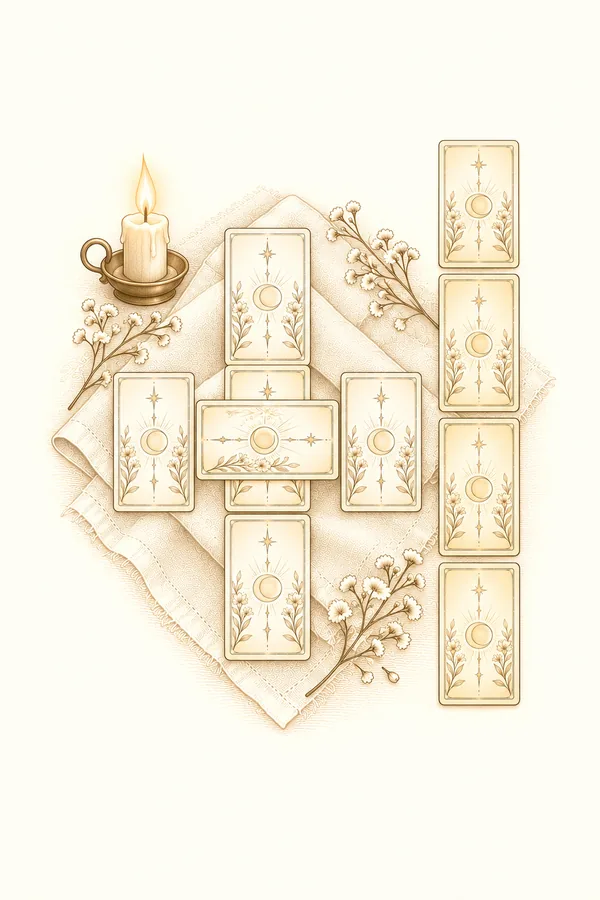
Position 8 sits on the vertical staff, directly above card 7. Together, cards 7 and 8 form a short column that runs alongside the central cross and is usually read as the querent’s relationship to the world beyond themselves: card 7 closest to the reader (the self as seen from within), card 8 one step further out (the world as it sees the querent). In many versions of the spread the staff continues upward through positions 9 and 10, so the column reads from bottom to top as a progression from self, to surroundings, to hopes and fears, to outcome. Position 8 is the hinge where the reading turns outward.
What the card represents
Books name this position differently: external influences, the environment, how others see you, outside forces. The variation is real, and worth naming when you read for someone, because “how others see you” and “outside forces” produce different readings of the same card. In practice, most readers treat position 8 as the querent’s surroundings and the people in them, including how the querent is perceived.
The contrast with card 7
Position 8 directly contrasts with position 7: card 7 is the self as experienced from the inside; card 8 is the self as encountered from the outside, plus the external conditions acting on the situation. Confusing the two is the most common reading error in the Celtic Cross. If a card in position 8 describes an inner feeling, check whether it belongs in position 7 instead.
The core meaning: the world around the querent, not the querent’s will
Position 8 in the Celtic Cross describes the environment surrounding the querent: other people, institutions, social pressures, and circumstances the querent did not create and cannot directly control. Its job is to report conditions, not intentions. The card here tells you what the querent is up against or held within—the weather, not the will.
The guiding rule
If a card in position 8 feels like something the querent is doing—choosing, wanting, resisting—pause and double-check whether that meaning belongs to card 7. Position 7 covers the querent’s own stance and effort. Position 8 reports what the querent is meeting. The same card can appear in both, but the framing changes entirely: in position 7 it is an attitude; here it is a condition.
Reading it by question type
- Career: workplace culture, management style, industry climate, or colleagues’ agendas—the forces shaping the querent’s situation from outside.
- Love: the partner’s own context (their history, obligations, mood) or the opinions of family and friends pressing in on the relationship.
- General readings: timing, circumstance, and the wider field of events—what is already in motion around the querent.
Read position 8 as a description of the terrain. Advice stays minimal here; the card’s task is to show the querent what they are actually standing in, so their choices (card 7) can respond to reality rather than assumption.
Rider-Waite symbolism to watch for in card 8
Position 8 in the Celtic Cross shows your environment and the influence of others—how the world around you sees you, and what it is doing to you. Because this is an external position, read Rider-Waite imagery literally as people and structures, not inner psychology.
Majors as institutions
The Emperor here is rarely your inner discipline; it is the boss, the board, or the bureaucracy—authority with real power over your situation. The Hierophant points to tradition, group norms, or an institution’s rules shaping what is “allowed.” When a Major appears reversed in this position, read it as an external structure resisting change—not your personal block. A reversed Hierophant, for example, shows an organization clinging to outdated policy, not your private doubts.
Court cards as actual people
In position 8, court cards often name a real person in your environment: the Queen of Swords as a candid colleague, the King of Pentacles as a financial gatekeeper. Ask who fits the figure’s element and rank.
Pentacles and withheld resources
Watch the Four of Pentacles especially: someone withholding money, information, or support. The Two of Pentacles can show an employer juggling commitments at your expense. Note where figures face—away from the significator suggests self-interest.
Reading card 8 through suits, numbers, and reversals
Position 8 in the Celtic Cross shows your environment and the influence of others—the people, institutions, and circumstances surrounding the querent. Reading this card well means asking who or what is pushing on the situation, and how.
Suit logic in position 8
- Swords: conflict, criticism, or news arriving from outside—other people’s words and agendas.
- Cups: the emotional climate others create around the querent, for better or worse.
- Pentacles: money, contracts, or institutional limits—external structures that constrain or fund.
- Wands: outside momentum or competition; rivals and fast-moving forces in the environment.
Numbers and reversals
The number shades the pressure: Twos show partnerships and negotiation, Fives disruption, Tens collective weight. A reversal here is advice to question external pressure rather than simply accept it—ask whether the “obstacle” is truly immovable or merely assumed.
Finally, remember that a very positive card in position 8 often signals allies and support, not just obstacles. Read the card as the nature of surrounding influence, then decide whether to lean on it or push back.
Pairing card 8 with card 7: self versus surroundings
Position 8 in the Celtic Cross shows the environment surrounding the querent—the people, atmosphere, and external pressures they meet. Position 7 shows what the querent themselves brings to that environment: their stance, assumptions, and energy. Read separately, each card tells half a story. Read together, they become a dialogue between self and surroundings.
A practical technique
Place cards 7 and 8 side by side and treat them as two speakers in a conversation. Ask: what does the querent bring, and what meets them in return? Then check the tone between the two cards—harmony or friction.
Consider some worked contrasts:
- 7 of Swords beside the Sun. Caution and guardedness meet an open, generous environment. The surroundings offer clarity and goodwill; the querent may be over-defensive. The dialogue asks whether the wariness is still necessary.
- The Emperor beside the 5 of Cups. Firm structure meets an atmosphere of disappointment and loss. The querent’s control may be meeting a situation that cannot be managed, only grieved.
- The Star beside the 10 of Wands. Hope and openness meet an overburdened environment. The querent’s optimism is real, but the surroundings are genuinely heavy—the pairing shows where support is needed.
Before moving on, state the pairing as a single sentence: “I bring X, and I meet Y.” This fixes the dynamic in the querent’s mind and keeps the reading grounded in the relationship between self and world rather than in either card alone.
Position 8 across the staff: links to cards 5, 6, and 10
Position 8 sits on the staff as the card of external environment—other people, circumstances, and pressures the querent does not fully control. Its meaning sharpens when read against card 5, the conscious influence “above,” and card 10, the outcome. Card 8 tests whether the querent’s stated ambition (card 5) is matched by the world around them; card 6, the recent past, often shows how a prior external factor set this pressure in motion.
The variable most likely to change the result
This is why a heavy card 8 can legitimately soften a hopeful card 10. A bright outcome card describes a trajectory, not a guarantee, and position 8 names the variable most likely to bend it. Say so plainly: “The result you want is available, but this outside pressure is the deciding factor—so the question becomes how you respond to it.” That keeps the spread one connected story rather than a clash between a good card and a bad one.
Honest without fatalism
Name the tension directly, then return agency to the querent. Card 5 tells you what they are consciously steering toward; card 8 tells you whether the course holds. If the external card is difficult, treat it as a condition to manage, not a verdict. The reading’s value lies in showing exactly which outside influence connects the conscious goal to the final card—and that is where practical advice begins.
Common misreadings and beginner mistakes at card 8
Card 8 in the Celtic Cross sits just left of the center, traditionally labeled “external influences” or “how others see you.” Its meaning is relational, not personal—and that distinction is where beginners most often go wrong.
Mistake 1: Reading it as the querent’s own attitude
Newer readers frequently collapse card 8 into the self, treating it like another card 1 or card 2. If the Eight of Swords appears, they’ll say, “You feel trapped.” But card 8 asks a different question. The correction is a simple reframe: restate the card as “who or what around you.” The Eight of Swords here is a boss, a family dynamic, or a social circle that constrains—not the querent’s inner state. Keep the querent and their environment separate, and the reading sharpens immediately.
Mistake 2: Pulling it in isolation as a yes/no verdict
Card 8 is a fragment of a larger story. Reading it alone as “this means no” or “this means trouble” ignores how it converses with the surrounding cards. Instead, treat the card as advice for how to relate to that external force. The Tower at card 8 isn’t a prophecy of ruin; it’s guidance on approaching upheaval around you—directly, without clinging to what’s collapsing.
Mistake 3: Doom-spiraling on negative cards
Harsh cards at position 8 tempt readers into fatalism. Remember: external influence describes weather, not destiny. Weather can be forecast, prepared for, and outlasted. Name the force, describe its texture, then return agency to the querent by asking how they’ll dress for the storm.
What to do when card 8’s message is uncomfortable
In the Celtic Cross, position 8 describes how others see you and the environment you’re operating in—the external lens, not your private self-image. When that card lands badly (the Devil, the Tower, Ten of Swords), your first instinct may be to soften it. Don’t. Use this short protocol instead.
1. Name the force plainly
Say what the card shows without cushioning: “The Devil suggests a controlling workplace,” or “The Tower suggests sudden external change.” For yourself or a querent, plain naming is calmer than vague reassurance—it treats the message as information, not a verdict.
2. Ask what part is negotiable
Separate what’s fixed from what’s movable. Sudden change (Tower) usually isn’t negotiable; your response to it is. A controlling system (Devil) is often partly negotiable—contracts, conversations, distance.
3. Pair advice with a boundary-setting question
Offer one small, practical action, then ask a boundary question: “What will you no longer accept here?” or “What boundary would make this situation livable?”
Keep it steady
For beginners: ground the reading, speak slowly, and remind the querent that position 8 shows conditions, not fate. The card names the weather; the boundary question returns the umbrella to their hands.
Sample question and quick walkthrough of card 8
Position 8 in the Celtic Cross shows how the people and systems around the querent see the situation — the external environment, other people’s attitudes, and the querent’s sense of belonging within it. A quick worked example shows how it reads in practice.
The sample question
“When will my job search finally gain traction?” The spread places the Five of Pentacles in position 8.
The walkthrough
Position 8 as the Five of Pentacles suggests the querent feels shut out of the system — as though the hiring world has no place for them — and others may be reading them the same way, as someone struggling on the margins. Check it against position 7 (the querent’s own stance): if card 7 shows guardedness or self-doubt, the outer dismissal and inner hesitation are reinforcing each other, and the environment is mirroring a belief the querent already holds. Then trace the thread to the outcome card: if the outcome is hopeful, the Five of Pentacles marks a temporary season of exclusion that lifts; if it is heavy, the reading warns that the querent’s external network needs deliberate rebuilding before results change. In a few sentences, the pair of cards 7 and 8 explains why the environment feels closed, and the outcome shows what that closure ultimately costs or yields.
Celtic Cross position 8 FAQ
Is position 8 about other people or me?
Position 8 is about the people and outside forces that shape your situation—family, friends, colleagues, or the wider environment. It shows how others influence the matter, not who you are at your core. Read it as context surrounding you, not as a verdict on your character.
What if card 8 is reversed?
A reversed card in position 8 suggests external influences that are blocked, hidden, or working against you. It may point to mixed signals from others or support that isn’t showing up as expected. Treat it as a prompt to check who actually has your back.
Does position 8 predict the future or describe the present?
Position 8 primarily describes the current environment and the energies around you right now. Any forward-looking hint is secondary to what’s happening in your circumstances today. Use it to understand your present support system, not to forecast events.
Can card 8 mean a specific person?
It can represent a specific person when the card clearly matches someone in your life, but it usually describes a role or pattern rather than an individual. Only name a person if the card’s imagery fits them strongly. Otherwise, read it as the type of influence at play.
How does card 8 differ from card 10?
Card 8 maps the external environment around the issue, while card 10 shows the likely outcome if things continue as they are. Position 8 explains the influences at work; position 10 shows where they lead. Read them together to see how outside forces feed into the final result.
Recommended tool
The 10-Card Celtic Cross
Lay the full spread and read all ten positions of your question.
Keep reading
More on Celtic Cross
October 31, 2026
Celtic Cross Position 1: The Present Card
Celtic Cross position 1: the heart of the matter, the significator debate, and how card 2 rewrites what you read here. With Rider-Waite examples.
Read the article
October 31, 2026
Celtic Cross Position 9: Hopes and Fears
Celtic Cross position 9: the card that holds hope and fear at once. How to tell which is speaking, and the question that separates them.
Read the article
October 31, 2026
Celtic Cross Position 7: The Self Card
Celtic Cross position 7, the self card: how you are showing up, what attitude shapes the reading, and why this position often stings most.
Read the article