October 25, 2026
Celtic Cross Outcome Card: What Position 10 Really Says
A deep dive on the Celtic Cross outcome card: outcome vs near future, reading card 10 through the other nine, reversals and contradictions.
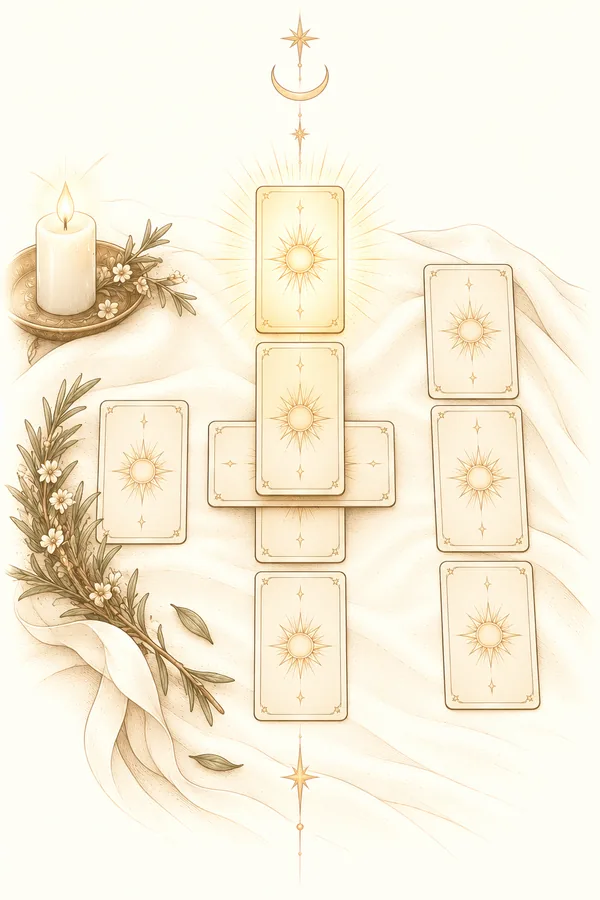
The tenth position of the Celtic Cross—commonly called the outcome card—is the most anticipated and most feared card in the entire spread. After nine positions have mapped the querent’s situation, crossed influences, foundations, recent past, aspirations, near future, self-perception, environment, and hopes or fears, the final card lands with the weight of a verdict. Readers report genuine anxiety turning it over, and querents often fixate on it before any other card is even interpreted. That weight is understandable, but it is also frequently misplaced.
This deep dive focuses exclusively on that final card, not the spread as a whole. It assumes the standard ten-card Rider-Waite arrangement, in which the tenth position sits at the top of the staff column and answers the question: where is this heading? The distinction matters, because most confusion about the outcome card comes from treating it as a separate oracle rather than as the culminating voice of a connected narrative.
The core argument here is straightforward: the outcome card is a direction, not a fixed verdict. Read in isolation, it invites fatalism; read in context, it reveals trajectory, momentum, and likely consequence. Throughout this guide, we will examine how to interpret the tenth card as a compass bearing—showing where current energies lead if nothing changes—rather than a sentence already passed.
What the Tenth Position Actually Represents in the Celtic Cross
The tenth card sits at the top of the staff, the vertical column of four cards to the right of the central cross. In the Rider-Waite tradition popularized by A.E. Waite and Pamela Colman Smith’s 1909 deck, this final position is often labeled “final outcome” — but its real function is synthesis. It distills the previous nine cards into a single image of where the reading is heading, weaving together the querent’s situation, obstacles, goals, and surrounding influences into one coherent conclusion.
Outcome as Trajectory, Not Fate
The tenth card describes a likely trajectory given current energies — not a predetermined ending. If the surrounding cards show unresolved tension, the outcome reflects that momentum; change the underlying conditions, and the trajectory shifts. Treating this card as fixed fate is one of the most common beginner misconceptions. Equally common: reading it in isolation, as if it overrides the other nine. It doesn’t — it summarizes them.
Lineage Differences in Labeling
Different lineages name this position differently: “final outcome,” “overall direction,” or “likely result.” Each label nudges interpretation slightly. “Direction” emphasizes movement; “result” implies consequence; “outcome” suggests culmination. Knowing which convention your deck or teacher uses helps you read the tenth card with appropriate nuance rather than false certainty.
Outcome Card vs Near Future Card: Clearing Up the Confusion
In a Celtic Cross deep dive, positions six and ten are the two most frequently muddled. Position six, the Near Future, describes what is approaching within weeks to a few months—the next weather front. Position ten, the Outcome, describes where the trajectory lands once the entire spread has played out. Readers conflate them because both sit on the vertical axis and both look predictive.
Practical Tells
- Time horizon: Near Future is imminent and provisional; Outcome is cumulative, often months out or open-ended.
- Scope: Position six is a single event or atmosphere. Position ten is the resolved sum of all nine preceding cards.
- Derivation: Read the Near Future against the present (positions one and two). Read the Outcome against the whole cross—especially the hopes/fears and advice cards, which feed it.
A Concrete Example
Suppose the Six of Wands lands in position six and the Star in position ten. The Six of Wands as Near Future says recognition arrives soon—a win, a public nod. The Star as Outcome says the deeper destination is healing and renewed faith after the noise fades. Swap them and the reading breaks: the Star as imminent news is too diffuse, and the Six of Wands as final outcome mistakes a victory lap for a destination. The near future shows the next scene; the outcome shows the closing frame.
Reading the Outcome Card Through the Lens of the Other Nine
The tenth card of the Celtic Cross is not a standalone verdict. It is the final sentence of a paragraph the other nine cards have already begun, and it should be read in dialogue with three cards in particular: the significator (card one), the crossing card (card two), and the hopes-and-fears card (card nine). The significator establishes the querent’s stance; the crossing card names the friction; the hopes-and-fears card reveals the emotional stake. The outcome card shows where that triangle lands.
A Three-Step Check
- Echo: Does the tenth card repeat a suit, number, or figure already present? An echo confirms the trajectory and amplifies it.
- Contradiction: Does it clash with the crossing card or significator? Contradiction signals an unresolved tension the querent must consciously address.
- Reframe: Does it recast an earlier card in a new light? A reframe is the most instructive result—it shows the situation transforming rather than merely repeating.
Read the Spread’s Weighting First
Before interpreting the final card, scan the whole spread for dominant suits and repeated numbers, and count the Major Arcana. A Major-heavy spread gives the outcome card archetypal weight; a Minor-heavy one keeps it practical and near-term. The tenth card inherits that texture—read it last, but read it through everything before it.
Major Arcana Outcomes: When the Final Card Signals a Life Lesson
When the tenth position of the Celtic Cross is occupied by a Major Arcana card, the reading changes register. Position ten normally answers “where is this heading?” — an outcome in time. A Major there insists the answer is developmental rather than chronological: the situation is being pulled toward a soul-level theme, and the “result” is a lesson the querent is being asked to integrate. Minor Arcana outcomes describe circumstances; Majors describe who the querent is becoming.
Specifics in the Outcome Slot
- Death: not literal loss, but a necessary ending the querent has been postponing. The outcome is closure that makes renewal possible.
- Judgement: a reckoning and a calling — the querent will be asked to rise, account for the past, and answer something larger than the immediate question.
- The Tower: not disaster, but demolition of a false structure. The lesson is what cannot stand being shown to be unsound.
- The World: completion with a mandate — the cycle closes, but the querent is asked to carry what was learned into a new whole.
Guarding Against Fatalism
Scary Majors in position ten are frequently misread as verdicts. Rider-Waite symbolism softens them: Judgement’s figures rise at a trumpet, not a sentence; the Tower’s falling figures survive, the lightning only striking the crown of a construct; the World’s dancer moves within a wreath — a boundary that is also a gateway. Read these as invitations to participate, not predictions to endure. In a Celtic Cross, a Major outcome is the deck’s way of saying: the event matters less than the growth it demands.
Minor Arcana and Court Card Outcomes: Practical, People-Focused Results
In the Celtic Cross, the outcome card (position 10) shows where the situation is heading if the current trajectory holds. When a Minor Arcana lands here, read it as a concrete domain of life rather than a vague destiny:
- Pentacles — money, work, health, tangible security
- Cups — relationships, feelings, emotional reconciliation
- Swords — decisions, communication, conflict or clarity
- Wands — action, ambition, momentum, creative drive
One Example per Suit
- Eight of Pentacles: steady effort pays off — expect skill-building or a work commitment, not a windfall.
- Two of Cups: a partnership or reconciliation becomes central; the outcome is relational.
- Five of Swords: a costly win or unresolved argument; the outcome is friction you must manage.
- Knight of Wands: bold forward movement — a trip, launch, or passionate push.
Court cards in this position often point to a person (who influences the outcome) or a role the querent must adopt (e.g., the King of Pentacles: become the steady decision-maker).
Person or Energy?
Use a simple test: if a specific individual fits the card’s profile and is active in the situation, read it as a person. If not, read it as the energy or role required of the querent. When in doubt, state both possibilities in your reading and let context decide.
Reversed Outcome Cards: Delay, Internal Block, or Redirected Path
The tenth card of the Celtic Cross gives the spread its verdict. When it lands reversed, that verdict is rarely a simple “no” — it is one of three things, and the rest of the spread tells you which.
The Three Readings
Delay. The outcome is still coming, but timing is off. Look for a stalled final card in the staff, or supporting cards that are upright but slow (Pentacles, the Hanged Man).
Internal block. You are the obstacle: fear, ambivalence, or a belief keeping the result at arm’s length. Internal blocks usually pair with a crowded crossing card or reversed court cards representing you.
Redirected path. The outcome you asked about is not the one available. Check whether the final card contradicts the spread’s momentum — if the rest of the reading points elsewhere, the reversal is a signpost, not a stop sign.
The Reversal Debate, Briefly
Rider-Waite tradition never intended reversals; many readers treat them as weakened uprights, others as full inversions. Pick one policy — I recommend reversal-as-blockage — and apply it to every tenth-card reversal so your readings stay comparable over time.
Two Examples
Reversed Ten of Cups: the harmony exists but is delayed, often by family friction. Read it as delay unless the crossing card shows your own resistance.
Reversed Sun: the vitality is blocked, not cancelled — or the path needs redirecting toward a smaller, truer success. The spread’s strongest suit decides which.
When the Outcome Card Contradicts the Rest of the Reading
Few things unsettle a querent like a hopeful Celtic Cross capped by a bleak Outcome card—or a spread of warning signs ending in the Sun. Before assuming you misread the cards, work through three reconciliation strategies.
Check Your Position Definitions
The Outcome card in the Celtic Cross has no universal meaning. Some readers treat it as a fixed destiny; others read it as the trajectory if nothing changes. Much apparent contradiction dissolves once you clarify which definition you’re using. State it explicitly to your querent before interpreting.
Re-examine the Question’s Framing
A vague or double-barreled question (“Will I get the job and will I be happy there?”) can produce a spread where earlier cards answer one half and the Outcome answers the other. Sharpen the question and the contradiction often resolves.
Read the Outcome as Conditional
Treat the final card as an “if-then”: the surrounding spread shows present momentum, and the Outcome shows where that momentum leads unless the querent intervenes. A grim Outcome beneath positive cards is not an error—it’s a warning with a built-in exit.
Contradictions rarely signal spread failure. More often they return agency to the querent, showing that the ending is still being written.
The Outcome Card as Agency, Not Fate: Reframing the Final Position
Position ten of the Celtic Cross is routinely described as “the outcome”—the place where the reading lands, the verdict. This framing is a disservice. Read as fixed destiny, the final card invites passivity; read as trajectory, it becomes the most actionable card in the spread. The outcome shows where the current path leads, not where you must go.
The “If Nothing Changes” Frame
The cleanest way to interpret position ten is to silently append if nothing changes to every reading. The Ten of Swords is not “ruin”; it is “if you keep pushing this way, collapse.” The Star is not “salvation”; it is “if you tend this hope, recovery.” This small linguistic shift converts prophecy into counsel.
Phrasing It for Clients—and Yourself
Say: “This is the direction of travel, not the destination.” Follow with an action question: “What would need to shift for this card to change?” When reading for yourself, write the outcome, then list three concrete choices that could tilt it.
A Prompt for Difficult Cards
Place the outcome card face-up. Light a candle if you like. Journal: This card shows me where I’m headed. What is my part in it—and what is one small act of agency available today? Sit with the answer before drawing again.
Common Outcome Card Combinations and What They Suggest
In a Celtic Cross deep dive, the outcome card gains precision when read alongside the significator or the crossing card. These pairings are quick-reference prompts, not fixed verdicts.
Significator Pairings
- The Lovers crossed by the Three of Swords: Heartbreak or divided loyalty shapes the outcome; a choice must be made from honesty, not avoidance.
- The Fool followed by the Hermit: A leap of faith leads to inward reflection; new beginnings mature into solitude and self-knowledge.
- The Emperor crossed by the Five of Pentacles: Rigid control meets scarcity; examine where structure has become exclusion or fear.
- The High Priestess crossed by the Seven of Swords: Hidden knowledge and deception interact; trust intuition over surface promises.
Crossing-Card Pairings
- Death crossed by the Six of Cups: An ending softens through nostalgia or an old connection returning.
- The Tower crossed by the Star: Upheaval clears space for renewal; the crisis is not the final word.
- The Two of Cups crossed by the Devil: A partnership entangled in attachment or unhealthy patterns; commitment needs scrutiny.
- Strength followed by the Nine of Wands: Resilience tested but intact; the outcome favors persistence.
Read every pairing within the full spread—surrounding cards, position, and question context refine or override any single combination.
Frequently Asked Questions About the Celtic Cross Outcome Card
Is the outcome card final?
No. In the Celtic Cross, the outcome card shows the most likely trajectory if nothing changes—not a fixed verdict. Think of it as a weather forecast, not a fate. Your choices between now and then can shift the result, which is why the outcome pairs best with the agency discussion in our deep-dive synthesis.
What if it’s a card I dislike?
A difficult outcome card is information, not a punishment. Ask what conditions produced it and where you still have leverage. Cards like the Tower or Ten of Swords often flag needed endings rather than guaranteed disasters. Read it as a warning that rewards early action.
Can I pull a clarifier?
Yes, but sparingly. One clarifier—asking “what should I know about this outcome?”—can add nuance. Pulling repeatedly until you get a card you prefer just muddies the reading. If you feel the urge to keep clarifying, that’s usually anxiety talking, not the cards.
Does the outcome card change between readings?
It can, especially if weeks pass, your circumstances shift, or you’ve acted on the reading’s advice. Minor changes are normal. Wholesale reversals in a short window usually mean the question itself changed—check that you asked the same thing both times.
Which card should I trust if the outcome and near future disagree?
Trust the pair, not one card. The near-future card describes the immediate stretch; the outcome describes where that stretch leads. A rough near future with a hopeful outcome often means short-term turbulence serving a larger resolution. For how these positions talk to each other, see our synthesis section.