October 31, 2026
Celtic Cross Position 7: The Self Card
Celtic Cross position 7, the self card: how you are showing up, what attitude shapes the reading, and why this position often stings most.
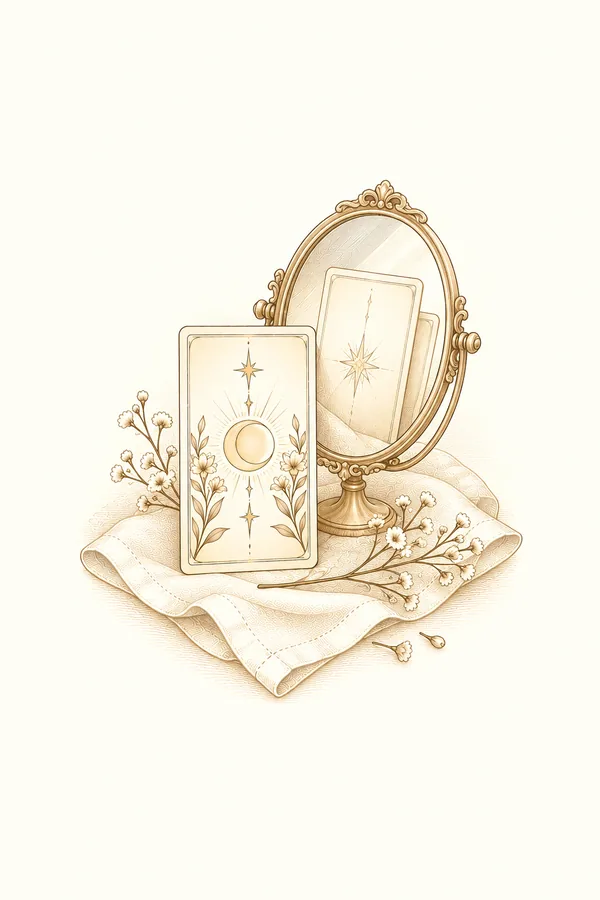
Position 7 of the Celtic Cross is the card many readers look up and then hesitate over. It sits at the bottom of the staff—the vertical column of four cards on the right side of the spread—and it is usually labelled “Self,” “Self/Advice,” or sometimes just “Advice.” That inconsistency is exactly why so many readers search for clarity on this position. Does the card describe who the querent is right now, what they should do next, or both at once? The short answer is often both, but the placement itself gives you a way to tell which side is speaking louder.
Position 7 sits directly below position 8, the External Influences card. Read the two as a pair: position 8 shows what the world is doing to the querent, and position 7 shows where the querent is standing in response. It is a mirror for inner stance versus outer circumstance, which is why card 7 can read as a portrait of the querent’s attitude and still function as practical counsel—what to change, hold, or lean into.
This guide walks through what position 7 means, how to read it using Rider-Waite symbolism, and how to turn it into a real next step rather than a vague description of your personality.
What Position 7 Actually Represents in the Celtic Cross
Position 7 is the Celtic Cross’s most contested slot. Many traditions label it Self—your attitude, self-image, and the role you are playing in the situation. Others call it Advice—the stance or action the cards recommend. The split is historical rather than doctrinal: different lineages of the spread grew up emphasizing either self-knowledge or counsel, and each shaped how readers taught the position. Both readings are valid.
One Card, One Internal Focus
Whichever label you use, the card describes your internal posture—how you are standing inside the situation. It is not about events, outcomes, or other people. A “Self” reading asks: how do I see myself here? An “Advice” reading asks: what stance should I take? The distinction is one of framing, not of subject matter; both point inward.
Choose One and Stay Consistent
Waite’s own presentation of the spread left room for variation, which is why the disagreement persists. Beginners should pick one meaning per reading—Self or Advice—and apply it consistently, rather than hedging between the two mid-spread.
Where the Card Sits in the Layout: The Staff and Its Sequence
Once the six-card cross is complete, the reading moves to the staff — the vertical column of four cards placed to the right of the cross. Position 7 is the bottom card of this staff, and it sits closest to the querent’s own row, directly beside the cross itself. From there, the staff rises in sequence: card 8 (environment) directly above it, card 9 (hopes and fears) above that, and card 10 (outcome) at the top.
Reading the Staff Bottom to Top
The staff is read upward as a progression: it begins with the self at position 7, moves through surroundings (8) and psychology (9), and culminates in the outcome (10). This vertical logic matters. Position 7 is the foundation of the entire staff — every card above it is built on the stance, attitude, or situation the self brings to the question. If card 7 shows resistance, the environment and outcome above it are filtered through that resistance; if it shows clarity, the upper cards rest on firmer ground.
The Neighbor to Watch
When interpreting card 7, note its visual relationship to card 8, its direct neighbor above. These two cards form the first pairing of the staff — self and environment in immediate conversation. Read them together before moving higher.
Card 7 Versus the Significator and the Crossing Card
Position 7 in the Celtic Cross is one of the most misunderstood slots, and it sits right next to two cards that beginners routinely confuse it with. Here is the distinction in plain terms.
The significator is an optional card you select before the reading to represent the querent overall—their personality, current state, or the heart of the question. The crossing card (position 2) is the immediate challenge or friction bearing down on the matter. Position 7, by contrast, shows how you are standing in relation to the situation—your stance, self-image, or the posture you are bringing to it. It is neither the whole person nor the obstacle.
Same Card, Three Positions
Suppose the Queen of Swords appears:
- As significator: “I am someone who processes life through logic and hard-won independence.”
- As crossing card: “This situation is cutting hard—sharp words, cold distance, or a decision I cannot soften.”
- As position 7: “Here, I am presenting myself as guarded and analytical, perhaps more than the situation requires.”
Me or Advice?
Position 7 describes how you are in the matter, which naturally carries advice: notice your stance, and decide whether it serves you. It is a mirror, not an instruction manual—read it as “this is where I stand,” and let the rest of the spread tell you whether to stay there.
Reading the Card as “You in the Situation”
Position 7 of the Celtic Cross is often labeled “Self” or “Your Position.” When you read this card as you—not as an outside event or another person—it answers a pointed question: what face or energy are you bringing to this situation, and is it helping or hindering?
Compare two Rider-Waite figures. The Emperor upright shows you taking charge: setting boundaries, making decisions, owning your authority. That energy can steady a chaotic situation—or harden into rigidity if you’re over-controlling. The Four of Cups suggests the opposite: withdrawal, apathy, a refusal to engage with what’s offered. Likewise, the Queen of Cups can describe emotional attunement and receptivity, while the Seven of Swords can expose self-deception—avoidance dressed up as strategy, or telling yourself a convenient story about your motives.
This position rewards honesty over flattery. The card isn’t asking whether you’re a good person; it’s asking what role you’re actually playing. Court cards here deserve special care: they usually describe your posture or function in the matter rather than a literal person, even when the figure resembles someone you know.
Ask yourself directly: Does this energy serve the question I’m asking? If the card shows a strength, lean into it deliberately. If it shows a blind spot, name it without excuses—that recognition is where the reading becomes useful.
Reading the Card as “Advice”: Turning Symbolism Into Action
Position 7 in a Celtic Cross self-reading shows the card as counsel—not a prediction but an instruction. Your task is to translate its imagery into a behavior you can perform and test.
Read the symbols literally. The Chariot’s sphinxes pull in opposite directions while the driver holds the reins: the advice is “take the wheel”—name the competing pulls in your situation and consciously choose one. The Hermit’s lantern lights only the next step: “pause and reflect before acting”—schedule the reflection rather than promising to “be more mindful.” The Two of Wands’ figure holds a globe while standing between castle and sea: “commit to a direction”—pick the option and set a date to act on it.
Vague counsel (“be patient,” “trust yourself”) is a failure of this position. Convert the card into a specific, testable action: “Send the email by Friday,” “Say no to one request this week,” “Write the pros and cons list tonight.” Then observe the result.
Reversed cards usually flip the advice inward. The reversed Hermit suggests withdrawing not to plan but to release; the reversed Chariot suggests stopping the push and waiting. Each still needs a concrete form—“wait” becomes “delay the decision seven days and note what changes.”
Reading Card 7 Together With Card 8 and the Rest of the Spread
Position 7 in the Celtic Cross shows the querent’s own stance — self-image, attitude, or role in the situation. It is a mirror, not a verdict, and it means little until compared with the cards around it.
Card 7 and Card 8: Self and Environment
Read 7 against 8 (external influences, other people, the wider field). Ask: is the self aligned with the surroundings or out of step? A confident 7 facing a hostile 8 suggests friction with the environment; a defensive 7 facing a supportive 8 suggests self-imposed isolation. The gap or match between these two cards is the first real insight.
Card 7 and Card 2: Stance and Challenge
Then pair 7 with card 2 (the challenge). Does your stance cause the obstacle or answer it? If 7 echoes 2, the querent’s own attitude is part of the problem. If 7 contrasts with 2, the stance may be the resource that meets the challenge.
Card 7 and Card 10: Advice and Outcome
Finally, connect 7 to card 10 (outcome). Does the positioning in 7 point toward the likely result or warn you away from it? If the advice implied by 7 runs counter to 10, the spread is cautioning against the current stance.
Worked Example
A querent draws 7 as the Eight of Cups (withdrawal), 8 as the Ten of Pentacles (settled family), 2 as the Four of Cups (apathy), and 10 as the Six of Cups (reunion). The self isolates from a stable environment; the withdrawal matches the apathy challenge; the outcome suggests reconnection, so 7 warns against the current stance.
Never read position 7 in isolation — its meaning emerges from these pairings.
Common Interpretive Pitfalls and How to Avoid Them
Position 7 in the Celtic Cross is often labeled “self” or “self-image,” but it carries a dual role: it shows how you see yourself now and offers advice on how to meet the situation. Several misreadings creep in here.
Treating position 7 as prediction
This card describes your current self-concept, not a fixed future. Fix: read it in the present tense (“I am someone who…”) and treat any forward motion as a direction of travel, not a verdict.
Moralizing the advice
When the card carries an advisory layer, readers often turn it into a lecture. Fix: phrase advice as an invitation (“consider…”) rather than a command or judgment.
Ignoring reversals’ inward meaning
A reversed card here usually turns the focus inward — blocked self-image, disowned traits, or advice to stop performing a role. Fix: ask “what part of me is hidden or resisted?” before reaching for external events.
Splitting self from advice
Reading only the “self” layer skips the guidance; reading only the advice skips the identity context. Fix: state both in one sentence — “You see yourself as X; the advice is to Y.”
Panicking at a “negative” card
The Tower as position 7 signals upheaval in identity, not doom. Fix: reframe it as advice to dismantle an outdated self-image — the collapse clears space for a truer one.
Questions Position 7 Answers Best
Position 7 in the Celtic Cross — the self card — shows where you stand in the matter: your stance, attitude, and part in the story, whether or not you’ve acknowledged it. Its companion, position 8, describes the surrounding environment and other people. Together they map the gap between your inner posture and the outer situation.
Because this card is about you, it rewards questions that turn the lens inward. Useful framings include:
- “What is my role in this situation?”
- “What attitude am I bringing that I haven’t admitted?”
- “What stance would serve me best right now?”
- “Am I the obstacle or the solution here?”
Phrase these openly (what, how, where) rather than as yes/no. “Am I the obstacle or the solution?” works because it invites the card to describe a quality of stance; “Will I win?” does not, because a one-word answer wastes the position. Note this for querents and writers alike: yes/no questions tell you almost nothing about the self card, while reflective, open questions turn it into honest self-knowledge and practical counsel.
Applying the Card: A Journaling and Homework Practice
Position 7 of the Celtic Cross is the Self card—where you stand in the situation, your attitude, and the stance you bring to it. It rewards direct engagement, so give it a repeatable practice rather than a passing glance.
The Three-Line Exercise
After the draw, write two sentences and one action:
- Self reading: In one sentence, state what this card says about where you stand.
- Advice reading: In one sentence, state what the card asks of you—position 7 shows your stance, so treat it as counsel to adjust, not just a label to accept.
- Homework: Name one small, concrete action for the week that embodies the advice.
Journaling Prompts
- What would it look like to embody this card tomorrow?
- Where does my current stance help the situation, and where does it block it?
- What is one belief about myself this card challenges?
Check-In and Tracking
At your next reading, ask: Did I act on card 7, and what shifted? Photograph each draw and keep the images for a month—comparing how position 7 evolves reveals whether your stance is genuinely changing or merely repeating.
Variations You’ll Encounter and How to Adapt
Position 7 of the Celtic Cross sits at the base of the staff, and if you compare five books you’ll find at least three different names for it. The most common alternatives are “Your Approach,” “Self,” and “Advice.” Each carries a slightly different emphasis: Approach asks how you’re engaging the situation; Self places you, the querent, at the center; Advice turns the card into a recommendation rather than a description.
Then there are structural variations. Some spreads merge cards 7 and 8 as a single “self and environment” pairing—useful if you read the staff as a narrative arc, but it sacrifices the mirroring between inner stance and outer influence. Others reorder the staff entirely, placing position 7 above the significator or swapping it with position 9.
Staying Coherent
None of these is wrong, but mixing them mid-reading is. Decide the label before you lay the cards and state it, especially when reading for someone else. If you publish or teach, name the variation you’re using—“in this spread, card 7 is your approach, not the querent themselves”—so students can map your method onto the books they’re reading. When comparing sources, treat the label as part of the system, not a detail to gloss over.
Recommended tool
The 10-Card Celtic Cross
Lay the full spread and read all ten positions of your question.
Keep reading
More on Celtic Cross
October 31, 2026
Celtic Cross Position 9: Hopes and Fears
Celtic Cross position 9: the card that holds hope and fear at once. How to tell which is speaking, and the question that separates them.
Read the article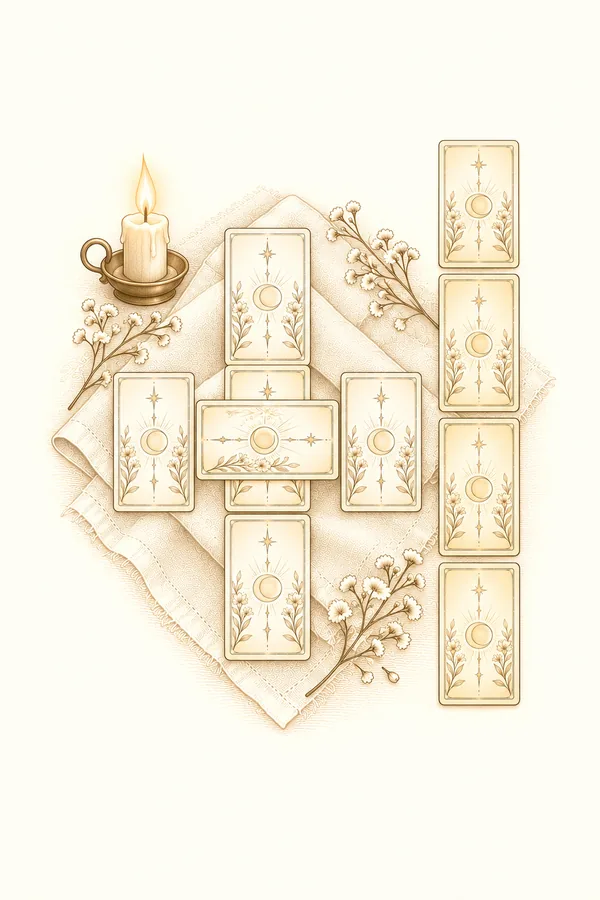
October 31, 2026
Celtic Cross Position 1: The Present Card
Celtic Cross position 1: the heart of the matter, the significator debate, and how card 2 rewrites what you read here. With Rider-Waite examples.
Read the article
October 31, 2026
Celtic Cross Position 8: The Environment Card
Celtic Cross position 8: the people and outside forces shaping the question, how to tell influence from interference, and the follow-up to ask.
Read the article