October 31, 2026
Celtic Cross Position 1: The Present Card
Celtic Cross position 1: the heart of the matter, the significator debate, and how card 2 rewrites what you read here. With Rider-Waite examples.
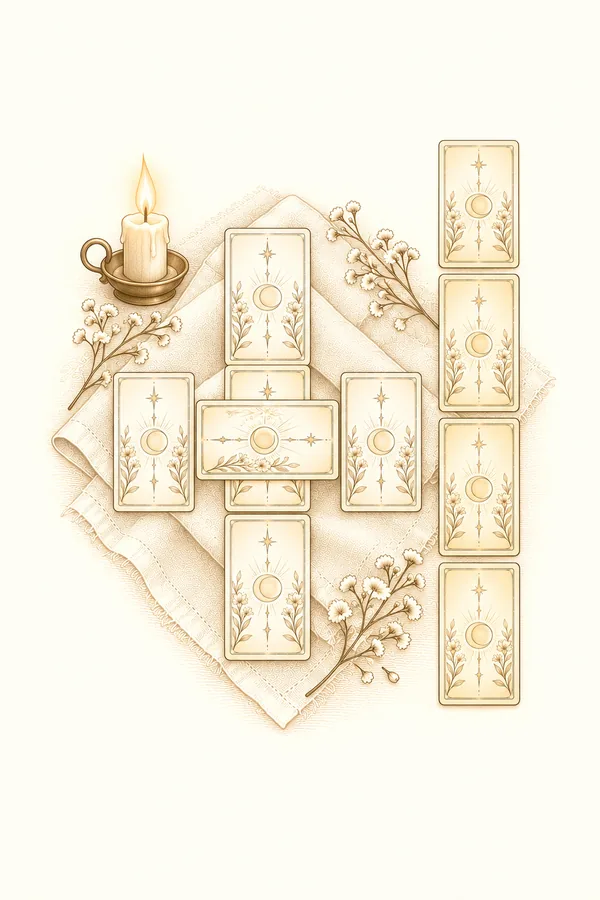
Celtic Cross position 1 is the card that lands face-up in the centre of the cross—often called “the present” or “the heart of the matter.” It anchors the entire ten-card spread, and before any other card is interpreted, this one sets the tone for everything that follows.
If you have ever drawn a single card, laid it down, and asked, “What does the first card in the Celtic Cross mean?” you have already met position 1. Its meaning is the answer to that exact question: it names the central issue, energy, or lesson alive in the querent’s life right now. Position 2 crosses it to show what helps or hinders; positions 3 and 4 root it in past and future; the remaining cards expand outward from this core. Remove position 1 and the spread loses its spine.
This article covers everything you need to read it with confidence: its core meaning and symbolism, how it relates to the crossing card, and practical reading tips for beginners and experienced enthusiasts alike. Whether you are learning your first spread or refining decades of practice, position 1 is where every Celtic Cross reading truly begins—and where its story is first told.
What Position 1 Represents in the Celtic Cross
Card 1 is often called the “present” or “significator” position, and it sits at the heart of the Celtic Cross. It depicts your current situation—the core energy surrounding your question right now. This is not a fixed destiny or a verdict on how things must unfold. It is a snapshot: where you genuinely stand at this moment, relative to what you are asking about.
Circumstances and Inner Climate
The card in Position 1 can describe external circumstances—a relationship dynamic, a work situation, a decision waiting to be made—but it also reveals your inner climate: the mood, fears, hopes, or assumptions you carry into the matter. Read both layers. If the card seems out of step with the facts of your life, ask whether it is mirroring your inner state rather than your outer one.
It Sets the Tone for the Reading
Everything else in the spread is read in relation to this card. Position 2 crosses it, Positions 3 and 5 show its roots and its crown, and the later cards trace where this starting point may lead. Position 1 therefore sets the tone for the entire reading: it anchors the narrative and gives every other card its context.
The Present Card, the Heart of the Matter, or the Significator
Position 1 of the Celtic Cross carries three competing names, and the confusion is worth clearing up before you read a single card. Many modern guides call it the present — the querent’s current situation as it stands today. Others call it the heart of the matter, the central issue beneath the surface question. Older traditions treat it as a quasi-significator: a card deliberately chosen (sometimes by the reader, sometimes by the querent) to embody the person or the core theme before the spread is laid out.
Where the labels overlap and diverge
All three agree on one thing: position 1 is the anchor. The divergence is about agency. “The present” is observational — you draw whatever falls and read the moment. “The heart of the matter” is diagnostic — you read the root, not just the weather. The significator approach is selective — the card is picked, not dealt, which changes the energy of the whole reading.
Pick one frame and stay consistent
Choose your frame before you shuffle and apply it every time. Mixing them mid-reading — treating a drawn card as if it were deliberately chosen, or hunting for a “significator” after the fact — muddies the interpretation and confuses the querent.
A note for beginners
Do not overcomplicate card selection. Deliberately choosing a significator is an advanced habit that invites second-guessing. Draw position 1 like any other card, read it as the heart of the matter, and let the present reveal itself through the surrounding positions.
Reading Card 1 Through Rider-Waite Symbolism
Card 1 in the Celtic Cross names the present situation—not the future, not the distant past, but the weather you are standing in right now. To make that reading concrete, anchor it in the actual imagery of the Rider-Waite deck. Ask what the figure is doing, where their weight rests, and what they can or cannot see. A present state becomes legible when you describe the picture before you interpret it.
From Image to Lived Experience
Take the Fool. He is not merely “new beginnings”—he is a figure mid-step, one foot off the cliff edge, eyes on the sky rather than the drop. In position 1, that reads as a present state of momentum without footing: you are already moving, and the ground has not yet been checked.
The Two of Swords shows a blindfolded figure holding two blades in rigid balance, seated with water behind her. Here the present is a deliberate standoff—a choice postponed, held in tension rather than resolved, with the emotional current still churning at her back.
The Eight of Pentacles gives a third: a worker bent over one coin, hammer mid-strike, the finished pieces lined up beside him. Position 1 becomes a present of patient repetition, where the meaningful action is the next small stroke, not the completed wall.
Read this way, the card stops being an abstraction and becomes a description of your actual posture today.
Card 1 Across the Major and Minor Arcana
Position 1 of the Celtic Cross — the card laid across the first, often called the present situation or the heart of the matter — gains much of its nuance from the deck it comes from. A Major Arcana card here points to a destined, significant theme: something with weight and staying power, a lesson or turning point that shapes the reading rather than merely colouring it. A Minor Arcana card, by contrast, tends to describe a passing, everyday matter — the immediate circumstance, mood, or concern that will likely shift as events unfold.
Court Cards and Reversals
A court card in position 1 often signals a person or role active in the present: someone whose energy, attitude, or influence is central right now, whether that is the querent themselves or another figure in the situation. Reversed cards suggest blockage or energy turned inward — the theme is present but stalled, resisted, or being worked through privately.
Suit Flavour
Elemental flavour adds texture to this present-situation reading. Wands bring drive and ambition, Cups bring feeling and relationship, Swords bring thought and conflict, and Pentacles bring resources and practical matters. Read the card’s suit alongside its rank to sense what is really at the centre of things.
Position 1 in Context: How It Interacts with the Crossing Card
Position 1 in the Celtic Cross—traditionally the significator or “present situation” card—is never read in isolation. The crossing card (position 2) lies directly over it, and the two together form the heart of the reading. Where card 1 shows what is present, card 2 shows the challenge, tension, or countervailing force meeting that situation. Reading card 1 alone is like hearing only half a conversation.
The Axis of Awareness
This pair functions as an “axis of awareness”: a compact statement of the core dynamic that the rest of the spread—past, future, root, crown, and beyond—will elaborate and contextualize. If positions 1 and 2 are misread, everything downstream drifts. Treat them as a single unit before proceeding.
Practical Phrasing
Combine the two cards into one sentence using a “this, meeting that” structure:
- “The present situation is [card 1], and what meets it is [card 2].”
- “You are standing in [card 1], while [card 2] presses against it.”
- “The energy of [card 1] is being challenged by [card 2].”
Keep the sentence neutral—describe the tension, don’t resolve it yet. Once that single sentence feels accurate, move on to positions 3 and 4, which will begin explaining where this dynamic came from and where it’s heading.
Common Questions About the First Celtic Cross Card
Should I choose card 1 deliberately or draw it at random?
Either works, but be consistent. Card 1 represents the present moment or heart of the matter, so a random draw keeps the reading honest, while deliberate selection can suit reflective, self-guided pulls. Decide your method before you shuffle and note it in your journal so future readings stay comparable.
What if the querent disagrees with card 1?
Don’t argue — explore. A mismatch is information: the card may show what the querent hasn’t yet named, or you may need to revisit what the question actually is. Ask, “What feels off about this?” and let the sitter correct the frame. Sometimes the disagreement itself is the reading’s starting point.
How do I handle a confusing or “negative” present card?
Stay calm and reframe. Name the card’s theme plainly, then ask where in the querent’s life it appears. Avoid dramatic language; emphasize that card 1 describes the present, not a fixed fate. A challenging card is a conversation opener, not a verdict.
Build fluency with journaling
Track card 1 across multiple readings: note the card, the question, and what actually unfolded. Over time, patterns show you what this position means in your own practice — far more useful than memorized definitions alone.
Recommended tool
The 10-Card Celtic Cross
Lay the full spread and read all ten positions of your question.
Keep reading
More on Celtic Cross
October 31, 2026
Celtic Cross Position 8: The Environment Card
Celtic Cross position 8: the people and outside forces shaping the question, how to tell influence from interference, and the follow-up to ask.
Read the article
October 31, 2026
Celtic Cross Position 9: Hopes and Fears
Celtic Cross position 9: the card that holds hope and fear at once. How to tell which is speaking, and the question that separates them.
Read the article
October 31, 2026
Celtic Cross Position 7: The Self Card
Celtic Cross position 7, the self card: how you are showing up, what attitude shapes the reading, and why this position often stings most.
Read the article