October 25, 2026
Celtic Cross Card Placement: Which Positions Matter Most
A position-by-position guide to Celtic Cross card placement: what each of the ten slots means, the disputed ones, and the patterns that matter most.
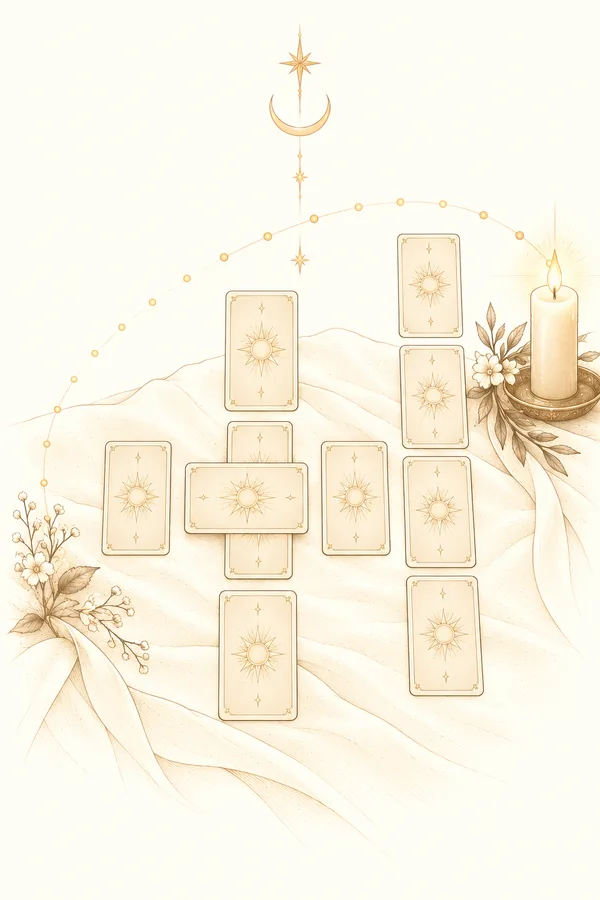
The Celtic Cross is the most recognized tarot spread in the world—ten cards that map a question with remarkable depth. But here is what surprises many newcomers: in this spread, where a card lands matters as much as which card it is. Placement is not decoration; it is the interpretive frame. Each of the ten positions asks a different question, so the same card carries a different meaning in Position 2 (the obstacle) than it does in Position 10 (the likely outcome). The Two of Cups that signals a budding partnership in the outcome position may describe a tension you must overcome when it appears as the challenge.
This guide focuses on significant card placements in the Celtic Cross—the positions that do the heaviest interpretive work—using Rider-Waite-Smith symbolism as the reference deck, since its imagery underpins most modern tarot study.
A word for beginners: you do not need to memorize ten definitions before your first reading. Start with the positions that shape the story most—the present, the obstacle, the outcome—and let the others deepen your understanding as you practice. By the end of this guide, you will know which placements deserve your closest attention and why the same card can tell a completely different story depending on where it falls.
What the Celtic Cross Actually Is (And Isn’t)
The Celtic Cross is a ten-card spread built from two parts: a central cross of six cards, and a staff of four laid to its right, read top to bottom. The cross forms the heart of the reading—card one (the significator or present situation), card two crossing it (the obstacle or dynamic), with cards three through six surrounding them as foundation, past, goal, and recent past. The staff extends the narrative outward, covering self-image, environment, hopes and fears, and outcome.
Not Ancient, Not Druidic
Despite the name, there is no evidence the Celtic Cross is Celtic or druidic. Its structure appears in early twentieth-century tarot writing—most famously in Arthur Edward Waite’s The Pictorial Key to the Tarot (1910) and later popularized by the Rider-Waite-Smith tradition. The “Celtic” label is atmosphere, not history.
What It Isn’t
- It is not a yes/no oracle. The spread tells a story, not a verdict.
- It is not strictly predictive. Outcome cards show trajectory, not fixed fate.
- It is not locked to one position order. Many readers swap card seven and eight, rename positions, or read the staff as a timeline.
Placement meaning is interpretive convention, not fixed law—which is exactly why so many variations exist. Learn the classic structure first, then adapt it with intention.
The Structure: Cross and Staff and Why Layout Shapes Meaning
In the Celtic Cross, geometry is not decoration—it is part of the reading. Significant card placement begins with the layout’s two-part architecture: the cross holds the querent’s inner situation, while the staff traces the trajectory outward and forward. Where a card lands changes what it can say.
The Cross: Inner Situation
At the center, card 1 names the heart of the matter, and card 2 literally lies across it. This visual overlap is deliberate: the crossing card symbolizes either the obstacle in the way or the energy amplifying the situation. Because it physically covers card 1, the reading shows the central issue as something being acted upon—never neutral, always in tension or support.
The vertical axis reads inward: card 3 as inner foundation (what lies beneath, often the subconscious or root cause) and card 5 as aspiration (what crowns the querent, the conscious goal or ideal). The horizontal axis reads as time: card 4 behind, card 6 ahead. Position, not just card identity, tells the story.
The Staff: Trajectory Outward
The staff of four cards moves the reading from self toward world—from the querent’s stance (7) through environment (8), hopes and fears (9), to outcome (10). Note that the significator slot remains optional in most modern practice; many readers let card 1 serve that role instead.
How to Lay the Cards: Placement Mechanics That Matter
Consistent dealing order is what makes the Celtic Cross readable. Begin with card 1 at the center. Lay card 2 directly on top of it, rotated 90 degrees so it crosses the first card horizontally—this orientation is deliberate, not an accident of space. Cards 3 through 6 form a column to the left of the center (3 below, 4 above, 5 above that, 6 at the base), then the staff begins: card 7 at the bottom of a column to the right, flowing upward through 8, 9, and 10.
Practical habits protect the reading:
- Leave space between positions. Crowded layouts blur which card belongs where.
- Keep a photo reference of the standard spread beside you until the geometry is automatic.
- Note reversals as you deal. Record which cards land reversed the moment they appear, not after the fact.
- Deal face-up or face-down—but choose one and stay consistent, so each card’s position and identity are recorded together.
Card 1 — The Heart of the Matter: The Present Situation
Card 1 sits at the center of the Celtic Cross, and everything else in the spread revolves around it. This position describes the querent’s current reality and the central energy of the reading — not the whole answer, but the ground on which every other card stands. Treat it as a snapshot: what is true right now, before advice, outcomes, or hidden influences are considered.
Reading the card as a snapshot
Ask what the card says about the querent’s present circumstances and inner state, then name it plainly. The Two of Wands in this position might show someone standing at a threshold — a decision formed, a horizon in view, but no step yet taken. The Four of Pentacles might show someone holding on too tightly — to money, security, or control — and feeling the cost of that grip. In both cases the card is descriptive, not prescriptive.
An anchor for the rest of the spread
Because Card 1 anchors all the others, interpret it before drawing conclusions from the surrounding positions. The crossing card, the foundation, the recent past, and the outcome all gain their meaning in relation to this central situation. If you read the outcome first, you risk answering a question the querent isn’t actually living. Start here, state what is true now, and let the remaining cards elaborate on it. Writers should show this sequencing explicitly, so readers learn to build the reading outward from its heart.
Card 2 — The Crossing Card: The Challenge, Blockage, or Catalyst
In the Celtic Cross, Card 2 is laid horizontally across Card 1, and that visual of crossing is the whole reading: two energies in contact. What the second card does depends on what it is, how it sits, and how it meets Card 1. It may oppose, complicate, or energize the situation.
Contrast these pairings:
- Eight of Swords crossing the Sun: the challenge is fear or self-limitation dimming an essentially joyful, open situation — anxiety blocking the light.
- Knight of Wands crossing the Hermit: a restless, outward energy disrupts a period of solitude and reflection — not hostile, but catalytic, pushing the querent out of isolation before they are ready.
The card’s nature and suit set the tone. A Swords crossing often brings mental conflict or hard truth; a Wands crossing agitates and drives; Cups complicate emotionally; Pentacles test materially. Reversed, the crossing card usually signals that the challenge is easing, operating internally rather than externally, or not yet fully in play.
Don’t assume “bad”
The crossing card is not automatically a negative omen. It marks where tension, growth, or friction lives in the reading — a catalyst as often as an obstacle. Read it as a dynamic relationship with Card 1, not a verdict.
Card 3 — The Foundation: The Root, Subconscious Basis, and Hidden Cause
Beneath every Celtic Cross spread lies an unseen ground, and Card 3 names it. This position describes the root of the matter: the conditioning, inherited patterns, or subconscious driver that quietly sustains the situation the querent is asking about. Rider-Waite symbolism serves this reading well. The Four of Cups here can show a withdrawal so habitual it feels like temperament — arms folded, opportunities offered and declined before they are even considered. The Moon can expose murky fear operating below conscious awareness, a fog the querent navigates without knowing why.
Distant Past or Subconscious Present?
Readers dispute whether Card 3 belongs to the distant past or the subconscious present. In practice, note both readings rather than choosing. The distant past reading asks: what early experience laid this stone? The subconscious present reading asks: what belief is still actively shaping events? Often the same card answers both — an old wound that remains a live assumption.
The Card That Explains the Puzzle
Card 3 is most valuable as an interpretive key. When a present-position card seems oddly mismatched — a cheerful Six of Cups in a difficult spread, say — the foundation often resolves the contradiction. A hidden grief or an unexamined loyalty may be coloring what appears on the surface. Always read Card 3 alongside the cards it supports, and let it explain what would otherwise puzzle you.
Card 4 — The Recent Past: What Is Falling Away
In the Celtic Cross, Card 4 marks the events and energies just behind the querent—still influencing the reading but receding from active power. This is the recent past in the practical sense: usually weeks to months, not the distant past of childhood or long-standing history. It is also distinct from Card 2 (the foundation or deeper root cause); Card 4 describes what has recently been loosening its grip, while the foundation addresses what underpins the situation at a deeper level.
Interpret this card as momentum leaving the querent’s life. The Six of Cups here may show nostalgia as a passing phase—sweet but no longer steering decisions. The Ten of Wands often signals a burden recently set down: a job, obligation, or worry the querent has just released or is in the process of releasing.
Connecting Card 4 to Card 1
Read Card 4 causally with Card 1 (the present position), but avoid over-determining fate. Ask how the receding energy shaped the current situation rather than treating it as a fixed cause. A helpful phrasing: “What was happening, and what is now fading, that led here?” Let the cards suggest influence and sequence, not inevitability.
Card 5 — The Conscious Goal or Crown: What You’re Aiming At
Card 5 sits at the top of the central column, directly above the querent (Card 1). This position describes your conscious aim: the ideal outcome you’re actively hoping for, the result you can currently imagine as best-case. It’s what you think you want, held clearly in mind rather than buried in the subconscious.
There’s a second layer worth knowing. Read as the “crown,” this card also represents the conscious thought hovering above the situation — the mental framework you’re using to interpret events. A querent whose Card 5 is the Star may be aiming at healing or renewal, hoping the situation resolves toward hope and recovery. The Emperor in this position often signals a desire for control: the querent wants to impose order, set firm boundaries, or take charge of the outcome. Note whether the card supports the aim realistically or shows the goal as grandiose, rigid, or out of reach.
Card 5 vs. Card 6 — the classic mix-up
Readers frequently confuse the crown with the outcome or future card (Card 6), since both seem to point forward. Hold the distinction firmly: Card 5 is aspiration — what you want to happen. Card 6 is trajectory — where things are actually heading. They can align, or they can diverge sharply. When they do, that gap is often the most useful insight in the entire spread.
Card 6 — The Near Future: What’s Coming Next
Card 6 sits in the right arm of the cross in the Celtic Cross and describes the next development likely to unfold from the situation you are in. Its timeframe is short — typically days to weeks — and it should be read as a trend that flows directly from the central cross, not as an isolated event or a fixed prophecy.
Not the Outcome
This position is often confused with Card 10, the final outcome. Keep them distinct. Card 6 shows what is coming next along the current path; Card 10 shows where that path eventually leads. Card 6 is a forecast of the near term, and the cards that follow can still redirect it.
Reading It as a Hinge
Treat Card 6 as the pivot between present circumstances and the eventual result. Ask: how does this card grow out of the crossing card, and how might it prepare the ground for Card 10?
Examples
- Three of Wands here suggests early expansion — a plan gaining traction, first results arriving, or an opportunity opening outward.
- Page of Swords signals news, a message, or a period of questioning and fresh information that changes the picture.
Read Card 6 as the coming turn in the road, not the destination.
Card 7 — Yourself: Self-Image, Attitude, and Approach
Card 7 in the Celtic Cross describes how you see yourself in the situation and the stance you are bringing to it. This is your self-image, your attitude, and your approach — the internal posture you adopt as you meet the question. It is deliberately different from Card 1, which shows the objective reality of the matter. Card 1 tells you what is actually happening; Card 7 tells you how you perceive yourself within it. The two often diverge, and that gap is where much of the reading’s insight lives.
Reading the Self-Image
The card here may reflect genuine self-knowledge or a flattering or harsh distortion. The Queen of Swords suggests guarded clarity — you see yourself as incisive and boundaried, perhaps keeping others at a measured distance. The Nine of Pentacles shows self-reliance, a quiet confidence in your own resources. Notice whether the card depicts the posture you are actually taking or the one you believe you are taking.
Flagging Blind Spots
When Card 7 clashes with Card 10, the environment, or Card 4, the recent past, treat it as a warning of a blind spot. If you see yourself as the composed Queen of Swords while the surrounding cards show friction and alienation, your guardedness may be reading as coldness to others. The contrast, not the card alone, carries the message.
Your agency lives here: this position shows what you can consciously adjust. The attitude you bring is yours to change, and shifting it often reshapes the rest of the spread.
Card 8 — The External Environment: Other People and Outside Forces
Position 8 in the Celtic Cross describes the world around the querent: the people, institutions, and circumstances that shape the situation from outside. This is the card of the boss, the client, the competitor, the family member, the market, or the bureaucracy — forces the querent interacts with but does not fully control. The Emperor here may point to a demanding manager or rigid authority; the Seven of Wands to open competition or a struggle to hold ground against rivals.
Description, Not Advice
A common error is reading card 8 as counsel — as though it told the querent what to do. It does not. It is a statement of external conditions. Read it descriptively first: What is out there? Who holds power? What pressure or support exists? Advice emerges only from the whole spread, not from this position alone.
Pairing Cards 7 and 8
Compare position 7 (the querent’s own stance) with position 8 (the environment). Alignment — say, the Chariot against the Emperor — suggests the querent’s energy meets a compatible structure. Friction — the Hermit against the Three of Cups — reveals a mismatch between inner posture and outer demands. This comparison is often the most revealing moment in the reading.
Card 9 — Hopes and Fears: Why This Position Is the Real Key
Card 9 is the most revealing position in the Celtic Cross—and the most misread. It holds what the querent wants and what they dread, often the same thing. Hope and fear share one card because both shape behavior, and either can unconsciously create the outcome the querent is trying to avoid or achieve.
One Card, Two Faces
Consider the Ten of Cups: the querent may hope for deep harmony while fearing it cannot last—and that vigilance may quietly erode the very closeness they want. Or Death: fearing a change they cannot stop, while hoping for transformation they cannot yet imagine. The card does not tell you which side is active; the reading does.
Ask Which Way They Lean
Rather than announcing the card’s meaning, ask: “Does this feel more like what you’re hoping for, or what you’re afraid of?” The answer often surprises the querent—and reveals the belief silently steering their choices. That is why Card 9 is the real key: it names the inner tension that the rest of the spread is responding to.
Card 10 — The Outcome: Where It All Points (Not a Fixed Fate)
Card 10 is the probable result if current energies continue—a synthesis of the entire spread, not a standalone prophecy. It answers “where does this lead?” by gathering the narrative thread from the Significator, the crossing card, the past and future positions, and especially the querent’s own stance in Card 7 and hidden motives in Card 9. Read alone, it misleads; read as the spread’s conclusion, it clarifies.
The Conditional Outcome
This card is not final destiny. Card 7 (self-perception and agency) and Card 9 (hopes and fears) directly shape it. If Card 7 shows avoidance and Card 9 reveals a fear of commitment, a difficult Card 10 is a description of trajectory, not a sentence. Change the inputs—awareness, choice, action—and the outcome shifts.
When the Outcome Card Is Challenging
The Tower or Ten of Swords in position 10 is a wake-up call, not a verdict. Paired with, say, a stagnant Four of Pentacles in the recent past and a Three of Swords in the crossing position, the Tower reads as: the structure you’ve been protecting is already cracking; deliberate release now prevents collapse later. The card shows the cost of inaction—information, not inevitability.
Pairing Card 10 With Earlier Positions
Always ask why this outcome appeared. Trace it back: What did the Significator establish? What did Card 4 (recent past) set in motion? Which hope in Card 9 is feeding this result? The pairing explains causation and hands agency back to the querent.
Tracking the Soul of the Spread: Patterns, Pairs, and the Quintessence
Significant placement in the Celtic Cross extends beyond individual cards. Before interpreting any single position, read the spread as a whole—the architecture speaks first, and the details follow.
Pairs as Dialogue
Certain positions converse directly. Cards 1 and 2 set the present situation against its immediate challenge; 3 and 5 link the root cause to the conscious ideal; 7 and 8 compare the querent’s self-image with how others see them; 9 and 10 connect hopes and fears to the outcome. Read each pair as a dialogue: harmony, tension, or progression.
Suit, Element, and Number Patterns
Notice which suit dominates—a heavy Cups spread speaks a different language than one crowded with Swords. Watch for majors clustering in specific positions: several in the staff (8–10) suggests fate is steering, while majors in the early cross point to deep inner work. Repeated numbers flag recurring themes—three Fours, for instance, signal a stability question echoing across the reading.
The Quintessence
Optionally, sum the numerical values of all ten cards (majors at face value, courts at 11–14, aces as 1), reduce the total digit by digit until it lands between 1 and 22, and read that major as a summary card—the spread’s soul in one image. Then return to the individual positions.
The Disputed Positions: 3, 5, and 6
The Celtic Cross is remarkably stable across traditions—until you reach cards 3, 5, and 6. Here, reputable sources diverge, and the differences matter for interpretation.
Foundation: Root or Distant Past?
Card 3 is the clearest fault line. The “foundation as root” school (common in Waite-influenced and modern psychological readings) treats it as the bedrock beneath the querent now—subconscious drivers, unspoken assumptions, the ground the situation stands on. The “foundation as distant past” school (frequent in older British and some European lineages) reads it as causal history: events and choices that seeded the present. Root implies “what underlies you”; distant past implies “what brought you here.”
Crown: Goal or Conscious Thought?
Card 5 splits similarly. One camp reads the crown as the aspirational goal—the best possible outcome the querent is reaching toward. Another reads it as conscious thought: what the querent is aware of, fixated on, or telling themselves. A goal is directional; conscious thought is descriptive.
Card 6: Near Future or Best Outcome?
Card 6 is either the near future (the next development) or the best achievable outcome. The near-future reading suits “what happens next?” questions; the best-outcome reading suits “where should this lead?” questions.
Choosing and Staying Consistent
Pick the system that serves your question type and hold it across the reading—mixed systems produce incoherent spreads. Note the alternative aloud when it changes the reading materially (“read as distant past, this card suggests…”), and let the question asked decide.
When Not to Use the Celtic Cross
The Celtic Cross earns its reputation as a comprehensive spread, but its ten-card structure and layered positions make it the wrong tool for many situations. Knowing when to set it aside is as important as knowing how to read it.
Quick Draws and Simple Questions
For a daily draw or a single-point question, the Celtic Cross is overkill. Ten cards demand a coherent narrative, and forcing one onto a mundane query invites invented connections between positions that don’t need to speak to each other. A yes/no decision is similarly poorly served: the spread doesn’t deliver verdicts, and reading the final card as one distorts its actual role as an outcome-in-progress.
Acute Anxiety and Fixation Risks
In moments of acute anxiety, the spread’s density can amplify rather than settle distress. This is especially true of card 10, the outcome position. Anxious querents tend to fixate on it as a fixed verdict, ignoring that it sits at the end of a developing arc shaped by cards 1 through 9. The cross also struggles with very open questions—”What should I know?”—because its positions assume a defined matter to examine.
Better Alternatives
- Three-card spread for focus: past/present/future or situation/action/outcome.
- Two-card decision draw to weigh two options side by side.
- Single-card pull for daily guidance.
Avoid Repetition
Finally, resist repeating the Celtic Cross on the same question. Each re-layout muddies the reading—you begin interpreting the spread against itself rather than the situation. Give the first reading time to unfold before returning to the cards.
Common Mistakes and How to Avoid Them
Because the Celtic Cross assigns distinct weight to key positions, small reading errors magnify. The most common mistakes are:
Seeing cards in isolation
New readers often interpret card 2 or the outcome card before considering the spread as a whole. Fix: read the center pair (cards 1–2) first, then follow the column and staff in order, returning to significant positions only after the full picture emerges.
Panicking over the “bad” card
A single ominous card—Death, the Tower—rarely means disaster. Context, position, and neighboring cards temper it. Fix: note the card’s position meaning and ask what it is asking you to adjust.
Ignoring the crossing card
Card 2 is the real obstacle, not a decoration over card 1. Treat it as the central tension the reading must address. Fix: always state card 2 aloud before moving on.
Treating the outcome as fixed
The outcome card is a trajectory, not a verdict. Fix: pair it with advice from the staff and reframe it as “where this leads if nothing changes.”
Forcing a positive spin, position-order dogma, and skipping card 9
Avoid softening uncomfortable cards, rigidly following numbered order when the story flows otherwise, and glossing over card 9’s hopes and fears—often the spread’s most honest tension.
Practical fixes
Ask one clear question before shuffling, journal the full layout, and record card pairs (crossing/outcome, hopes/fears) to build pattern recognition over time.
A Complete Example Reading, Card by Card
Our querent asks: “Should I accept the promotion I’ve been offered?” We draw ten Rider-Waite cards, interpreting each position before the card.
The Cross: The Inner Story
1. Present situation: The position asks what dominates now. Eight of Pentacles — steady, focused work.
2. The crossing factor: What challenges or supports it? Four of Swords — the offer interrupts needed rest; the querent is running on empty.
3. Foundation: The hidden root. The Hermit — long reflection, a solitary streak.
4. Recent past: What’s passing. Five of Cups — a disappointment still coloring decisions.
5. Goal: Conscious aspiration. The Star — renewal, wanting to feel inspired again.
6. Near future: What approaches. Page of Wands — a spark of new initiative.
The Staff: The Outer Trajectory
7. Self-image: Queen of Swords — sees herself as clear-headed, decisive.
8. Environment: Ten of Wands — a workplace already overloaded.
9. Hopes and fears: Two of Pentacles — juggling; fear of dropping something.
10. Outcome: The Chariot — forward momentum, but only with firm control of competing pulls.
The Woven Narrative
The querent’s diligent present (Eight of Pentacles) collides with genuine exhaustion (Four of Swords), rooted in a solitary, reflective nature still processing an old disappointment (Hermit, Five of Cups) while craving renewal (The Star). The staff shows she sees herself as incisive (Queen of Swords) inside an overloaded environment (Ten of Wands), fearing she can’t juggle it all (Two of Pentacles) — yet the Chariot promises that deliberate, controlled effort will carry her forward. The cards advise negotiating support before accepting, not refusing outright.
Frequently Asked Questions
Is the Celtic Cross actually Celtic?
No. Despite the name, it originates from early 20th-century British tarot writing, not Celtic tradition. The “Celtic” label is atmospheric, not historical.
How long does a reading take?
A full Celtic Cross usually takes 20–40 minutes, depending on how deeply you explore each placement—particularly the significant central cards (positions 1 and 2) and the outcome.
Is it too hard for beginners?
It’s more demanding than a three-card spread, but learnable. Start with the central cross (positions 1–6) before adding the staff. Practice makes the placement logic intuitive.
What if the outcome card is scary?
The outcome card shows a likely trajectory, not a fixed fate. Read it as guidance: it flags where current energy leads and what you can adjust.
Can it answer yes/no?
Not cleanly. The Celtic Cross is built for nuance and context. For a direct yes/no, a smaller spread serves better.
How is it different from a three-card spread?
A three-card spread gives a quick snapshot; the Celtic Cross layers past, present, future, inner and outer influences, and outcome—ideal for complex questions.
Should I journal my reads?
Yes. Recording the significant card placements helps you spot patterns and build placement fluency over time.
How often should I use it?
Avoid repeating it on the same question—repeated draws muddy rather than clarify. Return to a question after real-world developments.
Do I need a significator?
No. A significator is optional; many readers skip it and let the central cards carry the focus.