November 26, 2026
Celtic Cross Timing: When Will It Happen?
How to read timing in a Celtic Cross: which positions carry the clock, the suits that speed it up or slow it down, and honest windows.
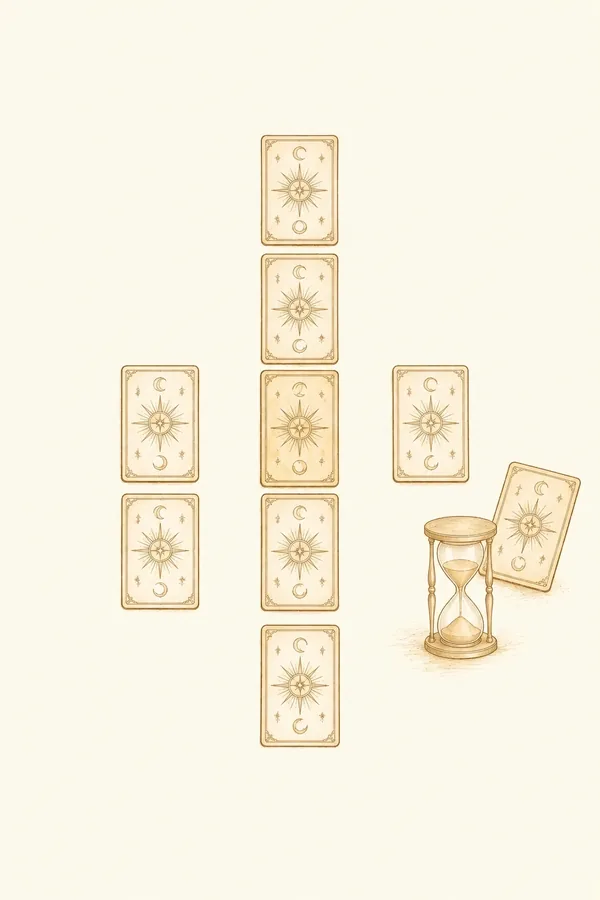
The Celtic Cross is the most widely recognized tarot spread in the Western world—a ten-card layout that has become the default choice for readers facing complex questions. Its structure moves from the heart of a matter through opposing forces, underlying roots, recent history, conscious goals, approaching influences, the querent’s own stance, environmental factors, and finally a trajectory of hope or fear alongside a projected outcome. That depth of coverage explains its popularity, but it also explains a particular frustration: seekers often arrive not asking what will happen, but when.
A Celtic Cross timing reading addresses that question directly. In tarot terms, timing is not a mechanical prediction but an interpretive art—cards do not display dates the way a calendar does. Instead, readers assess tempo, pacing, and developmental stages to estimate windows of possibility: is the energy quickening or stalled? Is the matter ripening now or still forming in the roots? This guide explores how to approach the Celtic Cross with time as the explicit focus. You will learn the standard layout, how each card position can be read through a temporal lens, and practical techniques—such as suit associations and card sequencing—for estimating when events are most likely to unfold. Timing in tarot is suggestive rather than clockwork, but read with intention, the Celtic Cross can offer genuinely useful windows.
Why the Celtic Cross Works for Timing Questions
Timing questions—“When will this happen?”—defeat single cards and even three-card draws because they ask for a trajectory, not a snapshot. A lone card gives a mood; a three-card spread gives a sequence. The Celtic Cross gives a system: ten positions that map momentum, pressure, and pace at once.
The Cross as Timeline
Positions 1–6 read as a compressed timeline. Past Influence (5) and the querent’s foundation (6) show what has already gained speed, Present (1) and Challenge (2) show the current trajectory, and Near Future (3) and the positional Crown (4) show where that momentum lands next. Because Past Influence, Near Future, and Outcome appear in the same layout, a reader can trace a single arc: what launched the situation, how it is accelerating or stalling, and where it finally resolves. If the Past card is a Knight charging forward and the Near Future card is a static Four, you can already sense a slowdown before you reach the Outcome.
The Staff as Conditions
Positions 7–10 supply the surrounding conditions that speed up or delay events—external factors, timing pressures, and the querent’s own stance. This is the Celtic Cross’s timing advantage: it separates what is moving (the cross) from what is pushing or braking it (the staff). A near-future card can change pace depending on whether the staff shows supportive or obstructive surroundings.
Imagery as a Timing Clue
Rider-Waite imagery makes pace visible. Knight cards are motion itself—Wands fast and impulsive, Cups measured, Swords sharp and sudden. Compare them with static figures like the Four of Pentacles or the Hanged Man, and the spread almost reads its own clock. This is why the Celtic Cross suits timing: it lets you watch a situation move rather than guess at a moment.
The Ten Positions and Their Timing Signals
In a celtic cross timing reading, each of the ten positions carries its own clock. Read them as a sequence of timing signals rather than static meanings.
The Ten Positions
- Significator: the current situation’s clock. A fast card like the Two of Pentacles juggling suggests events are already moving; the Eight of Pentacles slow craft says things take deliberate time.
- Crossing: what stalls or accelerates. The Eight of Swords hints at delay through overthinking; the Chariot signals acceleration.
- Foundation: old roots that delay. The Four of Pentacles shows entrenched patterns holding timing back.
- Recent Past: what already passed, confirming momentum already spent.
- Crown: what you’re consciously timing. The Wheel of Fortune shows awareness of cycles turning.
- Near Future: the closest window. The Six of Wands points to quick, visible progress.
- Self: your own pace and readiness in the matter.
- Environment: external timing influences. The Three of Wands suggests waiting on distant developments.
- Hopes and Fears: expectations that distort your sense of timing.
- Outcome: the furthest marker. The Ten of Pentacles shows a long, settled horizon; the Ace of Swords a sharp, sudden turn.
Compare fast and slow cues across positions to gauge when events actually unfold.
Reading Speed in the Cards with Rider-Waite Symbolism
In a Celtic Cross timing reading, the cards themselves suggest pace. The Near Future position (card 6) is your timing anchor, but each card carries its own tempo.
Fast Movers
Knights ride hard—especially the Knight of Wands on his rearing horse—signaling events days to weeks away. Wands generally accelerate outcomes, and the Chariot’s charging sphinxes confirm swift momentum. The Eight of Wands, wands flying through open sky, is the deck’s clearest “soon” card, often pointing to days.
Slow Movers
Pentacles ground and delay; the Hermit’s solitary lantern suggests months of gestation. The Hanged Man’s suspended figure signals a deliberate pause, while the Four of Swords’ recumbent knight counsels rest before movement resumes.
Aces and Tens
Aces show a seed just sprouting—near beginnings. Tens mark cycles nearly finished, with resolution close at hand.
Reversals and Court Cards
A reversed or blocked card in the Near Future pushes the timeline outward; the energy must clear first. Court cards often mean you’re waiting on another person’s timing—the Queen of Pentacles won’t be rushed. Read these cues together for a realistic estimate.
Suit and Season Timing Techniques
In a Celtic Cross timing reading, the suits give you a practical clock. Many readers map Wands to days or summer, Cups to weeks or spring, Swords to quick decisions or autumn, and Pentacles to months or winter. Others assign suits to seasons only and leave the question of “when” to the spread’s positions. Both approaches work; the key is choosing one system and staying consistent across readings so your interpretations build on each other rather than contradict.
Choosing Your System
Decide before you shuffle whether you are timing by unit (days, weeks, months) or by season, then apply that lens to every card in the spread. Consistency sharpens your readings—a Wands card in the Near Future means the same thing to you every time, which makes patterns easier to spot.
Sample Reading
Suppose the Eight of Wands falls in the Near Future and a slow Pentacle card, such as the Four of Pentacles, lands in the Outcome position. The Eight of Wands signals a fast launch—days, not months—while the Pentacle Outcome warns that consolidation takes far longer. Read together: expect a quick start with a slow finish. The reading tells the querent momentum arrives soon, but lasting results require patience, so they should plan for the long haul rather than abandon the effort when progress slows.
The Celtic Cross Timeline: Connecting Positions 4, 6, and 10
The Celtic Cross is not a static list of cards; it is a moving story. For timing questions, three positions form the spine of that story: Recent Past (4), Near Future (6), and Outcome (10).
Anchoring the Story
Position 4 anchors where you have been—the event or attitude that set the current in motion. Position 6 shows the next bend in the road, the development already forming. Position 10 shows where the momentum lands if nothing diverts it. Read together, they trace a line from cause to consequence.
Tightening the Predicted Window
Check whether positions 6 and 10 share suits, numbers, or reversals. Matching cards tighten the window: shared suits suggest the timeline moves through that suit’s element (fast for Wands, steady for Pentacles), while shared numbers or mirrored reversals indicate the outcome arrives sooner than the surface reading implies.
The Blocked Near Future
A strong Outcome card with a blocked or reversed Near Future is a timing warning. It means the destination is sound, but the clock depends on resolving the crossing card first. Read Position 2 before promising a date.
Choosing Your Question for a Timing Reading
The Celtic Cross is not a yes/no oracle—it maps conditions, not guarantees. For a timing reading to work, your question must name a specific, dated goal so the spread has something concrete to measure. Position 10 (the Outcome) sharpens dramatically when it is anchored to a real event with a real horizon, rather than floating in the vague “What’s next?” territory.
Phrase for Windows, Not Verdicts
Ask “When will this job offer arrive?” rather than “Will I get the job?” The spread can show timing windows and the conditions surrounding them; it cannot promise outcomes. The same principle applies across contexts:
- Career: “When is the most likely window for an offer from this interview process?”
- Relationship: “When might a serious relationship become possible for me?”
- Relocation: “When will my move become practically possible?”
Each question names a dated goal and a measurable milestone. That precision tells Position 10 exactly what to time—and keeps your reading honest.
Step-by-Step Timing Reading Walkthrough
Frame the Question with a Timeframe
Begin by stating the question in time-bound terms: “When will this job offer materialize?” rather than “Will it?” Write the question down and place it where you can see it. This anchors the whole spread to a timeline.
Shuffle with Timeline Intent
As you shuffle, hold the intent of when clearly in mind—picture a calendar or the coming months. Cut the deck into three piles, then restack.
Lay the Ten Cards
Deal the traditional cross (cards 1–6) and staff (cards 7–10). Keep the layout familiar so the timing logic stays consistent.
Read the Cross as Sequence, the Staff as Context
The cross reads left-to-right as a timeline of events; the staff shows surrounding conditions that speed up or delay them.
Note Near Future and Outcome First
Turn to card 5 (Near Future) and card 10 (Outcome) before anything else. These two set the timing window. Then work backward through cards 4, 2, and 1 to see what must clear before the Outcome can land.
Summarize as a Concrete Window
Close by stating a window: “Likely within one to three months, if the crossing card resolves.” Name the specific card or condition that must clear first. This turns the reading into a usable forecast rather than a vague impression.
Common Timing Mistakes and How to Avoid Them
Timing questions are among the most common in a Celtic Cross reading, yet they trip up even experienced readers. Avoiding a few predictable missteps will keep your predictions honest and useful.
Expecting Exact Dates
The Celtic Cross is a spread built on symbolism, not a calendar. Demanding “the third week of March” from the cards forces precision the symbolism cannot supply. Offer windows and conditions instead—“when the current obstacle clears,” “within the next quarter”—and frame them as tendencies, not guarantees.
Reading Positions in Isolation
Reciting positions one through ten in strict order flattens the timeline the spread is trying to show you. The Near Future card means little without the cards around it; relationships between the crossing card, the staff, and the Outcome are what reveal pace and sequence. Read the story, not just the slots.
Ignoring Reversals and Slow Cards
A reversed or sluggish card in the Near Future quietly stretches the whole predicted window. Miss that, and your “soon” becomes the querent’s frustrating wait. Name the delays explicitly and adjust your timeframe accordingly.
Re-drawing When the Outcome Disappoints
When the Outcome frustrates the querent, the temptation is to shuffle again. Resist it. Repeated draws muddy the timing signal and teach the querent to shop for the answer they want. Record the first spread, sit with it, and revisit timing only after circumstances genuinely shift.
Sample Celtic Cross Timing Reading
Here is a worked example. A querent asks, “When will my career situation change?” The reader lays the Celtic Cross and reads positions with timing in mind.
Reading the Positions
- Significator — Two of Wands: The seeker is poised at a threshold, planning but not yet moving.
- Crossing card — Five of Pentacles: Scarcity and doubt block momentum. The present reads as stuck: resources feel thin and hesitation dominates.
- Near Future — Eight of Wands: Speed, news, and rapid developments. This is the quickening card, signaling that inertia is about to break.
Building the Timeline
The reader anchors the reading: a stalled present crossed by lack, meeting an Eight of Wands near future, suggests movement within weeks. The final Outcome card, the Ten of Pentacles, points to lasting security — a settled result arriving by the close of a season, with a settled outcome by early next season.
Practice Advice
Model this structure — stuck present, quickening near future, windowed outcome — on fictional querents before reading live. Invent cards, rehearse the phrasing “expect movement within weeks, with a settled outcome by early next season,” and refine your timing vocabulary. Confidence grows through repetition, not improvisation.
Reversed Cards, Clarifiers, and Timing Adjustments
Reversals change the clock in a Celtic Cross timing reading. Where an upright card suggests a season or a neat window, its reversed form usually signals a delay, an internal block, or an event that arrives later than expected. The energy is present but held back—often by the querent’s own hesitation, unfinished business, or conditions that haven’t matured.
Reversals in Key Positions
A reversed Near Future card (position 6) is the clearest timing signal: it pushes the window out. If the upright card implied weeks, the reversal may stretch that to months, or shift the arrival until a blocking factor clears. A reversed Outcome (position 10) is subtler—it often means the timing is not yet fixed. The destination stands, but the date depends on choices and developments still in motion.
Clarifiers for Positions 6 and 10
One or two clarifier cards beside positions 6 and 10 can narrow the window. Draw a single clarifier for each to ask, in effect, “When, and what unlocks it?” A clarifying card may name a season, a trigger event, or the condition that must be met before movement occurs. Keep clarifiers to one or two—they add detail, not different answers, and piling on cards muddies the reading rather than sharpening the timing.
Frequently Asked Questions About Celtic Cross Timing
Can tarot predict exact dates?
No. Tarot can suggest windows and pacing, but exact calendar dates are beyond what the cards reliably deliver. Treat timing cards as indicators of when energy is likely to move, not as appointments.
How far ahead does the Celtic Cross look?
It depends on the question’s scope. For a decision already in motion, the spread often reads weeks to a few months. For long-term themes, it can stretch to six months or a year. State your time frame before you shuffle so the reading stays anchored.
What if the Outcome card suggests something slow?
A slow Outcome card isn’t a dead end—it’s pacing information. Pair it with the surrounding cards: slow cards near active ones often mean the result arrives later but still arrives. Adjust your expectations rather than forcing a date.
Do timing rules work the same in every deck?
No. Suit-based systems (Wands = days, Cups = weeks, Swords = weeks, Pentacles = months) vary by reader and tradition. What matters is consistency: pick one method, use it across readings, and learn how it behaves for you. Beginners don’t need an “official” timing chart—they need a repeatable habit.
Final Tips for Trusting the Timeline
Timing with the Celtic Cross is less about pinning down a date and more about learning to read pace and direction. To build real confidence, keep a simple journal: note the question you asked, sketch the spread and the positions that spoke to timing, and record your predicted window. Then write down what actually happened and when. Over a few months, these entries become your most honest teacher, showing where your interpretations run early, late, or right on target.
Let the Spread Show Direction, Not Fate
Remember that the Celtic Cross reveals momentum—whether a situation is accelerating, stalled, or turning—while your choices and actions shape the final timing. Trust the timeline by treating it as a map, not a verdict.
Start Fresh on a New Cycle
When you’re ready to test your skill, ask a fresh timing question on the next new moon or the first day of the month. Date the entry, stay curious, and let each reading sharpen your sense of how events truly unfold.
For the methods behind it, see tarot timing techniques, how to ask tarot about timeframes, and the Celtic Cross as a timeline.
Recommended tool
The 10-Card Celtic Cross
Lay the full spread and read all ten positions of your question.
Keep reading
More on Celtic Cross
November 10, 2026
How to Combine Celtic Cross Cards
Ten cards, one reading: pairing positions, reading echoes and contradictions, and the three combinations that explain most spreads.
Read the article
November 4, 2026
How to Read the Celtic Cross Without a Guidebook
Read the Celtic Cross without a guidebook: the three questions that replace memorised positions, and how to build the story card by card.
Read the article
October 31, 2026
Celtic Cross Position 9: Hopes and Fears
Celtic Cross position 9: the card that holds hope and fear at once. How to tell which is speaking, and the question that separates them.
Read the article