November 5, 2026
How to Ask Tarot About Timeframes
How to ask tarot about timeframes without forcing dates: suit-based timing, why 'when' questions stall, and phrasing that gives a usable answer.
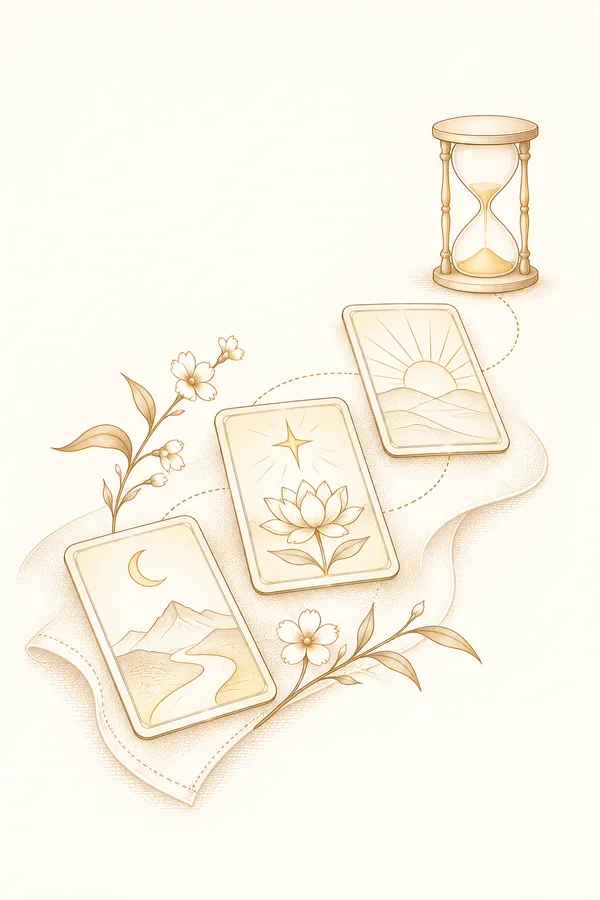
Tarot does not tell clock time. That single fact is the root of most frustration in timing readings. A querent asks, “When will I meet someone?” or “What exact date will I hear back about the job?” and the reader pulls cards that seem to promise “soon” or “by autumn”—then nothing happens on schedule, and confidence in the reading erodes. The problem is rarely the cards. It is the question.
Timing in tarot works best when it is treated as a study of conditions rather than a calendar lookup. Cards describe momentum, sequence, and readiness: what must happen first, what is blocking movement, and what a window of opportunity looks like when it opens. Ask for a fixed date and you force a symbolic system to do arithmetic it was never built for—which is why exact-date questions tend to produce vague, contradictory, or misleading answers.
This guide focuses on how to ask tarot about timeframes so the answers stay useful and honest. We will cover how to word timing questions around conditions and sequences, which spreads suit timing work, how card symbolism conveys pace and season, and the habits—like avoiding repeat pulls and false precision—that keep timing readings grounded. By the end, you will know how to frame a timing question that the cards can actually answer.
Why Timing Questions Fail Before You Even Shuffle
Most people who want to know how to ask tarot about timeframes make the same mistake before they even touch the deck: they ask, “When will it happen?” That question feels natural, but it hands the cards almost nothing to work with. A timeframe doesn’t exist in a vacuum—it depends on a situation, a decision, and the people involved. A vague “when” strips away all of that context, so the cards have no moving parts to reflect back to you.
Look at the Two of Pentacles in the Rider-Waite deck. He juggles two discs inside a loop, one foot lifted, the sea rolling behind him. Timing, as that image shows, is always a balancing act between competing priorities, energy, and choices. A useful timing question acknowledges those moving parts rather than demanding a fixed date.
Check What You’re Really Asking
Before you shuffle, pause and notice: is your question actually about time—or about fear, hope, or control? “When will they come back?” is often really “Can I stop feeling anxious?” “When will I get the job?” may be “Will I be okay?” Tarot answers the question you truly ask, so if the real question is emotional, a date-focused phrasing will give you a muddled reading.
Ask instead: “What needs to happen first?” or “What pace is realistic here?” Then the cards have something concrete to work with—and your timing question starts to earn its answer.
Scope Check: Is This One Question or Six?
Before you ask tarot about timeframes, check the scope of your question. A tangled ask produces a tangled timeline—if it produces one at all.
Run this five-point pre-pull check:
- Scope: One tension at a time. Multiple people, outcomes, or emotions split the reading’s focus.
- Ownership: Whose choices can the answer actually inform? Yours, primarily.
- Function: What should the reading produce—clarity on timing, a decision point, reassurance?
- Time horizon: What can current conditions realistically support? Weeks, seasons, or years?
- Evidence: How would you recognize the answer meeting something real in your life?
Take “When will he come back and will we be happy?” That’s at least six questions: his return, its timing, his feelings, your reunion, future happiness, and whether “we” even applies. No single card spread can carry that load.
Rewrite it as one clean ask: “What do current conditions suggest about the timeframe for us reconnecting?” Notice what drops away—the happiness verdict, his internal state, the guarantee. What remains is answerable, time-bound, and owned by you. Scope tightens, and the timeframe becomes readable.
Wording Timing Questions: Open, Closed and In Between
How you phrase a timing question shapes the answer you can actually use. A closed question—“Will it happen by June?”—forces the cards into a yes/no corner and usually produces a vague, unsatisfying result. An open timing prompt—“What needs to happen before this moves forward?”—invites the deck to describe conditions, pacing, and sequence instead.
Closed, Open, and the Middle Ground
Closed questions are not forbidden, but treat them as finishers, not starters. The productive middle ground sits between: questions that name the situation and ask the cards to reveal its rhythm.
A Bank of Usable Stems
- “What is the timeline for…?”
- “What season of this situation am I in?”
- “What is blocking the timing?”
- “What needs to happen before this moves forward?”
- “What can I do to speed this up or slow it down?”
Each stem keeps the reading descriptive rather than predictive, giving the cards room to speak.
One Timeframe Per Pull
Avoid stacking multiple timeframes into a single spread—“When will I meet them, and when will we commit?” muddles the answer. Ask one timing question, read it fully, then pull again for the next horizon. Clear questions produce clear timing.
Choosing a Time Horizon the Cards Can Support
When you ask tarot about timeframes, the first skill isn’t reading the cards—it’s choosing a span the spread can actually hold. A three-card pull offers a narrow window of narrative: enough nuance to trace a beginning, middle, and end, but roughly a season’s worth of movement, not a decade. Ask it to cover ten years and the cards will either blur into generalities or answer a different question than the one you intended.
Matching the Span to the Question
Set the horizon before you shuffle, and say it out loud in your question: “Over the next three months, what should I know about…?” Concrete anchors work best:
- One week for daily or weekly pulls—useful for pacing, energy, and immediate choices.
- One to three months for decisions like job offers, moves, or relationship conversations.
- Six to twelve months for big transitions such as career changes or long-term commitments.
Anchor Before You Ask
Avoid open-ended timing questions like “When will I meet my soulmate?” with no context—they invite vague or wishful answers. Instead, anchor the question in a defined period and a specific situation: “What should I focus on in the next six months to be ready for a relationship?” The cards respond best to bounded, present-tense questions—and so does your reading.
Timing Spreads Worth Learning
When learning how to ask tarot about timeframes, the spread you choose shapes the answer. Three layouts are worth mastering.
The Past-Present-Future Timeline
A three-card line read left to right clarifies sequence: card one shows the origin of the matter, card two the current state, card three what follows. Treat it as a narrative arc rather than fixed dates.
What Blocks / What Moves / What Lands
This variation targets pacing. The first card reveals the obstacle delaying events, the second the factor accelerating them, and the third the outcome once momentum resolves. It answers “how soon?” by showing what must shift first.
The Twelve-Card Zodiac Wheel
Lay twelve cards in a circle, one per astrological house, each representing a month ahead. This gives month-by-month windows and suits long-range questions, though it demands disciplined note-taking.
The Simplest Option Often Wins
A two-card “now / next” pull frequently answers timing questions more cleanly than elaborate spreads. Less structure means less room for creative interpretation.
Whatever layout you use, record the pull date and the predicted window in writing. That log is how you learn whether your timing readings actually hold up.
Reading Time in the Cards: Rider-Waite Symbolism
When learning how to ask tarot about timeframes, the Rider-Waite-Smith deck offers timing cues through imagery and rank—not as clockwork predictions, but as relative pacing. Read them as tempo markings, not timestamps.
Ranks as Speed
Aces and Pages signal beginnings and “soon”—an Ace marks a fresh seed, a Page the first knock at the door. Knights are movement itself: fast, transitional, arriving. Queens and Kings mature slowly; their timing is a ripening, not an event.
Suit Pacing
Wands move fastest (fire), Swords are quick but sharp and abrupt, Cups flow at a moderate emotional pace, and Pentacles are slowest—earth time, measured in seasons. The Eight of Pentacles shows deliberate craft, each coin placed patiently; the Six of Swords a gradual crossing over still water.
Specific Images as Timing
The Wheel of Fortune marks a turning point—sudden, fated, “when the wheel turns.” The Four of Swords is a deliberate pause: rest before movement resumes. The Ten of Cups reads as culmination—the fullness of a cycle completed.
Court Cards: People or Tempo?
Ask yourself which reading fits: a court card may represent a person entering the situation, or simply the pace of events. Clarify with a follow-up card before assigning timing.
When Traditional Timing Systems Actually Help
If you’re learning how to ask tarot about timeframes, traditional timing systems can be genuinely useful—as long as you treat them as refinement rather than precision. The Golden Dawn’s decan system, for instance, assigns each minor arcana card a 10-day window tied to astrological decans. The elemental suits map loosely to seasons: Wands to summer, Cups to autumn or water signs, Swords to spring or air, Pentacles to winter. The Four of Wands often serves as a spring or summer marker. These correspondences give you a vocabulary for narrowing “when,” not a guarantee.
Test Before You Trust
Before leaning on any system, keep a timing journal. Note the cards drawn, the question asked, and the actual outcome date. Over a dozen readings, you’ll see whether decans, seasonal suits, or the Four of Wands marker actually track with your experience—or whether you’re forcing patterns. Many readers find one method works and another doesn’t; that’s normal.
Cross-Check, Don’t Rely on One Card
A single card should rarely be your only timing anchor. When you ask tarot about timeframes, cross-check with a second spread: for example, a simple three-card layout with one position for “timing signal.” If one card says summer and a second spread confirms a similar window, you have reasonable confidence. If they conflict, treat the reading as “timing unclear” rather than hunting for a forced date.
Used this way, traditional systems sharpen your question instead of pretending to deliver a stopwatch.
Questions Tarot Isn’t Built to Answer
When learning how to ask tarot about timeframes, the first skill is knowing which timing questions the cards can’t answer—no matter how you phrase them. A pull reflects conditions and energies, not fixed appointments on a calendar. Ask for an exact date and you’ll get a card that means “soon,” “eventually,” or “when the ground shifts,” then spend the week arguing with it.
Timing asks that tend to waste a pull
- Exact dates — “Will it happen by June 15?” The cards show momentum, not clock time.
- Other people’s private decisions — “When will he propose?” You’re asking about someone else’s inner life; tarot reads your side of the dynamic, not their unspoken choice.
- Death and medical timelines — “When will she recover?” Fear-driven precision here is neither ethical nor accurate. Health questions belong with medical professionals.
- “When will I win the lottery?” — Windfall questions invite fantasy, not guidance. The cards can’t schedule luck.
Repair versions that actually work
- Exact date → “What conditions need to be present before this moves forward?”
- Someone else’s decision → “What’s the current energy between us, and what can I influence?”
- Health timeline → “What supports my wellbeing right now?” (then see a doctor)
- Lottery → “What’s my real relationship with money and risk?”
Every repair shifts the question from when to what—the territory tarot is actually built to map.
Asking Again, and What a Second Pull Really Tells You
When a timing reading doesn’t give you the answer you hoped for, the temptation is to shuffle and pull again on the same question. Resist it. Re-asking “when will this happen?” within the same reading cycle usually produces noise or wishful answers — the deck reflects your urgency back at you, not a cleaner timeline. A second pull on an unchanged question rarely tells you more; it mostly tells you that you didn’t like the first answer.
Set a Rule Before You Pull Again
Wait until something material changes — a conversation happens, an email arrives, a decision is made — before repeating a timing question. If nothing external has shifted, reframe the question entirely instead: not “when?” but “what needs to happen first?” or “what am I missing about this timeline?” A genuinely new question deserves a new spread; a repeated one usually doesn’t.
Journal the First Reading and Check It Later
Note what the first reading actually said — the cards, your interpretation, and the timeframe you derived. Then check it against reality when that window passes. This journal habit is how you learn your personal timing language and catch the difference between a reading that was wrong and one you simply re-pulled until it agreed with you.
A Worked Example: From “When Will He Text Back?” to a Clean Timing Reading
Step 1: Name the Worry Underneath
“When will he text back?” is rarely about the clock. It’s about uncertainty—does he care, am I waiting for nothing? Tarot can’t deliver a timestamp, but it can describe the pace and texture of movement. Reframe the question: “What energy surrounds this reply, and what should I watch for next?”
Step 2: Narrow the Scope
Drop the third-party mind-reading. A clean timing question keeps the focus on the situation moving around you. Choose a two-card Now / Next spread: Card one shows what’s happening, card two shows the pace of what follows.
Step 3: Draw and Read Honestly
Say you draw the Page of Cups in the Now position: an emotional message is stirring—sweet, tentative, maybe immature. Then the Four of Swords in Next. This is the key: the Four of Swords depicts rest and stillness, nothing fast. Together, the imagery suggests the energy exists (Page of Cups) but moves slowly, after a pause (Four of Swords). That means the reply likely comes after quiet space—not within a day. Resist adding a calendar date the cards didn’t give.
Step 4: Journal Note
Keep a note like: “Page of Cups + Four of Swords = tender but slow. Timing feels like ‘rest, then soft contact.’ Watch for quiet, not urgency.” Next time you ask about timeframes, check the note against what happened—that’s how your timing readings get honest.
Keeping a Timing Journal So the Cards Can Prove Themselves
When you’re learning how to ask tarot about timeframes, the cards can only prove themselves if you give them a record to be measured against. A timing journal turns each reading into a small experiment: you name a window before the event, then let reality render the verdict.
What to Log
For every timing question, capture six things:
- Date of the reading
- The exact question (“When will I hear back about the job?” not “career?”)
- Spread used, and the position assigned to timing
- Cards drawn, including the timing method (suits, numbers, court ranks)
- The window you predicted — write it as a concrete date range
- What actually happened, and when
Why It Works
This record is how personal timing patterns emerge. If Cups keep delivering within two weeks while Swords run long for you, the journal will show it. Watch repeat suits and court cards especially — a King of Pentacles may consistently signal “months, not weeks” in your readings, but only your log can confirm that.
A Simple Format
A notebook line or spreadsheet row works fine: Date | Question | Cards | Predicted window | Outcome | Actual date. Keep entries short; consistency beats detail.
Review Monthly
Once a month, scan your hits and misses. Adjust your suit and number assignments based on what your own record shows — that’s how general timing rules become your timing rules.
Common Beginner Mistakes with Timing Questions
Timing questions trip up even experienced readers, and beginners tend to repeat the same handful of errors when learning how to ask tarot about timeframes. Spotting them early saves months of confusing readings.
Demanding Exact Dates
Asking “What exact day will this happen?” forces the cards into a precision they don’t offer. Tarot reflects rhythms and seasons, not calendar appointments. The correction: ask for a range or a quality of time—“How soon?” or “What season does this energy belong to?”—rather than a fixed date.
Treating One Card as a Deadline
Pulling the Eight of Wands and declaring “it’ll happen in eight days” is a common overreach. A single card shows pace and momentum, not a countdown. Read timing cards as descriptors—fast, slow, stalled, ripening—and confirm with a second card or a spread position before committing to any number.
Letting Hope or Anxiety Override the Cards
When you desperately want a “yes, soon,” it’s tempting to bend a vague card into the answer you crave. Likewise, anxiety can turn a neutral card into a warning about delay. The correction: note your emotional stake before you shuffle, and read what’s drawn, not what you fear or wish.
Treating Ambiguity as Permission to Keep Pulling
An unclear card is not an invitation to redraw until something nicer appears. That’s how readings become noise. Instead, sit with the ambiguous card, ask a clarifying question once, or return to the spread later—trusting the original draw is part of learning to ask tarot about timeframes well.
Frequently Asked Questions About Timing and Tarot
Can tarot tell exact dates?
No. Tarot doesn’t read clocks; it reads energy and momentum. You can ask “What does the timing look like?” and pair the answer with a timing spread or a card-to-season mapping, but treat any date as a probability band, not an appointment. Use exact-date guesses only as a confidence check, never as a promise.
What does “soon” mean in a reading?
As little as you let it. Define “soon” before you pull: days? weeks? a season? Then run the same question through a three-card past/present/future spread or a timing wheel and compare. If the cards stay vague, ask a follow-up like “What needs to happen before this lands?” — it anchors “soon” to an event.
Which cards mean yes or fast?
No card guarantees speed. In timing work, Aces, Wands, and the Chariot tend to read as quick, direct movement; Swords can be swift but volatile; Pentacles and slow-moving majors like the Hermit or Hanged Man read as a long haul. Cross-reference with the yes/no check above rather than pulling one card.
How far ahead can tarot see?
Practically, weeks to a few months. Beyond that, readings blur because choices change the path. Keep questions inside a season, and re-ask later rather than stretching one spread.
Why did my timing reading change?
Because you acted, or the question shifted, or the spread was too vague. Re-run the same spread format with the same wording, and log results so you can see whether the change is real or noise.
Recommended tool
New to tarot?
Start with the beginners' cheat sheet and core keywords.
Keep reading
More on Methodology & Guides

October 9, 2026
How to Ask Tarot Questions: The Ultimate Guide for Clear & Accurate Readings
Vague question, vague reading. Learn how to ask tarot questions for clear, accurate answers every time.
Read the article
October 13, 2026
Tarot Timing Techniques: When Will It Happen?
When will it happen? Learn tarot timing techniques: suits, numbers, Majors, zodiac seasons, and honest ranges — never false dates.
Read the article
October 9, 2026
50 Best Questions to Ask Tarot for Love, Relationships & Soulmates
50 powerful questions to ask tarot about love, relationships, and soulmates - plus the ones to avoid.
Read the article