October 25, 2026
Celtic Cross Timeline: How to Read the Spread as a Story
Read the Celtic Cross as a timeline: the spine (3, 4, 6, 10), the present pivot, pairing cards across time, timing cues and contradictions.
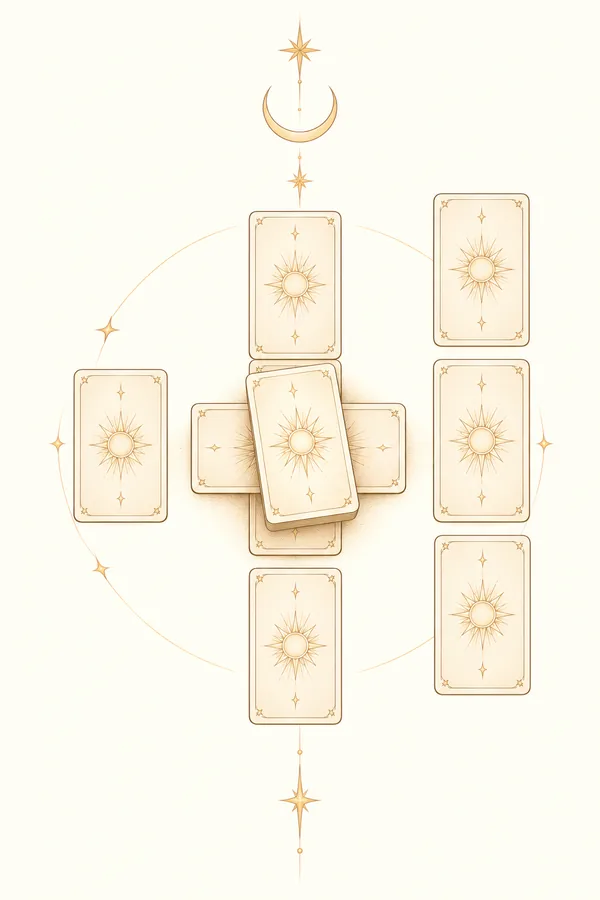
Most people who search for a Celtic Cross timeline interpretation guide have already done the hard part: they know all ten positions by heart. What they lack is a way to read those positions as a flowing story instead of ten isolated snapshots. That gap is exactly what this guide addresses.
Timeline interpretation means treating specific positions as a chronological spine. In the standard Celtic Cross, positions 3 (the roots, or what lies beneath), 4 (the recent past), 6 (the approaching future), and 10 (the outcome) form that spine. Read in sequence, they show where a situation came from, how it is currently moving, and where it is heading. The cross itself — positions 1 and 2 — anchors the present moment, giving the timeline a fixed reference point rather than an abstract sequence.
This method suits beginners in particular: readers who can lay out the spread correctly but freeze when the cards seem to contradict each other. Contradiction usually signals misreading, not a broken deck. When you separate present conditions from the timeline current, apparent conflicts often resolve into context.
The approach is practical and sequential: first read the cross to establish the present, then read the timeline to establish momentum, then synthesize the two into a single interpretation. The sections that follow walk through each step.
Why the Celtic Cross Reads as a Timeline, Not a Snapshot
Most people meet the Celtic Cross as a stack of ten separate answers, but the traditional layout is better understood as a timeline. Its positions encode time directly: card 3 holds the distant past, card 4 the recent past, card 6 the near future, and card 10 the final outcome. Read in sequence, these positions create a directional flow rather than a frozen verdict.
Sensing the Flow Through Imagery
Rider-Waite imagery makes that flow visible. The Fool at the start of his journey steps toward the cliff edge, poised at a beginning; the World at the end dances inside the wreath of completion. Placing such figures along the spread lets you feel forward movement across positions — from what has already happened toward what is still forming.
A Living Map, Not a Fixed Verdict
This is why the Celtic Cross timeline interpretation guide matters: cards 6 and 10 describe trajectory, not fate. They show where current momentum points if nothing changes. The spread is a living map you can revisit and revise, never a locked snapshot of your future.
The Timeline Spine: Cards 3, 4, 6, and 10
The Celtic Cross is usually read position by position, but four cards form a hidden timeline through the spread: Card 3 (distant past), Card 4 (recent past), Card 6 (near future), and Card 10 (outcome). Read together, they tell a single story from root to destination.
Build the Spine
Pull these four cards from the spread and lay them in a row, left to right, in timeline order. Read them as one sentence: this old pattern (3) was triggered by this event (4), which leads to this development (6), landing here (10) if nothing changes.
What Each Position Contributes
- Card 3 — the root. The origin of the situation: an old pattern, inherited habit, or long-standing cause.
- Card 4 — the trigger. The recent event or decision that activated the root and set things in motion.
- Card 6 — the next beat. The near-future development the trigger is steering toward.
- Card 10 — the landing point. Where the arc concludes if the querent changes nothing.
Read the Progression
Watch the suits move along the spine. Swords fading into Cups signals a shift from conflict toward feeling; Cups hardening into Pentacles shows emotion becoming practical commitment. Reversed and upright cards mark stalls and accelerations in the same thread. A Major Arcana card at any point flags a fated turning point — the story bends there, not merely drifts. If the spine contradicts the rest of the spread, treat it as the underlying plot and the other positions as commentary.
Anchoring the Present: Cards 1 and 2 as the Timeline’s Pivot
In a Celtic Cross timeline reading, every card hangs from the hinge formed by positions 1 and 2. Card 1 names the present situation—the ground you stand on. Card 2, the crossing card, names the tension that meets it: an obstacle, an ally, or an internal contradiction. Together they set the terms the rest of the spread must obey.
Reading the Crossing Card’s Geometry
Traditional layouts lay card 2 horizontally across card 1; many modern readers place it vertically, behind or beside it. Horizontal placement emphasizes active friction—something pressing against the situation. Vertical placement reads as a parallel force: a supporting condition, a hidden driver, or a quiet counterweight. Note which you use; the timeline’s logic depends on it.
Opposition, Support, and Reversals
A crossing card that clearly opposes card 1 marks a genuine crossroads. One that supports or softens it suggests the “problem” is really a resource. Reversals shift the tension: a reversed obstacle can mean resistance easing or turning inward; a reversed supporter can mean help withheld or misread. Read the pair as one statement before moving on.
Cards 3 and 4 in Light of the Tension
Interpret the past (3) and the foundation or recent past (4) only as explanations of the crossroads in cards 1–2. Ask of each: does this history built the present situation, feed the crossing challenge, or reveal where the tension began? A past card that doesn’t speak to the 1–2 hinge should be read as context, not cause—otherwise your timeline floats free of its pivot.
Reading the Cross Before the Staff
The Celtic Cross is a timeline before it is a verdict. In this celtic cross timeline interpretation guide, the sequencing rule is simple: read the six-card cross (positions 1–6) as the narrative core before touching the four-card staff (7–10). The cross tells the story in order — the situation at hand, the challenge crossing it, the roots beneath it, the trigger or recent past, the conscious aim, and the near future. Only once that arc makes sense should you move to the staff, where the querent’s self, environment, hopes and fears, and outcome contextualize the timeline with inner stance and outer pressure.
Why the Order Matters
The staff does not replace the story; it explains the conditions around it. Position 7 shows how the querent is meeting the situation, position 8 the external forces at play, and position 9 the hopes and fears coloring the near future. Read this way, the outcome card (10) lands as a conclusion to a told story rather than a bolt from the blue.
The Beginner Mistake
The common error is jumping straight to the outcome card before the narrative has been told. Without the cross’s sequence, the outcome reads as fate instead of consequence. Tell the story first; the staff then reveals how the querent stands within it.
Card 5 and Card 10: Goal Versus Landing
In a Celtic Cross timeline reading, Card 5 (the crown) holds the querent’s conscious goal—what they think they want and are actively steering toward. Card 10, the final outcome, shows where the timeline actually lands. Read together, these two cards measure the gap between intention and destination, and that gap is often the most useful information in the spread.
Reading the Pairing
Compare the two cards directly:
- Same suit, different rank signals adjustment: the goal and outcome share a domain, but the scale shifts. A Six of Cups goal against a Ten of Cups outcome shows the wish maturing into something fuller; reversed ranks suggest the landing falls short of the vision.
- Opposing elements reveals a grounding problem. A Wands goal (ambition, drive) against a Pentacles outcome (resources, tangible results) says the ambition must be anchored in practicality—budgets, timelines, and patience—before it can arrive.
- A Major in Card 5 with a Minor in Card 10 suggests the goal is larger than this situation can hold. The querent is reaching for something archetypal, but the timeline delivers a modest, concrete result. Name that honestly.
Using It in the Reading
State the goal in the querent’s own terms, then describe the landing without softening it. The space between the cards is where realistic strategy lives: adjust the target, ground the ambition, or accept that this chapter delivers a smaller version of the dream.
Pairing Cards Across the Timeline
The Celtic Cross reads as a story when you pair positions across its timeline. Read card 3 (root cause) beside card 10 (outcome): what seeds the situation often mirrors what it ripens into. When these two rhyme — same suit, matching numbers, repeated figures — a pattern is repeating, and the outcome will echo its origin until the root is addressed. Next, pair card 4 (past) with card 6 (near future): the past trigger projects forward, and a visual echo between them shows how yesterday’s event becomes tomorrow’s event. Pair card 1 (situation) with card 7 (the querent’s attitude) to check alignment — if they clash, the querent’s posture is working against the situation; if they match, self-awareness is high. Finally, read card 2 (obstacle) with card 8 (external pressure): inner resistance meeting outer resistance shows where the same lesson arrives from two directions.
Timeline Accelerators and Echoes
Note matching numbers (both Sixes, both Aces), repeated figures (the same Queen appearing at 3 and 10), or court cards facing the same direction — these mark accelerants and echoes. An echo says notice this; an accelerator says this moves quickly. Mark them before you interpret.
Working With Reversals Along the Timeline
Reversals in a Celtic Cross timeline reading rarely mean plain bad news. In positions 3, 4, or 6 especially, a reversed card usually signals an event that is stalled, internalized, or delayed rather than one that is purely negative. The energy is present but not yet moving in the world.
Practical Rules for Reversed Timeline Cards
- Reversed past cards point to unprocessed history still bleeding into the present. The matter is not closed; it is waiting to be integrated.
- A reversed card 6 (near future) often means the near future is on hold pending a choice. Something must be decided or released before the next step can land.
- A reversed card 10 does not mean doom. Read it as the timeline looping back for revision — an outcome that returns for another pass rather than a final verdict.
Rider-Waite imagery makes this concrete. The Hanged Man upright shows willing suspension and new perspective; inverted, the focus shifts to resistance, a pause that has become avoidance, or insight refused. Use such inversions to locate where the timeline is paused or doubled back, then ask what choice would set it moving again.
Timing Cues: Suits, Numbers, and Majors in the Timeline Positions
In the Celtic Cross, the staff positions (roughly 7–10) carry forward motion, making them your best candidates for timing cues. Read them as pacing indicators rather than fixed dates.
Suits as Speed
Fast suits move quickly: Wands suggest weeks, Swords days to weeks. Slow suits unfold gradually: Pentacles point to months or a season, Cups to an emotional arc that ripens on its own schedule. A future position dominated by fast suits signals near-term movement; slow suits counsel patience.
Numbers as Rhythm
Aces mark beginnings—something is about to start. Mid-range numbers (Fours through Sevens) suggest a process underway. Tens mark completions, indicating a cycle is closing. Note the number in the outcome position especially.
Majors as Turning Points
A Major Arcana card in a future position marks a turning point governed by larger forces, not the querent’s schedule. Timing becomes less predictable; the event arrives when it arrives.
Offer Timing Softly
Timing is the most speculative layer of any reading. Present it as a range—“weeks, not days” or “this season”—never a promise. Frame cues as tendencies the querent can work with, not deadlines set in stone.
When the Timeline Contradicts Itself
A bright card 10 paired with a bleak card 6, or a hopeful goal shadowed by a harsh outcome—these are not flaws in your Celtic Cross reading. They are the reading telling you where the tension lives. Treat the contradiction as information, not error.
Three Steps to Resolution
1. Locate the contradiction. Name the two cards in conflict and their positions. “The Empress crowns you at card 10, but card 6 shows the Five of Pentacles.” Specifics keep you from smoothing over the friction.
2. Identify the conditional card. In the Celtic Cross, card 6 (near future) is almost always the hinge—it describes what you are about to move through, not a fixed verdict. Card 10 is the destination if the current trajectory holds. When they clash, card 6 usually carries the condition: the outcome depends on how you meet what’s coming.
3. Frame around the choice point. Ask: what decision does card 6 present? The near future may require passing through difficulty to reach the bright outcome—or the bleak outcome may be averted by changing course now. The reading’s value sits at that fork, not in the final card alone.
Read the timeline as a sentence with a conditional clause, not a verdict. The contradiction is the clause.
A Worked Example: Tracing One Question Across the Ten Cards
Ask a concrete question — “Should I accept the job offer?” — and let the timeline emerge across the spread. In the distant past (position 3), the Four of Cups suggests a prior season of apathy or a chance once declined. The recent past (position 4) shows the Page of Swords: restless research, questions asked, information gathered. That momentum lands in the present (1–2): the Two of Pentacles juggling options, crossed by the Eight of Swords — indecision that feels more trapped than it truly is. The near future (6) brings the Ace of Wands, a spark of decisive energy.
Setting the Tension
The cross holds the question’s core contradiction: balancing two lives against a fear that stalls choice. Above, the Star (7) names the aspiration — a fresh, hopeful chapter; below, the Four of Pentacles (8) warns against clinging to security.
Refining Into Action
The staff resolves the tension. The Hermit (9) counsels solitary reflection before committing; Judgement (10) points to a clear, overdue decision. Three actionable threads: research thoroughly (Page of Swords), release the scarcity grip (Four of Pentacles), and trust the rising spark (Ace of Wands). The cards narrate a passage from apathy to agency — illustrative, not prescriptive.
Landing the Reading in Three Takeaways
Close every Celtic Cross reading with synthesis, not summary. The seeker does not need ten separate card definitions recited back to them — that scatters the reading and buries the timeline. Instead, distill the spread into three takeaways that hold the timeline together.
1. The Timeline’s Direction
Offer one insight about where the arc is heading: from the foundation and recent past, through the turning point, into the near future and outcome. Name the momentum in a single sentence. This is the thread the querent will remember.
2. The Querent’s Agency
Give one takeaway drawn from cards 1, 2, and 7 — the present position, the crossing influence, and the querent’s stance. These cards show where the seeker actually stands and what they bring to the situation. Frame it as agency: what they can work with, not what is being done to them.
3. The Practical Next Step
Draw one concrete action from the near future card. Keep it small, timely, and within the querent’s reach — the near future is where the timeline becomes touchable.
Emphasize the outcome card as a trajectory the querent can still influence, especially when card 6 marks a clear turning point. The outcome is a destination the reading points toward, not a verdict already sealed.