November 6, 2026
What It Means When Tarot Cards Fall Out
A card jumps out mid-shuffle: accident, emphasis or interference? How to read fallen cards without superstition, and when to put them back.
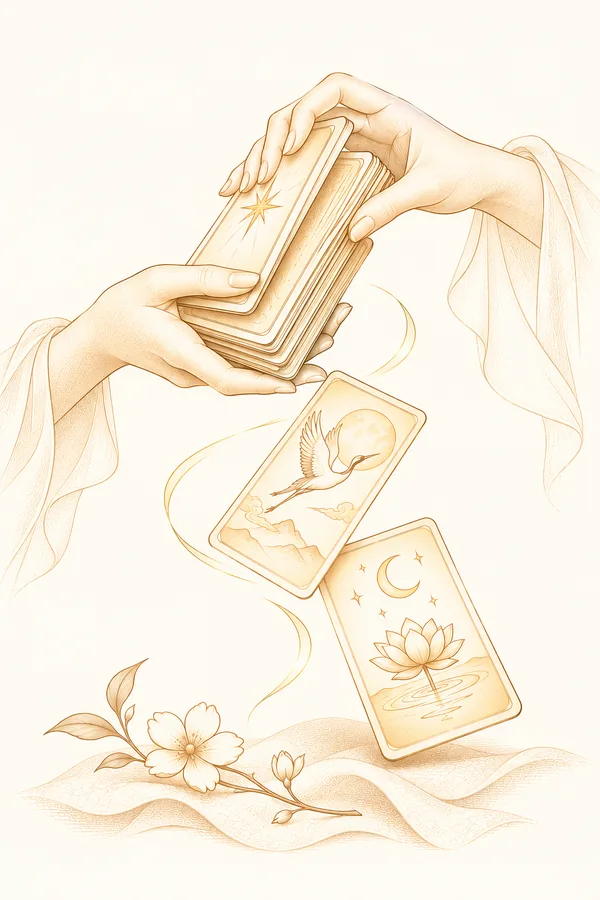
You’re shuffling your deck, maybe half-thinking about your question, when suddenly a card leaps from the pack and lands face-up on the table. Or three cards slide out at once and scatter across your reading cloth. If this has happened to you, you’re in good company—what does it mean when tarot cards fall out is one of the most common questions readers search for, and for good reason. It’s a genuinely odd moment that can feel too pointed to ignore, yet too random to trust.
Here’s the reassuring part: cards falling or jumping out of the deck during a shuffle is a normal, everyday experience. It happens to complete beginners and to readers with decades of practice. It is not a sign that you shuffled incorrectly, asked the wrong question, or somehow “broke” the reading. The cards are physical objects—slick, flexible, and often oversized—and gravity does what gravity does.
That said, many readers treat a fallen card as meaningful, and there are good reasons to take the phenomenon seriously without overthinking it. In this guide, we’ll cover what a jumping card is traditionally understood to mean, how to decide whether to include it in your reading, and when the wisest move is simply to slide it back into the deck and keep shuffling.
What It Means When Tarot Cards Fall Out: The Core Answer
When a card falls out of the deck while you’re shuffling, the most common reading is simple: treat it as an extra message. Many readers call these “jumpers”—cards that seem to leap forward on their own to demand attention. The usual approach is to note the card, place it beside your spread, and read it as a nudge from the deck or a thread running underneath your main reading.
Two Schools of Thought
Readers generally fall into one of two camps:
- Intentional energy. The falling card is meaningful—a message the querent needs whether or not they asked for it. Some read it as a clarifier, some as the true heart of the matter, and some as advice to keep in mind.
- Simple clumsiness. A card fell because hands are hands and decks are slippery. In this view, it carries no special weight, and forcing meaning onto it can muddy a clean reading.
Decide by Context
There’s no universal rule, so use context. If you’re shuffling carefully and a single card flips out cleanly, that’s worth noting. If you drop half the deck, that’s probably physics. Notice too whether the card resonates with you—but don’t strain to make it fit.
Above all: no card falling out is ever bad luck. Nothing about a slipped card is an omen of misfortune. It’s either a message worth considering or a small accident—and you get to decide which.
The “Jumper Card” Tradition and Where It Comes From
When a card slips from the deck while you shuffle, many readers call it a “jumper” and read it as a message — often the most important card in the spread. But this practice isn’t part of the classic Rider-Waite-Smith (RWS) instruction. The original RWS materials and early tarot guides say nothing about dropped cards; the tradition grew informally within modern reader communities.
How the Practice Spread
As tarot reading moved from closed esoteric orders into public workshops, online forums, and social media, readers swapped techniques. The jumper card spread through this peer-to-peer teaching — easy to demonstrate, memorable to students, and appealing because it feels spontaneous. Over time, many readers elevated the jumper to a place of special importance: a card the deck “chose” to surface, read as a central theme or urgent advice rather than a stray slip.
Why It Fits the RWS Approach
This emphasis on the unexpected card reflects the RWS tradition’s balance between fixed meanings and intuition. Classic RWS instruction assigns each card a defined meaning, yet it also encourages readers to trust their instincts and notice what draws their attention. The jumper tradition extends that principle: a card that falls out is treated as a prompt for intuitive attention, not a violation of the system.
So when tarot cards fall out, the jumper tradition offers one common answer — but it’s a modern, community-grown convention rather than a rule of classic tarot.
How Many Cards Fell and Where They Landed
When a card jumps from the deck, the first thing to note is how many fell. A single jumper usually carries one focused message—a nudge from the cards about the topic at hand. When several cards tumble out together, read it as a broader theme or a sense of urgency; the deck is speaking in a fuller sentence rather than a single word.
Position and Orientation Matter
Where the card lands adds nuance to what it means when tarot cards fall out. A card that lands face-up and upright is read much like a normal draw—clear and direct. Face-up but reversed suggests the message is blocked, internal, or still unfolding. A card that lands face-down is softer: it may invite a gentler or more hidden reading, pointing to something you sense but aren’t yet ready to see plainly.
Distance From the Reader
Proximity counts too. A card falling close to you feels immediate and personal, while one landing far across the table or floor can signal a matter at arm’s length—or a message that will unfold over time. Before interpreting, pause and simply observe: how many fell, and exactly where they came to rest.
Which Cards Tend to Fall Out and What They Signal
When a card jumps or falls from the deck while shuffling, the identity of that card carries more weight than the fact that it fell. A falling Tower or Death tends to alarm querents, but in practice these cards usually signal needed change rather than catastrophe—the Tower’s lightning-struck crown and crumbling stone point to a structure that was already unstable, and the fall simply mirrors that collapse. Death, similarly, marks an ending that clears space for renewal, not literal loss.
Reassuring Cards
A falling Star or Sun offers a gentler message. The Star’s figure pouring water from two vessels—one onto land, one into the pool—suggests restoration and quiet hope, while the Sun’s bright child on horseback signals clarity and relief. When these cards fall, read them as encouragement rather than warning.
Avoid Panic-Reading
The most common mistake is panic-reading dramatic Major Arcana. A tumbling Tower does not mean disaster is coming; it means something in your life is asking to be rebuilt. Let the imagery sharpen the message: ask what structure in your situation resembles that falling crown, or where you are being asked to pour out and replenish. The card that falls is the card to sit with—not to fear.
Reading a Fallen Card Alongside the Spread
When a card jumps out mid-shuffle or mid-deal, resist the urge to tuck it back into the deck. Set it face-up beside your spread instead, so the reading can speak to both at once. That placement is the whole point: the jumper becomes a live commentary on the layout rather than a stray interruption.
Three ways to integrate it
- As a clarifier: Let the jumper expand a card that feels vague or contradictory in the spread. If the Three of Swords sits in the outcome but feels flat, a fallen Star may clarify the recovery arc.
- As an underlying influence: Read the jumper as the current running beneath the spread—the mood, worry, or hope shaping every card you laid out.
- As a near-future card: Treat it as the next beat after the spread’s outcome, especially when the reading covers a short window.
When it accents vs. overrides
Most of the time the jumper accents the spread: it sharpens or deepens the main narrative without replacing it. Let it override only when it directly contradicts the spread’s central message or repeats a card already present—a strong signal to weight the jumper more heavily than the layout. In either case, interpret the spread first, then ask how the fallen card modifies it—not the reverse.
When Falling Cards Mean Nothing at All
Not every card that hits the floor is a message. Sometimes a fall is just physics. Ask anyone who has opened a slippery new deck fresh from the box—those first shuffles send cards flying constantly. A cramped hand gripping too tightly, a loose shuffle that lets the deck fan out, or a gust from an open window can scatter cards mid-reading without a whisper of symbolism involved.
A Simple Practical Rule
If cards spill repeatedly during a session, stop reading meaning into it and check the mechanics. The deck may simply be too large for your hands, especially common with oversized or thick-stock editions. Try a smaller size, shuffle in two halves, or deal from a cut deck instead of riffling. A too-loose shuffle—letting cards splay rather than interleave—also causes chronic drops. Tighten your grip slightly and shuffle over a table with a soft cloth to catch strays.
Dismissing a Fall Is a Valid Choice
Beginners often feel pressured to treat every tumble as the cards “jumping” with urgency. You are allowed to disagree. If a card falls from a slippery deck on a windy afternoon, picking it up and returning it to the pile is grounded, sensible practice—not a missed omen. Note it if it feels meaningful; let it go if it doesn’t. That discernment is part of reading well.
Common Questions About Cards Falling Out of the Deck
When a card jumps or drops from the deck, readers often wonder how to treat it. Here are the questions that come up most.
Is a fallen card a yes or no answer?
No. A single fallen card is a stray energy signal or emphasis, not a yes/no verdict. If you asked a yes/no question, finish the spread and read the answer there. You can note the fallen card as extra context, but don’t let it override the reading.
Should you put it back and reshuffle?
Usually, yes. Return the card, reshuffle, and continue. If the same card falls out again immediately, treat that as a sign to keep it out and read it alongside the spread. Otherwise, one drop is just a drop.
Does it count if it falls during someone else’s reading?
Yes, as a message for the querent, not for you. Acknowledge it, note its meaning, and ask the querent if it resonates. Don’t make it the center of the reading unless it keeps recurring.
Can the same card fall twice in one session?
Yes, and when it does, take notice. A repeat faller is usually a card the deck wants heard. Set it aside and read it as a recurring theme or a direct message tied to the question.
Practical Tips for Handling Jumpers in Your Own Practice
When a card jumps out of the deck mid-shuffle, the question “what does it mean when tarot cards fall out” can derail an otherwise grounded reading. A simple ritual framework keeps you centered.
A Four-Step Framework
- Pause. Stop shuffling and take one breath. Resist the urge to instantly assign meaning.
- Note the card and direction. Record which card fell and whether it landed face up or face down, toward you or away.
- Finish the shuffle. Complete your usual process so the spread itself remains intact.
- Decide deliberately. Choose whether to include the jumper as a clarifier—or set it aside entirely. Either is valid.
Keep a Jumper Journal
Log each fallen card with the date, question, and your eventual interpretation. Over weeks, patterns emerge: a card that jumps repeatedly may deserve attention, while a one-off fall is often just a loose grip.
Trust Your Judgment
The deck is a tool for reflection, not a source of commands. If a jumper feels meaningful, explore it; if not, return it to the deck without guilt. Your calm, consistent judgment outranks any superstition about falling cards.
Recommended tool
New to tarot?
Start with the beginners' cheat sheet and core keywords.
Keep reading
More on Methodology & Guides
October 26, 2026
How to Interpret Court Cards in a Reading
Court cards can be a person, a mood or a role. Learn the ranks, the suits and the questions that settle which reading applies, without second-guessing.
Read the article
October 13, 2026
How to Read Reversed Tarot Cards: Meaning Without Fear
Upside-down cards? Learn how to read reversed tarot cards with five lenses, a 4-step process, and honest limits — no fear required.
Read the article
October 10, 2026
How to Read Tarot Cards Together: Synthesis and Narrative Techniques
Stop reading cards in isolation. Learn synthesis and narrative techniques to read tarot cards together as one story.
Read the article