November 20, 2026
How to Read Tarot for Someone Else
Reading tarot for someone else: how to frame the question, set ethical boundaries, read aloud, and deliver hard cards with care.

Reading tarot for someone else is a skill, not a supernatural gift. When you sit across from a querent—the person you’re reading for—your role is that of a neutral guide: someone who uses the cards to help another person reflect, clarify, and make their own decisions. You are not a fortune-teller handing down fixed fates, and the sooner you internalize that distinction, the more trustworthy your readings become.
Reading for yourself and reading for a querent are two very different experiences. A solo reading is private and forgiving; you can sit with a card for an hour, change your mind, or abandon the spread entirely. A reading for someone else happens in real time, in front of an audience of one, and carries an implicit promise: that you will listen carefully, stay impartial, and never use the cards to impose your own agenda. This is why boundaries, empathy, and clear communication matter more than any claim to psychic ability. The most accurate card in the world means nothing if the reader steamrolls the querent’s feelings or delivers a prediction as a verdict.
Throughout this guide, we’ll use the Rider-Waite-Smith deck as our default reference, since most beginners start there and its imagery remains the shared language of modern tarot. You’ll learn how to prepare yourself and your space, navigate the ethics of reading for others, frame useful questions, choose appropriate spreads, and deliver messages with honesty and care.
Preparing Yourself and Your Deck Before a Reading
Reading for someone else begins before they sit down. Confidence comes from preparation, not performance, so give yourself ten quiet minutes to arrive fully.
Ground and Centre
Sit comfortably, feet flat, and take a few slow breaths. A simple practice works well: name five things you can see, four you can hear, three you can feel. This settles your attention in the room rather than in your own nerves. Set a quiet space too—silence your phone, soften the lighting, and let the querent know you’ll take a moment to settle.
Cleanse and Attune the Deck
Choose whatever method suits you: a knock on the deck, a pass through incense or sound, leaving it overnight with a clear quartz, or simply holding it and setting an intention. There’s no single right ritual—consistency matters more than ceremony.
Practical Logistics
A clean table, a spread cloth, good lighting and a glass of water for both of you create a calm, unhurried atmosphere.
Shuffling Rituals
Shuffle in your usual way, then offer the deck to the querent: “Would you like to shuffle and hold a question in mind?” If they decline, shuffle again yourself and proceed without comment. Preparation is quiet, unglamorous, and entirely the point.
Setting Ethical Boundaries and Consent
Reading for someone else begins with informed consent. Before any cards are drawn, explain what tarot can and cannot do: it offers reflection, perspective, and symbolic insight—not medical, legal, or financial prescriptions. Make clear that health concerns belong with doctors, legal matters with lawyers, and money decisions with qualified professionals, and that you will not make those calls for the querent.
Handling Third Parties
If a question concerns someone who has not consented (“What is my ex thinking?”), decline it kindly and redirect: “I can’t read for someone who hasn’t agreed, but I can read on how you might approach the situation.” This protects both the absent party and the querent.
Caring for Vulnerable Querents
Watch for distress, dependency, or pressure to make major decisions on the spot. Offer a pause, suggest supportive professionals where appropriate, and never exploit uncertainty.
Confidentiality and Stop Rights
Promise confidentiality and keep it. Tell the querent they may pause, redirect, or stop the reading at any time—no explanation required. Remind them that tarot illuminates choices; it does not make them. The querent holds full responsibility for their own decisions, and a good reading returns that power rather than taking it.
Framing the Question with the Querent
When you read for someone else, the question matters as much as the cards. Your first job is to help the querent move from a vague worry to a focused, open question. Take a hypothetical querent, Maya, who opens with, “Will my ex come back?” That yes/no framing limits the reading: the cards can only confirm or deny, and a “no” leaves her with nothing actionable. Reframe it together: “How can I approach healing from this relationship?” or “What do I need to understand about what ended?” Now the spread has room to offer guidance.
Why Open Questions Work
Open questions (“How can I…”, “What should I know about…”) let the cards describe dynamics, options, and inner shifts. Yes/no questions collapse that richness into a coin flip and quietly hand the deck authority over a future nobody controls.
Handling Timeframes Honestly
If Maya asks “When will I meet someone?”, resist promising dates. Explain that tarot shows energy and momentum, not calendars, then reframe: “What can I do to be ready for a relationship?” Discuss timing as seasons or phases, always with a caveat.
Good Versus Poor Phrasing
Poor: “Does he still love me?” Good: “What do I need to understand about his feelings and my own?” Help Maya leave with a question she owns—one that keeps her agency at the center of the reading.
Choosing and Laying Out a Spread
When you read for someone else, the spread is your shared map. Choose it together—or choose it deliberately—so the querent knows where the conversation is heading.
Beginner-Friendly Spreads
- One-card pull: Perfect for a focused question or a nervous first-timer. It answers one thing clearly and keeps the reading brief.
- Three-card past/present/future: A gentle narrative arc. Use it for “where is this going?” questions and to help the querent see momentum rather than fate.
- Five-card cross: Position one names the situation, two the obstacle, three the advice, four the likely outcome, and five an underlying influence or hidden factor. Ideal when someone wants both insight and a next step.
Position meanings shape everything: the same card reads differently as “obstacle” than as “advice.” Name positions aloud so the querent follows your interpretation.
Face-Up or Face-Down
Laying cards face-up lets you narrate as you go and invites the querent into the process. Laying them face-down first builds anticipation and lets you read the spread as a whole before details. Both work; ask what feels comfortable.
Match the Spread to the Question
Reserve a larger spread like the Celtic Cross for complex, layered situations—not a quick yes/no. If the question is small, a small spread serves the querent better.
Reading the Cards Aloud: Major and Minor Arcana
When you read for someone else, your job is translation. Take the Lovers: rather than announcing “union,” describe the Garden of Eden in the image—two figures, an angel above, a choice between innocence and experience—then ask, “Where are you standing at a crossroads right now?” The Tower’s lightning striking a crown from a stone fortress becomes: “Something you built on shaky ground is being shaken loose.” The Hermit’s lantern is “a light you carry alone while you figure out what’s true.” Translate image into sentence, then sentence into the querent’s life.
Big Themes and Daily Details
Treat the Major Arcana as the plot of a life—identity, loss, transformation—and say so: “This is a big chapter card, not a small one.” The Minor Arcana covers the daily weather. The suits are quick keys: Cups speak to emotions, Swords to thoughts and words, Wands to action and drive, Pentacles to money, body and resources. Tell the querent plainly: “This is a Cups card, so we’re talking about how you feel, not what you do.”
Court Cards as People and Attitudes
Court Cards confuse querents most. Offer them as people—the Queen of Cups as the empathetic friend—or as attitudes the querent can adopt. Ask: “Does this describe you, someone around you, or how you might need to act?”
Read slowly. Point at the card. Name what you see, then hand the meaning over in one clear sentence.
Synthesising Cards into a Coherent Story
When you read for someone else, the querent rarely remembers individual cards—they remember the story you tell. That story begins with pattern recognition.
Look for Patterns, Not Just Cards
Scan the whole spread before speaking. Repeating suits reveal where the energy lives: many Cups suggests emotional themes, while a flood of Swords points to mental activity or anxiety. Repeating numbers carry their own message—three Fives means instability and change are running through the situation. Majors clustered in one position (often the outcome or the querent’s role) signal a life-lesson or karmic weight; scattered Majors suggest fate is touching several areas at once. Also watch for visual echoes: repeated figures turning away, several figures sitting on thrones, similar colours recurring. These are threads, not coincidences.
Weave the Positions into an Arc
Treat the spread like a plot: past sets the scene, present is the tension, outcome is the resolution. Connect cards with language—“because,” “which leads to,” “meanwhile.” A challenging card in a strong position becomes a turning point rather than a verdict.
Balance Light and Shadow
Pair difficult cards with supportive ones in the same sentence, so the querent hears possibility, not doom. Name an obstacle, then name the resource beside it.
Notice What’s Absent
If no Wands appear, ask what action is missing. If the querent asks about love and no Cups show up, that silence is information—say so gently. Absence shapes a story as much as presence.
Delivering the Message with Sensitivity
When you read for someone else, your words carry weight. Aim for honest but kind, specific but open-ended: describe what the cards suggest, then hand the interpretation back to the querent.
Avoiding fatalistic language
Swap absolutes for possibilities. Instead of “You will lose your job,” try “The Tower suggests sudden change—what in your work life feels unstable right now?” Instead of “This relationship is doomed,” offer “The Ten of Swords marks an ending; what would closure look like for you?” Use phrases like “the cards point toward,” “one way to read this,” and “you might notice.” Always leave room for the querent’s agency.
Handling difficult cards without panic
Name heavy cards calmly before the querent reacts. For Death, say it signals transition, not literal death. For the Tower, frame it as upheaval that clears ground for rebuilding. For the Ten of Swords, acknowledge the painful ending while pointing to the dawn imagery—recovery follows. Pause, breathe, and invite questions.
Checking in with the querent
Ask often: “How does that land for you?” or “Does this connect to something in your life?” Let them link cards to their own experience rather than you dictating meaning. If they seem distressed, slow down and offer reflection points instead of conclusions.
Handling Difficult Questions and Emotional Reactions
Reading for someone else means you will eventually meet grief, fear, and tears across the table. Relationship breakdowns, health worries, grief, and career crises are the most common hard topics. Your job is not to fix the situation but to hold space: stay calm, speak slowly, and let silence do some of the work. If a querent cries, pause the reading, offer tissues and water, and say plainly, “Take your time. We can stop whenever you need.” Never rush past strong emotion to finish the spread. If distress seems ongoing or severe, gently suggest professional support—a doctor, therapist, or counselor—framed as care, not rejection: “This feels bigger than cards can hold, and you deserve real support.”
Answering Loaded Questions with Compassion and Limits
When someone asks, “Does he love me?” or “Am I going to die?”, respond with warmth and honesty about tarot’s limits. For the first, reflect the cards back as energy and choice, not verdict: “The cards show how things look now—not what he feels in his heart.” For the second, never predict death. Say directly, “Tarot isn’t a medical tool, and I won’t answer that. If you’re worried about your health, please see a doctor.” Reinforce pacing throughout: offer a break, check in, and remind them that they can pause or end the reading at any point.
Inviting the Querent into the Reading
When you read tarot for someone else, the querent is not a passive audience—they are a co-reader. The most accurate readings often emerge when you invite them into the process rather than delivering a monologue about what the cards “mean.”
Ask Before You Interpret
Try opening with an image-based question: “What do you notice first in this card?” or “What feeling does this figure bring up for you?” Their associations frequently unlock a layer of meaning you might have missed. A querent who says the Tower looks “freeing” rather than frightening has just told you something essential about where they are.
Prompt Without Leading
The key is neutrality. Avoid questions that smuggle in your own reading, like “Doesn’t this look like your fear of commitment?” Instead, use open prompts: “What stands out to you here?” or “If this card were a scene in your life, what would be happening?” Let silence do some work—give them a moment before you jump in.
Refine With Their Words
Use their responses to sharpen your interpretation. If they describe the Hermit as “lonely,” explore that; if they say “peaceful,” follow that thread. Reflect their language back: “You said this figure seems watchful—where in your life are you watching rather than acting?”
The reading works best as a dialogue. Your job is to hold the structure and symbolism; theirs is to supply the lived context that makes it land.
Closing the Reading and Next Steps
The final few minutes shape what your querent carries away. Summarise the reading in three or four clear sentences: name the central theme, the main tension, and the direction the cards suggest. Then offer something practical—a reflection question (“Where in your life does this feel most true?”) or one small action (“What’s one conversation you could have this week?”). Keep suggestions open-ended so the querent stays the author of their choices.
End on Empowerment, Not Verdicts
Avoid fixed predictions. Frame outcomes as possibilities: “The cards suggest this path is available—how you walk it is yours to decide.” Remind them gently that a reading is a snapshot of energies at this moment, not a verdict on their future.
Follow-Up and the “One More Card” Request
Offer a follow-up window—“If this raises questions, reach out in a week or two”—which honours the reading without creating dependency. When asked for “just one more card,” respond kindly but firmly: “We’ve covered the heart of it; sitting with it will serve you better than another draw.” Close with warmth and gratitude, leaving the querent grounded and empowered rather than anxious for more.
Aftercare: Journaling, Feedback and Practice
The reading ends, but your development as a reader doesn’t. Aftercare is where good readers become great ones.
Journal Every Reading
Keep a tarot journal with the spread you drew, the interpretation you gave, and — crucially — the querent’s reactions. Did a card land? Did they seem puzzled? Note it. Over time, patterns emerge: which spreads you rush, which cards you over-explain. This record is your most honest teacher.
Ask for Gentle Feedback
Close a reading by inviting feedback without pressure: “If anything I said didn’t quite fit, I’d genuinely like to know — it helps me learn.” When criticism comes, sit with it before responding. Thank the person, ask a clarifying question if appropriate, and resist defending your interpretation. A reading that missed is data, not failure.
Practise Before You Charge
Hone your skills on friends and at tarot meetups before accepting payment. Free practice readings give you room to make mistakes safely and to build the confidence and accuracy that paying querents deserve.
Common Beginner Mistakes
- Over-interpreting: pulling meaning from every minor detail until the reading becomes noise. Correct it by focusing on the two or three most significant cards.
- Rushing: filling silence with words. Slow down; let the querent respond.
- Projecting your own issues: noticing your interpretation mirrors your life, not theirs. Ask yourself, “Whose story is this?” before you speak.
Journal, listen, practise — and the tarot will teach you as much as you teach it.
For the next steps, see how to ask tarot questions, reading reversed cards, and court cards as people.
Recommended tool
New to tarot?
Start with the beginners' cheat sheet and core keywords.
Keep reading
More on Methodology & Guides

November 6, 2026
What It Means When Tarot Cards Fall Out
A card jumps out mid-shuffle: accident, emphasis or interference? How to read fallen cards without superstition, and when to put them back.
Read the article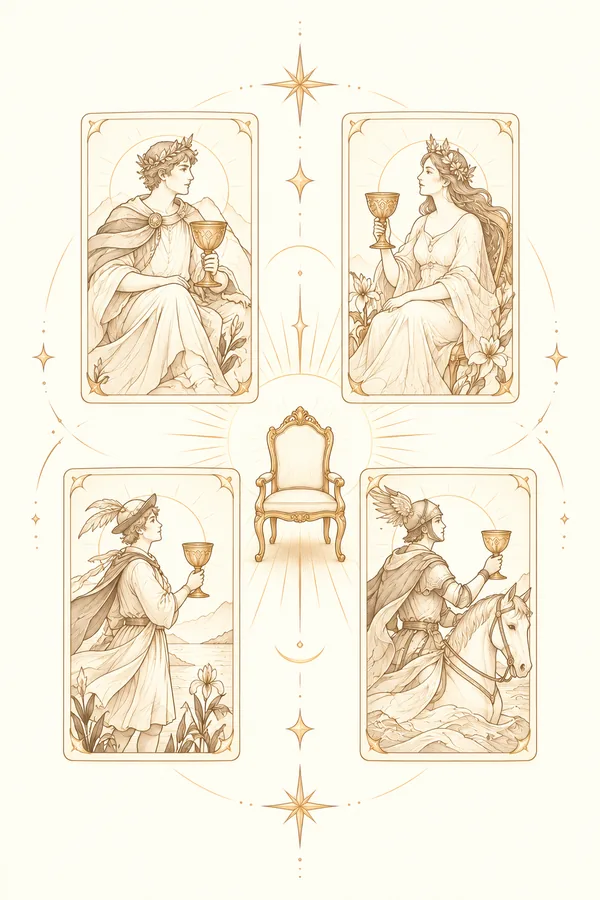
October 26, 2026
How to Interpret Court Cards in a Reading
Court cards can be a person, a mood or a role. Learn the ranks, the suits and the questions that settle which reading applies, without second-guessing.
Read the article
October 13, 2026
How to Read Reversed Tarot Cards: Meaning Without Fear
Upside-down cards? Learn how to read reversed tarot cards with five lenses, a 4-step process, and honest limits — no fear required.
Read the article