November 6, 2026
Daily One-Card Tarot Pull: A Simple Ritual
A daily one-card pull that stays useful: the two-minute ritual, how to phrase the question, and what to journal so it does not become noise.
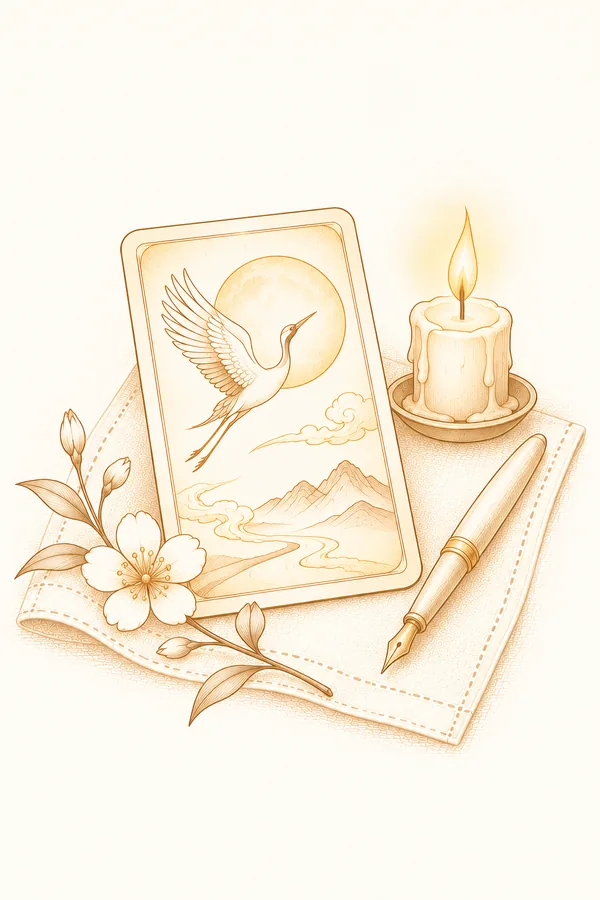
The daily one card tarot pull is one of the simplest and most repeatable rituals in tarot practice: you ask one focused question, draw a single card at the start of the day, and let it point to one clear next step. Nothing more is required—no elaborate spread, no hour-long ceremony—just you, a deck, and a few quiet minutes before the day takes over.
This simplicity is exactly why beginners and seasoned readers both return to it. For newcomers, the daily pull builds card familiarity faster than almost any other method: you meet each card in the context of your real life, so its meanings stick. For experienced readers, it keeps intuition sharp and delivers practical guidance for love, career, and everyday decisions—whether that’s a nudge to speak up in a meeting or permission to rest.
The practice draws on the Rider-Waite tradition and its rich symbolism, which means the same card can reveal new layers over time. The Fool you drew in January may mean something entirely different by June, because you have changed, not the card.
In the sections that follow, you’ll get the complete method: preparation, drawing, interpretation, journaling, and troubleshooting—everything you need to make this ritual a steady, useful part of your day.
Choosing Your Deck and Setting Up the Practice
Before you draw your first daily card, a little setup makes the habit stick. The right deck, journal, and timing turn a daily one card tarot pull from an idea into a ritual you actually keep.
Pick a Beginner-Friendly Deck
Start with a Rider-Waite-Smith deck or a close clone. Its imagery anchors the symbolism you will learn, so each card’s meaning stays connected to something you can see. Once you are familiar with the system, any 78-card deck works for a daily pull.
Keep a Dedicated Journal
Set aside a notebook or a notes app used only for daily draws. Record the date, the card, and a line or two of reflection. Over weeks, patterns emerge that a single draw would hide.
Store the Deck Within Reach
Keep your deck somewhere accessible—a desk drawer, a bedside table, a shelf by your coffee maker. If setup takes effort, the ritual quietly disappears.
Choose a Consistent Time
Draw in the morning for guidance on the day ahead, or in the evening for reflection on the day past. Either works; consistency matters more than the hour.
Settle on a Shuffling Habit
Riffle, overhand, or cut the deck into three piles and restack. The method matters less than doing it the same way each day, which signals to your attention that the pull has begun.
Forming One Clear Question Before You Draw
The question you bring to a daily one card tarot pull shapes everything the card can tell you. Before you shuffle, write the question down. This small ritual forces clarity and gives you a fixed reference point when you interpret the card later — and the question itself becomes the interpretive lens through which the card’s meaning resolves.
Ask for Guidance, Not a Verdict
Phrase your question around guidance rather than a fixed outcome. “What do I need to know about today’s meeting?” invites useful perspective; “Will I get the job?” demands a yes-or-no the cards are poorly suited to give in a single draw. Open, specific questions give the card room to speak to your actual situation.
When Nothing Comes to Mind
If no specific question surfaces, use the default: “What do I need to know today?” It is broad enough to fit any day and focused enough to keep the pull grounded.
One Card, One Question
Avoid stacking multiple questions onto a single card — “What about my career, and also my relationship?” splits your attention and muddies the reading. Equally, resist drawing repeatedly for the same question; if the first card confuses you, sit with it rather than reshuffling.
Write your question down first, then shuffle. The clarity you bring to the draw is the clarity you’ll get back.
Shuffling, Cutting, and Drawing a Single Card
The physical ritual of a daily pull is simple, but doing it the same way each time builds a kind of muscle memory that signals to your attention: this matters.
Shuffle with the question in mind
Hold the deck and shuffle gently. You don’t need a specific question for a daily card — “What do I need to know today?” is enough. Keep that question or intention loosely in mind as you shuffle; don’t strain to hold it, just let it sit there. Shuffle until it feels done. For most people that’s a minute or so.
Cut into three and reassemble
Set the deck face down. With your left hand, cut it into three stacks, left to right. Then reassemble them in whatever order feels right — often the middle stack first, but follow your instinct. The cut is a small reset, a way of marking the transition from shuffling to drawing.
Draw the top card
Take the top card and place it face down in front of you. This is the moment worth slowing down for: pause, take one breath, and turn it over slowly. The pause is not decoration — it’s what turns a quick flip into actual attention.
Decide on reversals once
Decide now, once and for all, whether you read reversals. If you do, let the card’s orientation happen naturally as you shuffle and turn it; don’t force a reversed card because you “feel like it.” Consistency is what makes a daily practice readable over time.
An equally valid alternative
Instead of cutting, fan the deck face down and pick the card your hand is drawn to. Intuitive selection works just as well — choose one method and stay with it.
Grounding First: The Card You Draw Is Today’s Lens
Before you shuffle, take one slow breath and set down the day you’re actually having—the meeting, the mood, the decision you’ve been circling. Grounding first keeps the pull from becoming a fortune-telling slot machine and turns it into a practice of attention.
Treat the card you draw as today’s lens, not a fixed prophecy. It doesn’t dictate events; it highlights the energy, theme, or decision point worth your notice. The same card in a fresh context offers fresh guidance—the Tower on a quiet Tuesday may point to a small, useful disruption, while on a tense Friday it may simply name the pressure you’re already feeling. The card stays; the day supplies the meaning.
The First-Glance Practice
Before consulting any book or guidebook entry, pause and notice your immediate reaction:
- Feeling: What emotion arrived first—ease, resistance, curiosity?
- Image: Which detail caught your eye before you looked away?
- Word: What single word came to mind?
Write those three notes down. They are your primary data. A book can add vocabulary later, but your first-glance response is the honest read—it tells you where your attention already is.
Close by asking one question: Where might this lens help me today? Not “what will happen,” but “what deserves my awareness.” That shift, from prediction to perception, is the whole point of the daily pull.
Reading the Card Through Rider-Waite Symbolism
Once your daily card is drawn, skip the keyword list and read the image in four steps.
The Four-Step Read
- Suit or Major Arcana — the domain. Cups point to emotion and relationships, Swords to thought and conflict, Wands to drive and action, Pentacles to work and body. A Major Arcana card signals a larger life theme.
- Number — the stage of the cycle. Aces are beginnings, threes early growth, tens completion. The number tells you where you are in the arc.
- Figures and symbols — what the imagery shows. Read the scene literally before interpreting it.
- Orientation — the direction of the energy. Upright, the card’s energy flows outward; reversed, it turns inward, stalls, or asks for balance.
Worked Examples
The Fool: a figure at a cliff’s edge, a white rose in one hand, a small dog at his heels. The Major Arcana says today’s theme is bigger than routine; the white rose suggests innocence, the dog instinct nipping at his steps. The coming leap is the message — take it, but look down first.
Three of Pentacles: three masons confer inside a cathedral, blueprint in hand. The suit places this in work; the number three marks early, collaborative progress. The message is craft built with others — not solo effort.
Let the drawn card’s own details set the reading.
Practical Meanings: Love, Career, and Daily Life
The same card can say very different things depending on the question you asked it. That is the heart of how to do a daily one card tarot pull well: write a specific question, then read the card through that lens rather than reaching for a generic lookup table.
One Card, Three Contexts
Take the Two of Cups. If your daily pull asks about a relationship, it speaks to mutual connection—a moment of reciprocity, a conversation where both people feel heard, or a small gesture of affection worth noticing. If your question is about a work decision, the same card points to partnership or negotiation: a meeting, a collaboration, or an agreement that needs balance between two parties. And in a general “what does today hold?” read, it becomes a moment of reconciliation—a chance to mend a small rift with a friend, colleague, or family member.
Read the Question, Not the Table
Before you shuffle, write your question in one clear sentence. That sentence is your filter. Match the card’s energy to it: the Two of Cups is about equal exchange, so ask yourself where exchange is happening in your situation.
Majors and Minors
Notice the card’s rank, too. Major Arcana cards often signal bigger themes unfolding over time, while Minor Arcana cards speak to the everyday matters your daily pull is usually best suited to answer.
Major Arcana vs. Minor Arcana in a One Card Pull
When you draw a single card each morning, the deck’s structure gives you an instant layer of interpretation. There are 22 Major Arcana and 56 Minor Arcana, so in a well-shuffled deck a Major appears roughly one day in four. That ratio is your first clue: because Majors are comparatively rare, drawing one in a daily pull often flags a significant, longer-arc theme rather than the small change of an ordinary day.
Weighting the Card You Draw
Treat a Major Arcana card as a soul-level lesson or a turning point — something asking for your attention beyond today’s to-do list. A Minor Arcana card usually speaks to the everyday: a passing mood, a task, or a conversation you’ll have before evening. Both are valid; they simply operate on different scales.
Reading the Court Cards
Court cards (Page through King) deserve their own read. They can point to a person in your day, a role you’re stepping into, or an attitude you’re being asked to adopt. Ask yourself: is this someone else, or a hat I need to wear?
Frequency Is Guidance, Not a Rule
Remember that these proportions are guidance, not law. You can draw three Majors in a week during a major transition, or go weeks on Minors during a steady season. Let the card’s weight inform your read — but always let the specific card, and your honest response to it, have the final word.
Journaling and Building a Daily Practice
A daily one-card pull becomes a real practice when you write it down. Keep a notebook or note file with six quick entries: date, your question (or “open message”), the card, its orientation, your first impression in one sentence, and a one-line “what happened” note at day’s end. That last line is what turns a card draw into data.
Why Patterns Emerge
Over weeks, your log reveals what single pulls cannot: recurring suits (a run of Swords may flag a season of mental strain), repeated Aces (fresh starts clustering), or one card that keeps returning to a specific question. When a card reappears, check whether the question changed or the situation did. Don’t dismiss repetition; record it.
The Weekly Review
Once a week, scan the journal for themes instead of reinterpreting each card. Look for suit balance, court cards, and repeated keywords in your first impressions. A ten-minute review beats a daily deep dive for building insight.
Keep It Small
Three minutes each morning to draw and note; one line each night to close the loop. Sustained over months, that tiny rhythm is the practice.
Five Mistakes That Ruin a One Card Reading
A daily one card tarot pull lives or dies on small habits. Here are the five that quietly wreck it.
1. Drawing until you get a “better” card
The moment you reshuffle for a nicer answer, you’ve stopped reading and started negotiating. Fix: one draw, full stop. Sit with the card you got.
2. Asking vague yes/no questions
“Will today be good?” gives a card nothing to work with. Fix: ask something open — “What do I need to notice today?” or “Where should I focus my energy?”
3. Ignoring your first impression for endless online meanings
Your gut reaction in the first three seconds is data. Scrolling ten sites until something “fits” is avoidance. Fix: note your instant impression, then consult a reference only to deepen it — not replace it.
4. Drawing without a question at all
A card pulled “just because” has no anchor. Fix: state a clear, simple question or intention before you shuffle, even if it’s one line in your journal.
5. Treating the card as a verdict rather than guidance
The Tower isn’t a prophecy of doom; it’s an invitation to look at what’s shaky. Fix: read every card as advice or a lens, then ask, “What’s one action this suggests?”
One card done well beats five done hastily — depth, not volume, is the point.
When One Card Isn’t Enough
The daily one card tarot pull is a practice of focus: one question, one card, one clear thread to follow through your day. But there are moments when a single card meets its limit. Big decisions, layered situations, or a question that keeps returning day after day are signals that the pull has done its job — it has pointed you toward something that deserves more room.
Signs to Expand the Spread
If your daily card leaves you with more questions than clarity, or if the same theme appears three days running, treat that as an invitation to go deeper. A three-card past/present/future spread shows how a situation is moving. A two-card situation/action draw clarifies what is happening and what to do about it. For recurring questions about relationships or work, a dedicated love or career spread gives the topic the structure it needs.
Expansion, Not Failure
Reaching beyond one card is not a failure of the daily pull — it is the pull working as intended, flagging where your attention belongs. Let the single card be the doorway, not the whole house.
Once the larger question is settled, return to your daily one card draw. Its simplicity is the point, and it will feel fresh again after the wider view.
Sample Card: The Fool as Your First Daily Pull
Pulling The Fool as your first daily card is a gift: it teaches you how much the question shapes the read. Before you draw, frame your query — career, love, or an open “what do I need today?” — then let the card answer it.
Upright: Trust the Leap
Upright, The Fool asks you to begin before you feel ready. The cliff edge is that new project launch — step off with curiosity, not certainty. The white rose is your innocence and good intent; the small dog at your heel is instinct, nipping you forward when doubt creeps in. The bundle on a stick is light packing: bring only what serves you.
- Career: send the pitch, start the draft, book the meeting.
- Love: say yes to the first date, lead with openness.
- General day: stay curious, keep your plans loose.
Reversed: Check Your Footing
Reversed, the same card turns cautionary. Hesitation keeps you frozen at the cliff’s edge; recklessness pushes you off without looking — think the impulsive purchase, or rushing a new relationship. The dog becomes a warning bark.
Practice tip: note the card and your question in a journal, then revisit at day’s end. That one-line reflection is what makes a daily pull stick.
Recommended tool
New to tarot?
Start with the beginners' cheat sheet and core keywords.
Keep reading
More on Methodology & Guides
October 23, 2026
How to Ground Yourself Before a Tarot Reading
A short grounding routine before you shuffle: breath, body scan, intention, a center card, and what to do when heavy cards surface.
Read the article
October 19, 2026
How to Cleanse Tarot Cards: Rituals That Work
How to cleanse tarot cards: smoke, salt, crystals, moonlight, sound and breath resets, plus when to cleanse and what to avoid.
Read the article
November 6, 2026
What It Means When Tarot Cards Fall Out
A card jumps out mid-shuffle: accident, emphasis or interference? How to read fallen cards without superstition, and when to put them back.
Read the article