November 26, 2026
Celtic Cross Position 8: The Advice Card
Position 8 is the advice card: how to read it as guidance rather than a verdict, what it changes in the rest of the spread, and the mistakes to avoid.
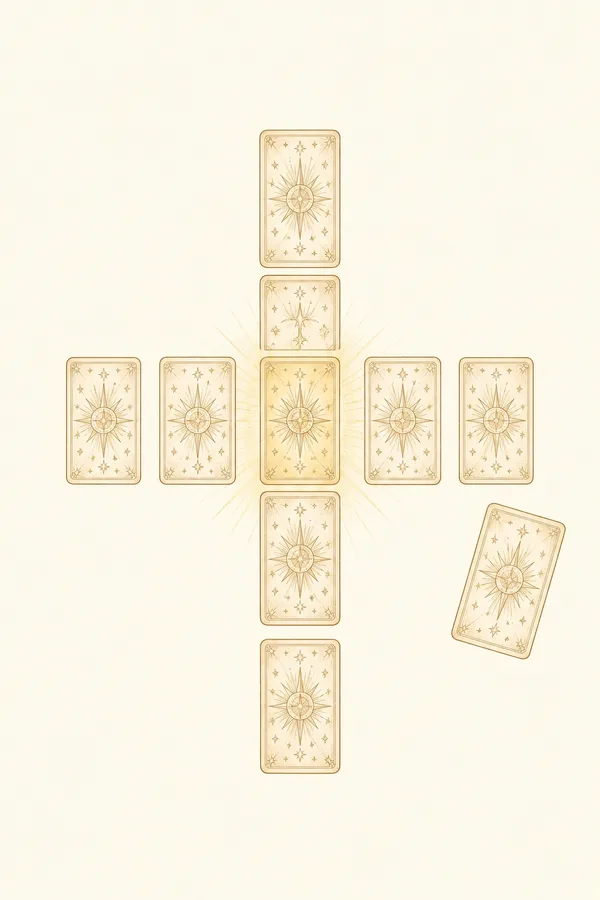
Position 8 sits on the staff of the Celtic Cross, directly to the right of Position 7. In the layout used throughout this guide, it represents external influences: the environment surrounding the querent, the energy of other people, and the circumstances pressing in from outside. If Position 7 describes what the querent brings to the situation, Position 8 describes what the world brings to them.
This distinction is the reason the position matters. It separates what belongs to the querent from what is being pressed upon them by circumstances or by others. A difficult card here does not necessarily indicate a personal failing; it may describe a demanding boss, a family expectation, or a cultural pressure the querent did not create. Read carelessly, the two positions blur together, and a querent can walk away believing they are the source of a problem that actually lives in their environment.
Beginners often confuse this card with “advice,” and the confusion is understandable. Some traditions assign advice to Position 7 (the self) and Position 8 to the environment; others reverse or merge them. This outline follows the first convention: card 7 as the querent’s own stance, card 8 as the external field they are moving through. The sections ahead cover the position’s core meaning, its symbolism, useful card pairings, and practical tips for reading it accurately.
What Position 8 Actually Represents in the Celtic Cross
Position 8 describes the external environment around the querent’s situation: outside influences, other people’s agendas, and conditions the querent does not fully control. It answers “what is surrounding this situation?” — not “what should I do?” That distinction matters, because readers often mislabel it as advice and then misread the card.
Visually, it is the second card from the bottom of the right-hand staff, directly above card 7. Read the two together: card 7 speaks to the querent’s own stance and self-image, while card 8 shows the surrounding climate those meet. A querent braced for conflict (card 7) facing a calm card 8 tells a different story than the reverse.
Some books name this position “environment,” “others,” or “how others see you.” These are variations on one theme, not rival definitions. Note them briefly when relevant — for instance, “how others see you” is useful when the reading centers on reputation — but don’t pile up every label. Give the reader one clear frame, then move on.
Why Position 8 Is Not the Advice Card (Clearing Up the Confusion)
Search for a Celtic Cross guide and you will meet a frustrating contradiction: some sources label card 7 as “advice,” others shift advice to position 8, and a few swap the two positions outright. If you have ever wondered whether position 8 is the advice card, here is the short answer: in the standard Waite-derived layout, it is not.
What Position 8 Actually Represents
In the conventional Celtic Cross, card 8 is the environment—the world around the self, including other people’s influence, external circumstances, and the forces shaping the situation from outside. Card 7, directly opposite it, is the self: your own stance, attitude, and approach. The column reads as a mirror—inner self on one side, outer world on the other. Advice, where it appears at all, is usually assigned to card 7 (your best approach) or treated as an interpretive layer over the whole spread, never to position 8.
Why the Confusion Exists
Many online guides are second- or third-hand retellings, and small labeling errors compound. Some conflate “approach” with “advice,” which is defensible—then the error migrates one position over.
How to Stay Consistent
- Choose one authoritative convention and note it in your tarot journal.
- Before laying cards, state your convention aloud: “Position 7 is your approach, position 8 is the world around you.”
- Keep the same assignments across readings so querents learn your system.
Consistency matters more than which variant you pick—but know that position 8 is the environment, not the advice card.
Reading the Card Itself: Symbolism and Tone
Position 8 shows the querent’s environment and the influence of others, so the card drawn here is best read as the face of the environment — not a private mood but what is looking back at the querent from outside. Start with the imagery itself. In Rider-Waite, the Three of Swords can describe criticism or heartbreak arriving from others; the Eight of Pentacles can point to a demanding workplace or a community that values craft. Ask what the figures, setting, and symbols say about the people and conditions surrounding the querent.
Suit and Element as Context
Let suit and element color the reading. Swords suggest conflict, honesty, or communication coming from others. Cups describe the emotional climate the querent moves through. Wands show momentum, ambition, and competition around them. Pentacles point to money, institutions, and practical obligations.
Majors represent large collective forces — cultural shifts, institutional power, events beyond any one person. Court cards indicate specific people or roles in the querent’s orbit: a manager, a rival, a mentor, a dependent.
Reversals and Tone
Factor in reversals as blocked, hidden, or internalized external pressure — criticism the querent has absorbed as self-talk, or an environment whose demands have gone underground. Read the card’s overall tone before the advice: is the environment supportive, indifferent, or hostile? That tone sets what the advice in position 9 must answer.
Pairing Card 8 With Card 7: Self vs. Surroundings
Card 8 in the Celtic Cross — often called the “external environment” or “how others see you” position — becomes far more useful when read as a pair with card 7, the querent’s own stance. Card 7 shows how the querent is approaching the matter; card 8 shows what they are standing in. One is posture, the other is terrain.
Reading the Contrast
Concrete pairings make the contrast vivid. Card 7 the Hermit (withdrawal, inner work) against card 8 the Three of Cups (a social circle actively pulling them out) describes someone retreating while their world keeps inviting them back. Card 7 the Emperor (control, structure) against card 8 the Five of Wands (friction they cannot govern) shows a querent trying to manage chaos that refuses to be managed.
Locating Ease or Friction
Instruct writers to treat the tension or harmony between these cards as the explanation for the querent’s felt experience. When the two align — say, the Star in position 7 and the Six of Cups in position 8 — the reading carries ease and momentum. When they clash, the friction the querent reports usually lives exactly here.
The Pair as a Sentence
Read the two together as a single sentence: “You are approaching this as X, while the world around you is doing Y.” That formulation keeps the advice grounded and shows the querent precisely where their stance and their surroundings meet, or fail to.
Pairing Card 8 With the Rest of the Spread
Position 8 describes the external environment—the people, opinions, and conditions surrounding the querent. Read alone, it’s just weather. Read against the rest of the Celtic Cross, it becomes diagnostic. Pair it deliberately.
With Card 2 (the crossing challenge): External pressure is often the challenge made visible. If Card 2 shows self-doubt and Card 8 shows a critical colleague, the inner obstacle has a face. Name that link explicitly—it tells the querent where the work actually lives.
With Card 10 (outcome): Test whether the environment supports or undermines the likely result. A hopeful Card 10 paired with a hostile Card 8 signals the outcome depends on changing the room, not just the querent’s resolve. Flag that tension rather than smoothing it over.
With Card 5 (conscious goal): Check alignment. If the querent’s stated aim sits in direct conflict with Card 8’s people or conditions, the goal may need renegotiating or the environment may need leaving. Say which.
One Full Cross-Staff Synthesis
Demonstrate it for writers: Card 2 (a fear of being dismissed), Card 5 (to be taken seriously), Card 7 (a presentation the querent is preparing), Card 8 (a skeptical, senior audience), Card 10 (recognition, but slowly). Read as a chain: the fear maps onto the real audience, so the goal must be met through the presentation itself; the outcome is achievable, but only if the querent addresses Card 8’s skepticism head-on. That is position 8 in context—never isolated.
Questions Position 8 Answers Best
Position 8 in the Celtic Cross shows the people and conditions surrounding your situation—the influences you didn’t put there yourself. It’s the card of context: other people’s agendas, community expectations, and circumstances beyond your control. That makes it the go-to position for questions like these, written the way a beginner would actually search them:
- “Who is influencing this situation besides me?”
- “Whose agenda is really at play here?”
- “What does my family/workplace/friend group expect of me?”
- “What conditions am I working within that I didn’t create?”
If someone types “does my partner’s family approve of me” or “why does my workplace feel so tense,” position 8 is where the reading looks for the answer.
Where Position 8 Shines
In love readings, card 8 reveals the partner’s friends, family reactions, and outside opinions pressing on the relationship—everything from a disapproving parent to a well-meaning friend’s advice. In career readings, it covers company culture, market forces, and a manager’s priorities: the forces shaping your workday before you even sit down.
When a querent asks “why does this feel bigger than me?”, position 8 is the card to turn.
Applying Position 8 to Love, Career, and Life Questions
Position 8 in the Celtic Cross—traditionally the “external influences” or “how others see you” card—describes the environment surrounding your question, not your inner world. Where you apply it matters enormously.
Love Readings
Here, card 8 points to your partner’s circumstances, exes, in-laws, or social opinion about the relationship. Read it as the weather around the couple, never as your partner’s feelings—those belong in positions 2, 6, or 10. Example: The Emperor in position 8 may signal a controlling in-law or a partner’s demanding family, not the partner’s own emotional state.
Career Readings
Treat card 8 as workplace dynamics, industry climate, or colleagues’ motives. Example: The same Emperor can flag an inflexible manager or rigid corporate hierarchy shaping your situation from outside.
Life Readings
Frame card 8 as family expectations, friendship circles, or societal pressure. Example: The Emperor here might represent a parent’s traditional expectations weighing on your choices.
In each context, ask: Whose voice is this card describing? Position 8 is rarely your own.
Common Mistakes When Reading Position 8
Position 8 in the Celtic Cross shows the querent’s environment — the people, institutions, and outside forces shaping the situation. It is not the advice card (that is Position 9, or in some layouts Position 7), and it is not a mirror of the querent’s inner state. Confusing these roles is the most common error.
Fault and Blame Traps
Watch for two opposite mistakes. The first is treating card 8 as the querent’s own fault or as a portrait of their psyche; it describes external influences, not inner ones. The second is using it to blame outside forces for everything, which can leave the querent passive. Balance is the goal: the card names a real pressure without excusing or condemning.
Reading “Others” Vaguely
A vague “someone may be influencing you” is useless. Name plausible sources: a manager, a sibling, a workplace culture, a legal process, a family rule. Then ask gently — “Does anyone in your life match this?” — rather than asserting names yourself.
When Reversals and Real Names Appear
A reversed card here may signal an external influence the querent has internalized and now mistakes for their own voice. And when card 8 clearly flags a real person or institution, do not ignore it; acknowledge it without dramatizing.
Journaling and Practice Prompts for Position 8
Card 8 in the Celtic Cross shows the external influences surrounding your question — the people, environments, and energies you don’t fully control. It rewards regular journaling, because the only way to know whether this card is accurate is to compare its predictions against what actually happens.
Log It, Then Check It
After each reading, write one sentence describing card 8: “Position 8 shows [X] coming from [person/situation/place].” Weeks later, return to the entry and note whether that influence materialized and where it came from. Keep these prompts short — a line or two is enough for beginners to start immediately.
Daily Environment Pull
Each morning, draw one card and ask: “What energy surrounds me today?” At night, jot whether you recognized that energy in your environment. This trains your eye to spot environment cards before they appear in position 8.
The Two-Spread Comparison
Ask the same question in a full Celtic Cross twice, several weeks apart. Compare card 8 from each reading side by side: what shifted in your surroundings? What stayed? Record one sentence on what changed and one on what didn’t.
Starter Prompts
- “Card 8 predicted ___; it did/didn’t appear because ___.”
- “The influence came from ___ (person, workplace, circumstance).”
- “Today’s environment card was ___; I noticed it when ___.”
Keep entries to three lines or less so the habit sticks.
To place it in the whole spread, see positions 7 to 10, position 10 and the outcome, and how to combine Celtic Cross cards.
Recommended tool
The 10-Card Celtic Cross
Lay the full spread and read all ten positions of your question.
Keep reading
More on Celtic Cross
October 31, 2026
Celtic Cross Position 7: The Self Card
Celtic Cross position 7, the self card: how you are showing up, what attitude shapes the reading, and why this position often stings most.
Read the article
October 31, 2026
Celtic Cross Position 9: Hopes and Fears
Celtic Cross position 9: the card that holds hope and fear at once. How to tell which is speaking, and the question that separates them.
Read the article
October 31, 2026
Celtic Cross Position 1: The Present Card
Celtic Cross position 1: the heart of the matter, the significator debate, and how card 2 rewrites what you read here. With Rider-Waite examples.
Read the article