November 9, 2026
Ace of Cups Feelings in Love
Ace of Cups as feelings: a new emotional opening, an overflowing cup, or a love not yet spoken. How it reads upright, reversed and beside the Two of Cups.
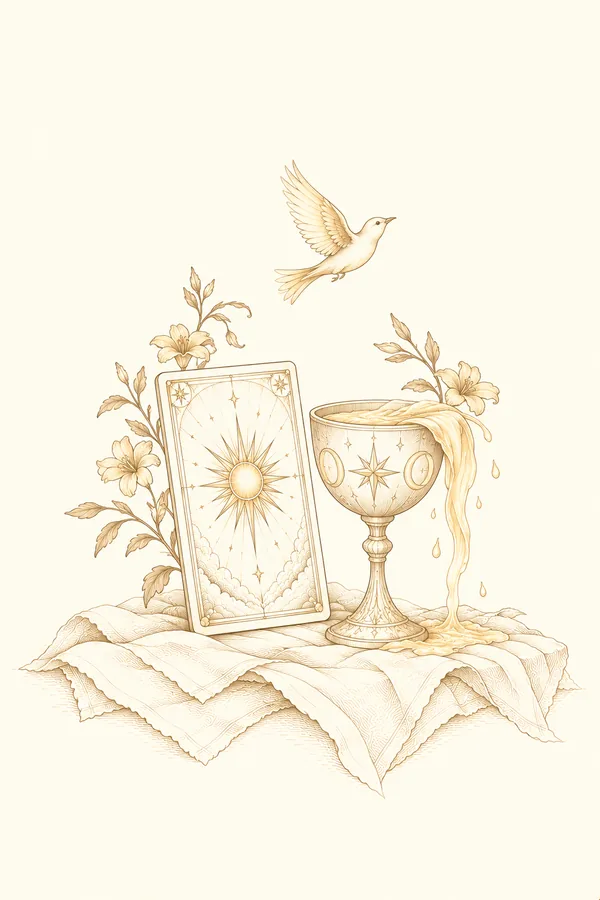
The Ace of Cups holds a unique place in tarot’s emotional vocabulary. As the seed card of the water suit, it represents the raw, unformed beginning of feeling—love before it has a name, a history, or a shape. Where the Two of Cups formalizes connection and the Three celebrates it, the Ace is pure potential: an overflowing vessel, a heart opening for the first time. This is precisely why it dominates searches about “feelings in love.” When readers ask what someone feels, they are rarely asking about committed structure; they are asking about the spark, the tenderness, the quiet stirring beneath the surface—and no card captures that better.
Most people arrive at this card with one urgent question: does he or she have feelings for me? It is the query behind nearly every “Ace of Cups feelings” reading, and it deserves more than a vague yes or no. Using the Rider-Waite-Smith imagery—the cup, the dove, the five streams, the hand emerging from the cloud—we will walk through what this Ace actually says about romantic emotion, how it differs from the Two of Cups, and which surrounding cards sharpen or soften its message.
Written for beginners but grounded in practical Rider-Waite interpretation, this guide treats the Ace of Cups as a working tool rather than a misty symbol. Enthusiasts will find nuance in the reversals and elemental pairings; newcomers will find clear, usable answers.
The Rider-Waite Image and What It Reveals About Feelings
The Ace of Cups is one of the most emotionally legible cards in the Rider-Waite deck: every element in the illustration is doing feeling-work. Read it symbol by symbol, and each detail becomes a statement about how love is experienced rather than merely an ornament.
A Hand from the Cloud
The chalice is offered by a hand emerging from a cloud — a source that is unseen, whether divine or unconscious. In love readings, this speaks to feelings that arrive without a traceable origin: affection that seems to well up from somewhere deeper than logic, or an emotional offer whose full source the receiver cannot yet name.
The Overflowing Cup
Five streams pour from the cup even as it remains full. This is feeling that cannot be contained — the moment when affection stops being manageable and starts spilling into everything: thoughts, plans, generosity. For a querent, it reads as love that demands expression, not storage.
The Dove and the Wafer
A dove descends bearing a wafer marked with a cross — peace, blessing, a sense of rightness. Emotionally, this is the calm beneath the excitement: the feeling that this love is safe, sanctioned, spirit-blessed rather than merely urgent.
The Lotus Pool Below
The cup rests above a pool of blooming lotus flowers, roots in water. Feelings here are not fleeting — they are planted in the unconscious and already flowering, suggesting love with staying power.
Writer’s instruction: tie every symbol directly to the querent’s felt experience. The cloud answers where does this feeling come from?; the overflow answers what does it make me do?; the dove answers does it feel safe?; the lotus answers will it last? Keep each line about the heart, never the iconography alone.
Upright Ace of Cups as Feelings: The Core Meaning
The upright Ace of Cups as a feelings card describes a fresh, genuine emotional opening. Whether the question concerns a new love, an existing bond, or a heart slowly softening after a guarded season, this Ace signals that real feeling is present — not performed, not strategic, but sincere. Someone is experiencing a wellspring of affection, and they know it.
Real Feelings, Felt Intensely
Writers should emphasize that these emotions are authentic and often intense. The Ace of Cups can arrive as a sudden surge of warmth, a quiet sense of being moved, or a budding tenderness the person did not expect. However, the card speaks to feeling, not action. The person may feel deeply and still show little outwardly, so readings should not promise declarations or gestures just yet.
The Ace Versus the Later Cups
Distinguish the Ace clearly from the Two through Ten of Cups. The Ace is the beginning of feeling — a source, an opening, an overflow with no shape yet. It does not describe mutual development (Two), friendship (Three), or emotional commitment and “happy ever after” (Ten). Those cards show where feeling goes; the Ace only shows that it has begun. Frame it as the first drop rather than the full cup: promising, alive, and entirely unformed.
A Heart Opening: Vulnerability and Overflowing Emotion
The Ace of Cups in a feelings or love reading describes a heart that has become a vessel too small for what is pouring into it. This is not measured affection or cautious interest — it is emotion that swells past the rim, arriving faster than the mind can organize it. When this card appears for a querent or a person of interest, write them as someone surprised by the volume of what they feel, perhaps after a long dry season of guardedness or emotional flatness.
The Offered Cup
The hand in the Ace of Cups holds the cup out freely, and this is where the vulnerability lives. Nothing guarantees the feeling will be returned. Describe the person as exposed and tender, emotionally available in a way that may be new or long unused — opening themselves to another without conditions attached. The overflow is generous, but it is also unprotected.
Writing the Reading
Instruct querents to name what is rising rather than managing it. Ask them: where is the water already spilling — in thoughts, in gestures, in the urge to reach out? Frame the Ace of Cups not as a promise of reciprocated love but as an invitation to let the heart be seen while it is full. The tenderness is the point.
Unspoken but Deeply Felt: Why the Ace Rarely Means Confession
When the Ace of Cups appears in a feelings or love reading, it is tempting to read it as a green light for disclosure—surely someone feeling this much is about to say something. In practice, the card describes the birth of feeling, not its expression. The water is in the cup, but no one has tipped it.
Emotion, Not Communication
The Ace of Cups confirms that genuine tenderness, attraction, or love exists. It does not confirm a confession, a text message, a proposal, or any declaration at all. The card speaks to the inner life of the person in question—what they hold in their heart—while remaining silent on what they will do with it. Many querents see this Ace and wait for words that never arrive, because the feeling is real but the action is absent. The cup is full; the pouring is a separate card entirely.
What This Means for Readers
Give realistic expectations. Tell your querent plainly: this card confirms emotion, not communication. Someone may feel deeply and say nothing—because the water is still in the cup, because the moment hasn’t come, or because they haven’t decided what to do with what they hold. The Ace is a beginning in the heart, not a move in the world. What they do next belongs to the cards that follow.
In a New Connection or Crush
The Ace of Cups in a new connection or crush reads as a heart opening its doors for the first time. This is the butterflies stage with a spiritual undertone: infatuation yes, but also a quiet sense of “this could be something.” The feelings are fresh, unguarded, and generous—the querent may feel unusually tender, hopeful, or moved by small gestures. It is the emotional equivalent of a first sip, not the full cup.
Genuine Opening vs. Projection
When writing about this card, note the difference between a true heart-opening and projection. The Ace describes the capacity for love stirring, not proof that the other person reciprocates or that the bond is mature. Counsel writers to ask: is the querent responding to who this person actually is, or to the feeling of finally feeling something? Both are valid, but only one builds a connection.
Pairing for Confirmation
Suggest pairing the Ace of Cups with the Page of Cups to confirm sweet, early-stage messages and sincere curiosity, or the Two of Cups to show the feeling becoming mutual and reciprocal. Alone, the Ace is a beautiful beginning—pair it before promising a future.
In Established Relationships: Renewed Warmth
The Ace of Cups rarely signals a beginning in the way it does for singles. In an established relationship, it arrives as a refresh: an emotional reset that reopens the heart after a period of routine, distance, or quiet accumulation of small hurts. Where the suit’s later cards narrate the love story, the Ace is the source itself—love offered again, fresh and unmuddied.
Emotional Reconnection and Forgiveness
This card advises writers to describe the Ace as a moment of thaw. A partner rediscovers feelings they feared had dulled—looking across the table and truly seeing the other person again. It also covers forgiveness: an old grievance released, a conversation that clears the air, an apology finally landing. Positioned mid-relationship, the Ace suggests a second honeymoon phase is available, not through novelty but through renewed sincerity.
Fertility and Family Joy
The Ace of Cups carries longstanding associations with fertility and family happiness. Writers should note this where relevant: pregnancy news, the arrival of a new baby, or a shared emotional milestone—a vow renewal, a first home, a reconciliation within the wider family—all express the Ace’s overflowing-cup imagery. The emotional bond, not just the event, is what refills the relationship.
The essential message: love in an established partnership can be poured out again, and the Ace of Cups feelings love offers precisely that second cup.
During Separation, Breakups, and No Contact
Lingering Love, Not a Guarantee of Return
In separation and no-contact readings, the Ace of Cups is one of the most misread cards in the deck. Its overflowing cup suggests feelings that have not switched off: love that persists, tenderness that resurfaces, or an emotional reopening on one or both sides. What it does not promise is reconciliation. The Ace describes the feeling itself — a full heart — not the action that follows it. It may also signal closure arriving through compassion: grief softening into acceptance, or forgiveness that releases rather than reunites.
Write Honestly, Then Verify
When writing for querents in this scenario, be honest. Frame the Ace as an emotional state, not a comeback. A sentence like “the love is still there” lands very differently from “they are coming back,” and the card supports only the first. Before allowing a reader to build hope on it, direct them to clarifying cards: the Three of Swords (heartbreak still unprocessed) and the Six of Cups (nostalgia that looks backward, not forward). If these appear, the Ace likely describes memory and ache, not a new beginning.
No contact is silence, and the Ace of Cups can be a beautiful feeling held in that silence. Let readers hold it without mistaking it for a door opening.
Reversed Ace of Cups as Feelings: Blocked Emotion and Fear of Vulnerability
When the Ace of Cups appears reversed in a feelings reading, imagine a chalice turned upside down: the water of love is still inside, but it cannot pour. This is the card’s essential paradox in matters of the heart — the feeling is often present, yet something has dammed it, denied it, or made it frightening to express.
Three Common Readings
Emotional suppression. The person may be holding back affection deliberately, guarding a tender interior behind guarded behavior. They feel something, but showing it feels risky.
Blockage from past hurt. An old wound — a betrayal, an abandonment — can seal the cup. The reversed Ace often points to someone who wants to love but fears being hurt again, and so keeps the lid firmly on.
Timing misalignment. Two people may simply be out of sync: one is ready to open, the other is not yet able to receive.
This is why mixed signals are so common with this card. Reversed does not usually mean indifference; it means love that exists but cannot flow.
Writing About This Card
When interpreting the reversed Ace of Cups as feelings, emphasize that absence of expression is not absence of emotion. Guide querents to ask what is blocking the flow — fear, history, or timing — rather than assuming the love has gone.
Emotional Energy: Keywords and Intuitive Signals to Watch
The Ace of Cups in a feelings-and-love reading is a vessel: it can arrive full or overturned, and your job is to sense which. Build a compact keyword bank for each orientation and draw on it deliberately.
Keyword Bank
Upright: new love, tenderness, emotional openness, receptivity, a heart beginning to fill, forgiveness, compassion, intuitive stirrings, readiness to receive.
Reversed (or blocked): guarded, emotionally emptied, afraid to feel, love held back, self-protection, grief unspilled, numbness, a cup tipped over before it could fill.
Intuitive Cues
Describe the body’s signals so readers can confirm which version is live in the spread. Upright often shows up as gut warmth, a softening in the chest, tears that feel releasing, an open throat. Reversed may register as throat-tightness, a clenched jaw, heaviness behind the sternum, or tears that sting rather than soothe. Invite the reader to notice which sensation arrives first when they look at the card.
The Final Authority
No keyword list outranks context. Surrounding cards — a Three of Cups versus a Five of Cups, a Swords card cutting in — and, above all, the client’s own story decide which Ace is present. Use the cues to start the conversation; let the querent’s lived truth finish it.
Ace of Cups vs. “How Someone Sees You,” Intentions, and Outcome
The Ace of Cups carries a very specific emotional signature, yet readers routinely blur it across question types. In a feelings reading, it is sincere affection—a genuine, unguarded emotional opening. Love is present; it simply hasn’t been tested by time or circumstance.
The confusion begins when the same card appears in other positions.
How the Card Shifts Across Question Types
As “how someone sees you,” it describes a loving, even idealized perception—they regard the querent as someone easy to care for, perhaps more perfect than reality allows. As intention, it signals a desire to offer love, a wish to extend the cup. The offer is real, though the follow-through is a separate question.
As outcome, it marks an emotionally fulfilling new chapter—fresh feeling, happiness, relief after emotional drought. It does not automatically mean marriage, commitment, or a defined future.
Practical Guidance for Writers
State this distinction plainly. When a querent asks “what does he feel?”, they often conflate feeling, intention, and outcome into one answer. Frame it explicitly: as feelings, tender affection; as perception, an idealized view; as intention, a wish to give love; as outcome, an open emotional chapter. Readers need that clarity.
Combining the Ace of Cups with Other Cards
The Ace of Cups shows a pure, overflowing beginning of feeling: a heart opening that has not yet taken shape. Pairing it with other cards tells you what kind of love that emotion is likely to become, and whether it will be spoken, reciprocated, or held back.
The General Rule
First, teach the system: Cups amplify the feeling, making it warmer and more emotionally vivid. Swords cool or complicate it, adding distance, thought, or pain. Wands activate it, turning emotion into pursuit or passion. Pentacles ground it, moving feeling into commitment and daily reality. Explain this once, then show how it works in pairs.
Specific Pairings
With the Lovers or Two of Cups, the Ace of Cups becomes mutual, developing love: an emotional opening that meets a willing partner, choosing and being chosen.
With the Tower or Three of Swords, it describes an opening that follows heartbreak. The feeling arrives after a rupture, as a tender renewal rather than a fresh start from nothing.
With the Emperor, the Ace is guarded affection, slowly offered: real depth protected by structure and caution, revealed through consistency rather than words.
With the High Priestess, feelings stay secret and unspoken: private, intuitive, and possibly not yet understood even by the person holding them.
Give your reader this vocabulary, and a single Ace can speak in a dozen different dialects of love.
A Step-by-Step Reading Practice for Feelings Questions
The Ace of Cups often appears when someone asks, “What does he/she feel for me?” Its overflow of emotion is real, but vague. This practice turns that ambiguity into a clear reading.
Step 1: Name the Question Precisely
Replace “What do they feel?” with “What emotional capacity do they currently hold for me?” Precision prevents you from reading hope into the card.
Step 2: Draw the Ace as the Feeling
Read the Ace of Cups as the seed of feeling — attraction, tenderness, or openness — not a declaration. Note its suit: water means emotion is present, but it is new or unexpressed.
Step 3: Draw One Clarifier
Ask: “What supports or blocks this feeling?” The clarifier grounds the Ace. A Swords card may show overthinking; a Wands card, chemistry outrunning commitment.
Step 4: Check the Spread Position
Position matters more than the card. An Ace in the “their feelings” slot is not the same as one in “obstacles.”
Two Suggested Layouts
- Feelings and Intentions (2 cards): Ace in position one; position two reveals what they plan to do about it.
- Should I express this? (3 cards): Ace as their feeling, card two as likely reception, card three as advice for you.
Phrasing Findings Honestly
Say “there is emotional openness here” rather than “they love you.” Frame the clarifier as context, not fate, and close with the advice card, not a promised outcome.
Real-Life Interpretations and Journaling Prompts
The Ace of Cups in a love reading is less about a relationship’s status and more about an emotional opening. Watch how it shows up in ordinary life.
Three Scenarios
The crush who suddenly melts. Someone you assumed was guarded becomes unexpectedly warm—a longer conversation, a small confession, a softening in their voice. The card marks the moment a heart opens, theirs or yours.
The ex who admits old love. A former partner says plainly, “I did love you.” Nothing may follow, yet the Ace of Cups frames this as honest feeling arriving fresh—an offering to receive, not necessarily a door to reopen.
The partner softening after distance. After weeks of coolness, your partner reaches for your hand and says they missed you. The cup refills; the question is what you both do with the water.
Journaling Prompts
- Where is my own cup overflowing right now—and who or what is filling it?
- What would I do if the feeling were real, not just hoped for?
- How do I usually receive love when it’s offered plainly?
- What am I protecting myself from by analyzing instead of feeling?
Let the card move you toward one honest act: say the thing, accept the gesture, or simply sit with the fullness.
Common Mistakes and Frequently Asked Questions
Common Mistakes
The most frequent error is treating the Ace of Cups as “he loves me, wait by the phone.” This card signals the beginning of a feeling—a wellspring, an opening—not a finished relationship or a guaranteed call. Waiting passively for someone to act misreads its energy.
A second mistake is ignoring the reversed nuance. Reversed, the Ace often points to emotional blockage, self-love work, or a feeling that hasn’t surfaced yet—not an automatic “no.” Skipping this distinction leads to black-and-white readings.
Third, readers treat it as guaranteed partnership. The Ace describes emotional potential, not commitment, timing, or mutual action. It’s the seed, not the harvest.
FAQ
Is the Ace of Cups a yes? Generally, yes—but a qualified yes. It favors emotional openness and new beginnings rather than confirming a specific outcome or timeline.
Does it mean an ex still loves me? It can indicate lingering fondness or a fresh emotional stirring, but not necessarily active love or intent to return. Read it as feeling, not decision.
Does it mean he is open to reconciling? Possibly. The Ace suggests emotional receptivity, but openness isn’t action. Pair it with surrounding cards and real-world behavior before concluding anything.
Conclusion: What to Do When the Ace Shows Up in Love
When the Ace of Cups surfaces in a feelings-focused reading, treat it as an offered emotional beginning rather than a guaranteed outcome. The card signals that a fresh current of feeling—tenderness, hope, the urge to connect—is available, but it arrives as a cup extended, not a promise signed. Your task is to decide how to meet it: with openness if the context feels safe, or with self-protection if history or circumstance says otherwise. Neither response is wrong; discernment is the point.
A Small, Honest Step
Rather than waiting for certainty before you act, match the card’s vulnerability in a modest, truthful way. Say one sincere thing you actually feel. Ask one real question instead of performing ease. The Ace rewards sincere beginnings, not grand declarations, and small honesty builds the trust that clarity later rests on.
Track the Pattern
Keep a journal of your feelings-related draws, noting the question, the card, and what you did next. Over time, patterns emerge—recurring Aces may mark readiness, while repeated blocked or reversed Cups may flag caution. Let the record, not the moment, guide you.
Takeaway: respond to the Ace of Cups with one small, honest act of openness this week—and log it.
Recommended tool
Explore the Arcana
Browse the 22 Major Arcana and their meanings.
Keep reading
More on Individual Cards

October 27, 2026
Queen of Cups Feelings in Love: What She Hides
Is it love or compassion? How the Queen of Cups feels, what she won't say out loud, and the cards that prove whether the feeling is mutual.
Read the article
November 7, 2026
Page of Cups Feelings as a Person
Page of Cups as a person and as feelings: the shy, tender energy behind the card, what they are not saying, and how to read it in a spread.
Read the article
October 23, 2026
Eight of Cups Love Meaning: Walking Away, Explained
The Eight of Cups in love: leaving a relationship that no longer fulfils you, upright vs reversed, feelings, advice and past-present-future.
Read the article