October 8, 2026
Celtic Cross Love Spread: Positions and Meanings
Ten positions, one love story: learn what each Celtic Cross position means in relationship readings, with examples and ethics.
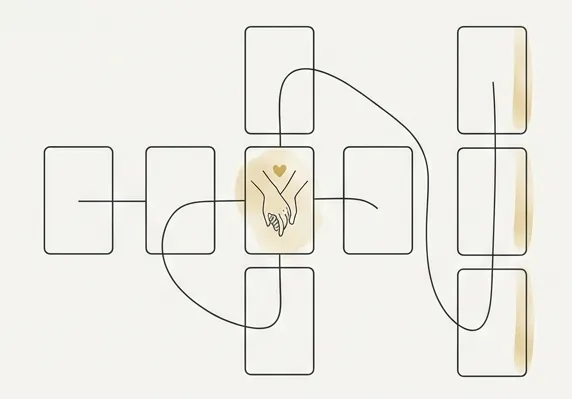
The Celtic Cross is the most requested love reading layout in professional tarot practice, and for good reason. A simple three-card pull can describe a relationship’s past, present, and future, but it rarely explains why two people keep circling the same argument, what one partner is not saying, or how outside pressures are shaping the bond. The Celtic Cross solves this by distributing ten positions across a narrative arc: the heart of the matter, the crossing influence, the foundation, the recent past, conscious hopes, near future, the querent’s stance, the partner’s stance, external factors, and the likely outcome.
The celtic cross love spread positions use the same ten cards as the classic spread; only the interpretive lens changes. Every position is read through relationship dynamics rather than general life themes. This outline follows the Rider-Waite-Smith deck as the standard reference for symbolism, since its imagery remains the shared language of most modern tarot study.
By the end of this section, you will know what each position means in a love context, the specific question it answers, and how to phrase that question for a querent—clearly, compassionately, and without fatalism.
Position 1: The Present Heart
In the Celtic Cross love spread, Position 1 sits at the center of the reading—literally and figuratively. It is the first card laid down, and everything else builds around it. This card captures your current emotional state or, depending on how you frame the question, the relationship as it stands today.
The phrasing you choose matters. If you ask, “What is in my heart right now?”, the card speaks to your inner emotional landscape. If you ask, “Where does this relationship stand?”, it reflects the dynamic between you and your partner. Both are valid, but be consistent: mixing the two mid-reading muddies the interpretation.
Reading Reversals Here
Beginners often panic when a card like the Two of Cups appears reversed in Position 1, assuming it means a breakup. Not so. A reversed Two of Cups more often signals emotional disconnect, imbalance, or a stalled connection—two people in the same room but not quite meeting. It is a nudge to examine where the spark has dimmed, not a verdict.
A Critical Beginner Warning
Instruct those new to the spread: Position 1 is never the other person’s feelings. That is a separate position. Reading this card as “what my partner feels” is one of the most common and damaging mistakes in Celtic Cross love readings—it projects your own emotional state onto them. Keep the center card where it belongs: with you.
Position 2: The Crossing Card
In the Celtic Cross love spread, Position 2 is laid horizontally across Position 1, forming the shape of a cross. It is the only card read sideways, and this physical orientation matters: it signals friction with the card beneath it. Here, the crossing card represents the obstacle, tension, or conflicting force in the relationship—but always in relation to Position 1, never as a standalone message.
The Classic Debate
Readers disagree on how to handle this card. One school treats it strictly as a challenge or blockage. Another reads it as a supporting influence that only feels like opposition—a hidden resource disguised as resistance. Context decides. The Lovers in Position 1 crossed by the Eight of Swords, for example, often signals fears or self-imposed limitations blocking commitment. But the same Eight of Swords could mean the relationship’s pressure is forcing clarity, indirectly strengthening the bond.
How to Read It
Notice that the crossing card modifies Position 1 rather than replacing it. If Position 1 is the situation, Position 2 is what complicates, tests, or tempers it. Ask: is this energy obstructing love, or refining it? The horizontal card rarely cancels the first card’s promise—it tells you what that promise must move through.
Position 3: The Foundation or Distant Past
The card in Position 3 sits directly beneath the center card (Position 1) of the Celtic Cross love spread. Its placement is deliberate: whatever appears here is the ground on which the relationship stands. This is not the story of what is happening now, but the deeper root cause—the long-standing pattern, inherited belief, or unresolved wound that quietly shapes how both partners love today.
Common sources for this card include family-of-origin dynamics, a previous heartbreak, or an old belief about love carried silently into the present. It answers the question: what is underneath all of this?
Etiquette for Reading Position 3
- Placement: Lay it below Position 1, forming the base of the central cross.
- Read it as context, not current events. This card explains why the situation looks the way it does in Positions 1 and 2—it does not describe what is happening right now.
Sample Reading
If the Five of Pentacles appears in Position 3 of a love reading, the foundation of the relationship may rest on financial stress or a history of rejection. Perhaps one partner grew up watching money anxiety strain their parents’ marriage, or carries the memory of being left when things got hard. That old scarcity—emotional or material—can show up as present-day trust issues: hesitation to rely on the partner, fear of being abandoned when circumstances turn difficult. The Five of Pentacles doesn’t predict doom here. It simply says: this relationship’s roots grew in thin soil, and the fear of not being enough (or not having enough) is part of its foundation. Recognizing this pattern is the first step toward healing it rather than repeating it.
Position 4: The Recent Past
The card in Position 4 sits to the left of the center of the Celtic Cross, directly below the foundation card of Position 2. In a love reading, it represents the near past: events, choices, or emotional shifts that have just happened and are still actively shaping the relationship question. This is the “what led to now” card, the immediate backstory behind the present situation.
A Flexible Time Frame
Position 4 does not correspond to a fixed calendar. Its time frame is relative to the querent’s story. For someone navigating a new romance, it may describe the last few weeks. For a long-term partnership in crisis, it might reach back several months. The card marks the most recent significant development, not a date on a timeline.
How to Read It
A card such as the Knight of Cups reversed here often points to a fading romantic gesture, a recent mixed message, or an ideal that cooled soon after it was offered. The energy arrived, then wavered. Position 4 shows what the querent is still reacting to, even if they have not named it.
Distinguishing Position 3 from Position 4
Writers must keep the two past positions distinct. Position 3 covers the distant past: old patterns, formative relationship history, and deep roots. Position 4 covers the near past: the most recent trigger, decision, or turning point. Position 3 explains the background; Position 4 explains the momentum carrying into the present.
Position 5: The Crown, Best Possible Outcome
In the Celtic Cross love spread, Position 5 sits directly above the center card and represents the querent’s conscious hope, goal, or what they believe they want from love. It’s the crown of the reading: the outcome the querent is actively imagining, often the picture they carry into the reading itself.
Expectation vs. reality
This position reveals expectations as much as desires. If the Ten of Cups appears here, the querent may be hoping for a harmonious family life, emotional fulfillment, or a “happily ever after” with a specific person. But note the gap between Position 5 and Position 10, the likely outcome. Querents are frequently surprised when these two cards diverge. A Ten of Cups in the crown paired with, say, the Eight of Pentacles in Position 10 doesn’t deny happiness — it suggests the happy family requires slow, patient effort, not immediate arrival. Timing delays, practical groundwork, or lessons in commitment may sit between the hope and its realization.
Treat Position 5 as a mirror of the heart’s wish list, not a promise. When reading for love, compare it directly to Position 10 and name the difference aloud. That contrast is often where the most useful guidance lives.
Position 6: The Near Future
In the Celtic Cross love spread, Position 6 sits to the right of the center and describes what is arriving next in the relationship. Think of it as the next weather front rather than the climate itself: it shows the immediate trajectory, the energy that is already in motion, not the final verdict on where the connection will end up.
Reading the Card in Context
A difficult card here often reads far gentler than it first appears. The Three of Swords in Position 6 rarely means the relationship is doomed; more often it signals a necessary honest conversation, a truth that needs to be said before healing can begin. The card describes what is coming, not what must be feared.
Timing and Pairing with Position 5
Readers commonly frame this position as covering roughly the next few weeks up to a season, depending on how quickly events in the querent’s life tend to unfold. For best results, read it alongside Position 5, the hopes and fears card, which sits directly above the center. Position 5 reveals the expectation; Position 6 shows how that expectation meets reality. When the two align, the near future confirms what the heart already senses. When they clash, the gap between hope and what is actually arriving is the real message.
Position 7: The Querent’s Stance
In the celtic cross love spread, Position 7 begins the vertical column rising to the right of the central cross. Often called the self or attitude position, this card shows how you see yourself and the role you play in love right now. It is a mirror, not a verdict.
What This Position Reveals
Position 7 captures your self-image in the context of the relationship. Draw the Empress here, and you likely see yourself as confident, nurturing, and worthy of love—someone who gives warmth without losing herself. Draw the Five of Cups, and guilt or regret may be coloring how you view your own part in the story, perhaps fixating on what went wrong rather than what remains.
This position can also reflect how you view the relationship itself: as steady and supportive, or as strained and uncertain. Either way, it describes your inner stance, not the objective truth of the bond.
Reading It With Care
Treat this card as an invitation to self-awareness rather than blame. Ask: does this image of myself serve the relationship, or limit it? If Position 7 shows a harsh self-portrait, the neighboring cards often suggest where compassion or honest communication can shift the picture.
Position 8: The Partner’s Stance or External Influences
Position 8 in the Celtic Cross love spread sits at the base of the staff, and in relationship readings it carries a useful double duty. Traditionally this card represents the other person’s feelings, stance, or attitude toward you and the relationship. In many love readings, though, it works equally well as the surrounding climate: family opinions, friend groups, work obligations, distance, or timing.
Reading the Card Both Ways
A single card can support either lens, so let context guide you. The Queen of Wands in Position 8 often shows a partner who is warm, magnetic, and genuinely interested, yet fiercely independent and not easily managed. The Hierophant here might point to family expectations around marriage, tradition, or “doing things properly” weighing on the connection.
Choose One Lens Before Shuffling
Advise querents to decide in advance whether Position 8 will speak for the partner or for external influences. Changing the interpretation mid-read muddies the message and invites projection. If both feel relevant, draw a clarifying card rather than bending the original one.
Insight, Not Mind-Reading
Frame findings as perspective, not certainty. You are reading energy and patterns, not claiming access to another person’s private thoughts. Say “this suggests” rather than “this proves,” and let the querent hold the insight with curiosity instead of fear.
Position 9: Hopes and Fears
Position 9 in the Celtic Cross love spread is the card most readers call hopes and fears—a single card that holds what the querent longs for and what they dread, often at the same time. In love readings, this position is rarely tidy. It shows the secret wish and the quiet anxiety living side by side, sometimes tangled into one image.
The Devil is a perfect example. As a hope, it can mean a deep craving for intensity, chemistry, or a bond so consuming it blocks out everything else. As a fear, it points to the opposite: dread of toxic attachment, obsession, or staying trapped in a connection that diminishes them. The same card carries both readings, and the surrounding cards tell you which way the energy leans.
How It Mirrors Position 5
Position 9 frequently echoes Position 5, the conscious outcome or crowning card, but it works at a deeper, less conscious level. Where Position 5 shows what the querent expects to happen, Position 9 reveals what they cannot admit they want—or cannot bear to lose.
Questions to Ask
- What would you be most afraid to hear right now?
- If this hope came true, what would it cost you?
- Which fear here is actually an unspoken desire?
Read this card gently. It is the querent’s most vulnerable truth about love.
Position 10: The Likely Outcome
In the celtic cross love spread, the final card is not a verdict handed down by fate—it is the probable result if the current trajectory, attitudes, and behaviors revealed in the other nine positions continue unchanged. Think of it as a weather forecast, not a court ruling: it tells you where the prevailing winds are blowing, not where you are forced to land.
Synthesizing Before Interpreting
Never read Position 10 in isolation. Before interpreting it, scan the entire spread: How many reversals appeared? What did the obstacles (Position 2) and hopes/fears (Position 9) reveal? A Lovers card in the outcome position feels very different when the earlier cards show open communication and mutual effort than when the middle of the spread is littered with reversed Swords and tense Cups. A positive outcome weakened by several reversed cards means the potential exists—but it requires conscious work, not passive waiting. Conversely, a difficult outcome card softened by a generally harmonious spread suggests challenges that can be managed with care.
Closing with Agency
When writing your interpretation, always close with agency-focused advice. Remind the querent that tarot cards describe energy and momentum, not inescapable fate. Invite them to ask: What would I need to change in positions 1 through 9 to invite a different Position 10? The outcome card is a mirror held up to the present—the future remains theirs to write.
Reading the Love Spread as a Whole
The ten celtic cross love spread positions only become a love story when you read them as connected beats, not ten separate fortunes. Start at the center: card 1 is the heart of the matter, your present situation, while card 2 is the challenge or crossing energy that complicates it. Read them as a pair — the relationship’s pulse and its friction.
Next, flow down the cross. Card 4 (recent past) explains why card 1 looks the way it does, while card 6 (near future) shows where that momentum is heading. Together they read as cause and effect: what shaped this, and what it is becoming.
Then climb the column: card 5 (hopes and fears) sits directly above you, feeding into card 10 (outcome) at the top. These two form the emotional arc — what you are wishing or dreading, and the likely landing point if nothing changes.
A Practical Reading Order
- Cards 1 and 2 — the core dynamic.
- Card 3 — the root beneath everything.
- Cards 4 and 6 — the timeline.
- Cards 7, 8, 9 — self, partner, and external influences.
- Cards 5 and 10 — hope versus outcome.
- Circle back to card 1 and ask: has the outcome reframed it?
Common Mistakes to Avoid
The most frequent error is interpreting each card in isolation, as if the spread were ten unrelated messages. The second is letting one frightening card — say, the Tower in position 2 — dominate the entire session. Remember that the challenge position describes tension to work with, not a verdict.
Keep speaking in full sentences that chain positions together: “Because card 4 shows distance, card 6 suggests reconnection.” Finish by summarizing the story in three lines: what brought you here, what you face now, and where the spread points next. That leaves a beginner with a complete, confident reading rather than a pile of loose cards.
Sample Love Question Walkthrough
A querent asks, “Where is this relationship heading?” She lays out the Celtic cross love spread positions and draws, among others, the Two of Cups in Position 1 (the present), the Five of Swords in Position 5 (the recent past), and the Star in Position 10 (the outcome).
Reading the Positions Aloud
Position 1 (Present): “The Two of Cups here shows genuine mutual affection — the connection itself is real right now.”
Position 5 (Recent Past): “But the Five of Swords suggests a recent argument where winning mattered more than understanding.”
Notice the shift: the same Star card would read as “quiet personal hope” in Position 1, yet in Position 10 it becomes “healing arrives once honesty replaces scorekeeping.”
The Outcome
Position 10: “The Star says reconciliation is possible, but it asks for patience and rebuilt trust, not a quick fix.”
A Compassionate Summary
“Your bond is real, but a recent clash left marks that still sting. If you both choose honesty over being right, this relationship can heal — slowly, and with care.”